
21.04.1870–09.02.1960
Alexandre Benois
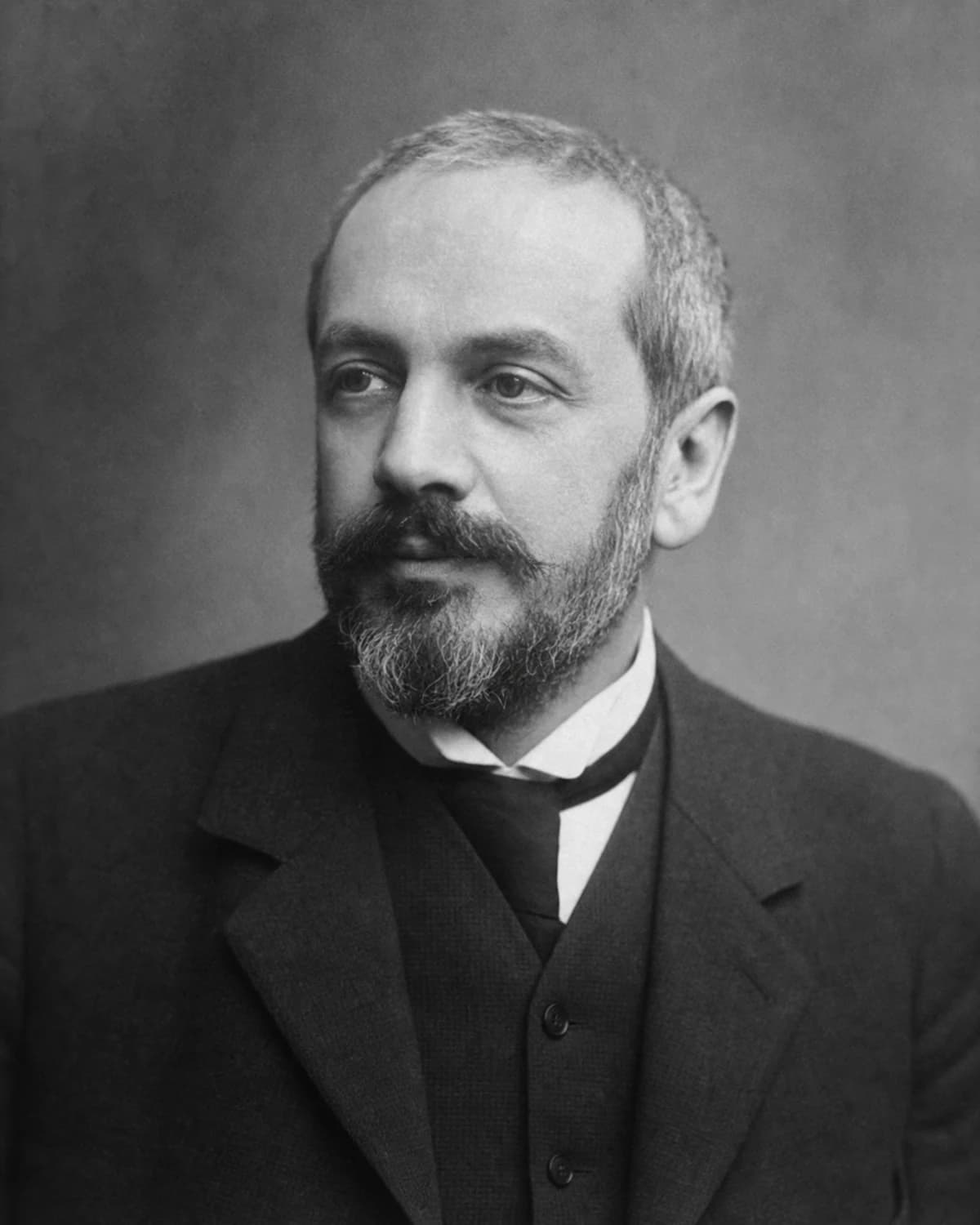
Alexandre Benois (1870–1960) gathered the circle of friends from which the World of Art magazine and society grew. He painted watercolours of Versailles and of 18th-century St Petersburg, illustrated “The Bronze Horseman” and “The Queen of Spades”, and designed “Le Pavillon d’Armide” and “Petrushka” for Diaghilev. An art historian and critic, after the revolution he ran the Hermitage picture gallery, and from the mid-1920s he lived in Paris.
Biography
In 1903, for the bicentenary of St Petersburg, the Circle of Lovers of Fine Russian Editions commissioned Alexandre Benois to illustrate “The Bronze Horseman”. The sheets he brought in outraged the clients: stylised, almost like posters, they struck them as “crude and absurd”, and the drawings were rejected. Diaghilev then printed them in the first issue of World of Art for 1904, and the public took to them. Benois went on to do “The Bronze Horseman” twice more, in 1905 and in 1916, but the book with thirty-seven of his drawings came out only in 1923, under the new regime.
He was born on 21 April (3 May) 1870 in St Petersburg, the youngest of four sons of the architect Nikolai Leontievich Benois and Camilla Albertovna, née Cavos. His grandfather, Louis-Jules Benois, a peasant’s son from near Paris, came to Russia in 1794 and served at the court of Paul I and then of the Dowager Empress Maria Feodorovna. His brothers also took up the arts: Albert became a watercolourist, Leon an architect.
He went to Karl May’s private gymnasium, and there, in 1885–1890, the company came together that would later form the core of the World of Art: Dmitry Filosofov, Walter Nouvel, Konstantin Somov. For a few months in 1887 Benois attended evening classes at the Academy of Arts and then dropped them, having decided that one becomes an artist only by working on one’s own. His elder brother Albert taught him watercolour. In his memoirs he proudly called himself self-taught and “a product of an artistic family”, and he regarded Watteau, Boucher, Cochin, Moreau the Younger and Fragonard as his real teachers. In 1894 he graduated from the law faculty of St Petersburg University; in the same year he wrote the section on Russian artists for Richard Muther’s German “History of Painting in the Nineteenth Century” and married Anna Karlovna Kind, whom he had known since childhood.
In the autumn of 1896 he came to Paris for the first time and went straight off to draw Versailles. These trips produced the series “The Last Promenades of Louis XIV”: the old king and his retinue among clipped bosquets, ponds and statues. In 1897 Pavel Tretyakov bought three sheets from an exhibition. To my mind there is more irony than nostalgia in these watercolours: the king, who “went out walking in all weathers”, looks a little like a doll in Benois’s hands. The theme held him for a quarter of a century, and the album “Versailles”, with twenty-six watercolours and his own text, appeared only in 1922.
Together with Diaghilev and Bakst he founded the magazine World of Art and was, by general consent, its chief organiser. Alongside it he worked on art history: “The History of Russian Painting in the Nineteenth Century” (1901–1902), the magazine Artistic Treasures of Russia from 1901, books on Tsarskoye Selo, the “Catalogue of the Picture Gallery of the Imperial Hermitage” (1910). From 1908 right up to the revolution his “Artistic Letters” appeared in the newspaper Rech. He also made books for children: the “Alphabet in Pictures” (1904) grew out of games with his little son Kolya and was printed in chromolithography with gold and silver in an edition of 2,500 copies. In 1911 “The Queen of Spades” came out with his illustrations; on the last sheet Death draws the curtain and snuffs out the candles, and the last musician leaves the orchestra pit.
The theatre in that illustration was no accident. As early as 1903 Benois had written the libretto of the one-act ballet “Le Pavillon d’Armide” for Nikolai Tcherepnin, and in 1907 he took on its sets and costumes for the Mariinsky Theatre. The preparations went badly: at one rehearsal the police chief led Diaghilev, whom Benois had invited, out of the hall, dancers in lavish costumes could not recognise one another, and Kschessinska and Gerdt refused to dance at the last moment. The premiere was moved from 18 to 25 November 1907, and the ballet was well received. On 19 May 1909 “Le Pavillon d’Armide” opened the first Russian Seasons of ballet in Paris, whose artistic director Benois was in 1908–1911. Then came “Les Sylphides” (1909), “Giselle” (1910) and Stravinsky’s “Petrushka” (1911). Of “Petrushka” the Paris papers wrote that Benois had “brought painting into the theatre”.
After the February Revolution he worked to protect historic monuments, and in 1919 he became head of the Hermitage picture gallery. At the same time he worked for the Bolshoi Drama Theatre in Petrograd; his last production in Soviet Russia was “The Marriage of Figaro” on the same stage. In 1925 he took part in the Paris Exhibition of Decorative Arts.
Having left the USSR on an official assignment, he never came back.
In Paris he made set and costume designs, worked a great deal for La Scala in Milan, illustrated French books, and in 1945 painted forty-four watercolours for “The Captain’s Daughter” which were never published. The main work of his last years was his memoirs: two volumes came out in New York in 1955. His son Nikolai became a stage designer and from 1936 headed the design department of La Scala; Eugene Lanceray and Zinaida Serebriakova were Benois’s nephew and niece.
Alexandre Benois died on 9 February 1960 in Paris and is buried in the Batignolles cemetery.
Related context
Associations
Works connected through artistic movements, cultural context and period. Priced works available in this market appear first.








Profile notes
Profile and sources
Image
Artist image
На основе открытого изображения: Boris Kustodiev; Wikimedia Commons; Public domain.
