
1970–present
Alexandre Arrechea
Alexandre Arrechea (born 1970) worked from 1994 in the Cuban collective Los Carpinteros, then left in July 2003 and began a career of his own. His projects take up power and surveillance: an aluminium tree fitted with cameras, a house that grows and shrinks with a stock index. His work is in MoMA, MOLAA, the Pérez Art Museum Miami and the Studio Museum in Harlem.
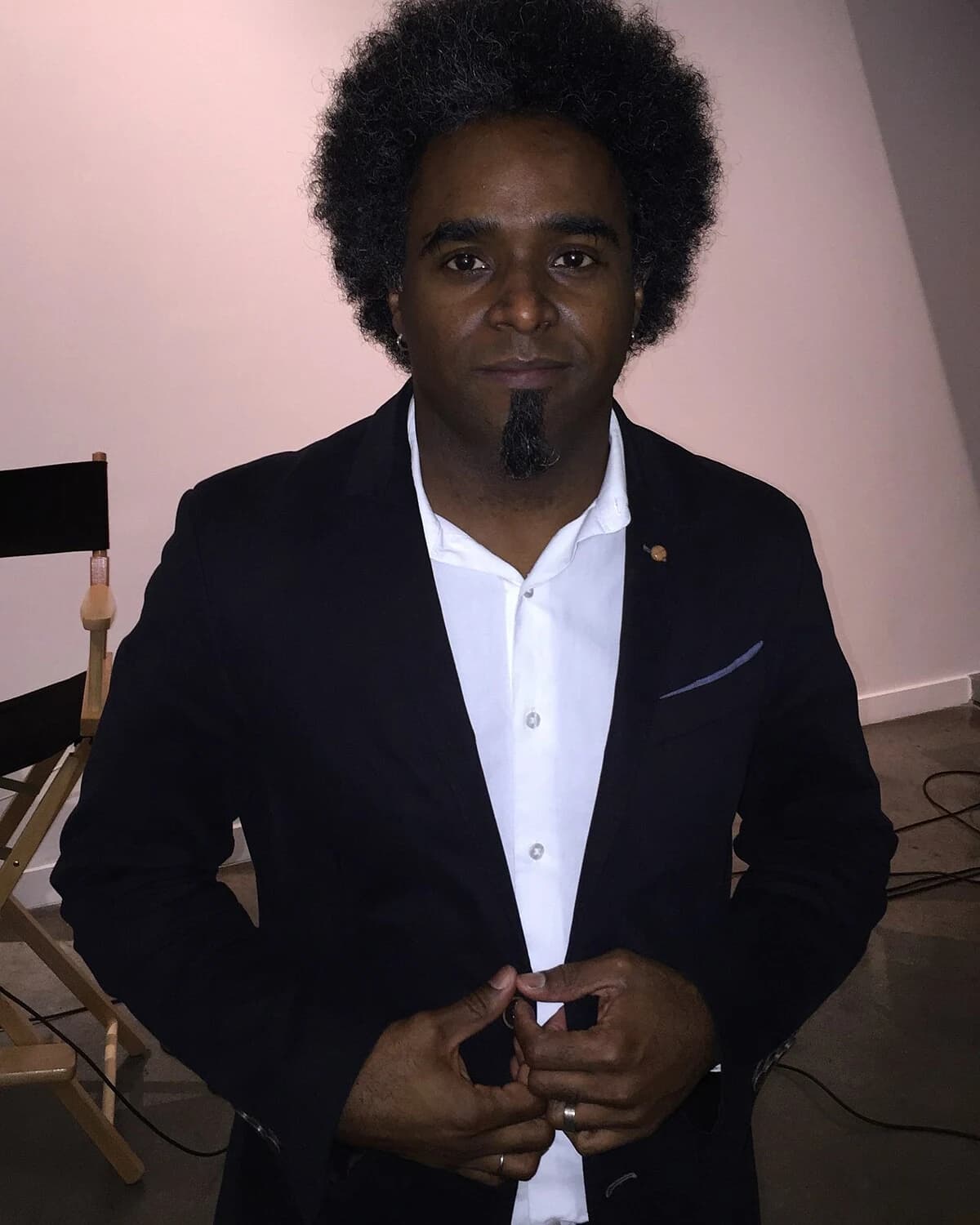
Biography
Arrechea’s first solo project, “The Garden of Mistrust” (El Jardín de la Desconfianza), took two years, from 2003 to 2005. Its centre was a whitewashed aluminium tree whose branches carried video cameras; they filmed the viewers and sent the images out over the internet. The project was shown in Los Angeles.
Arrechea was born in 1970 in Trinidad, Cuba. In 1994 he graduated from the Instituto Superior de Arte (ISA), the higher institute of art in Havana.
In the same year, 1994, he began working with Marco Antonio Castillo Valdés and Dagoberto Rodríguez Sánchez under the name Los Carpinteros (“The Carpenters”). The collective was quickly successful, and the Museum of Modern Art in New York (MoMA) acquired several of its drawings for its permanent collection. Arrechea stayed in the group, by one account, for twelve years; going by the dates it comes out somewhat less, since he left in July 2003, and I would not insist on the exact figure. Before he left, in 2000, came the project “Ciudad Transportable”. Awards fell in these years too: first prize from the magazine El Mundo at the ARCO fair in 1997, the Fomento de las Artes prize (UNESCO) at the 7th Havana Biennial in 2000, and in 2002 a residency at the Baltic Centre for Contemporary Art in Newcastle. In 2005 he received the Braziers International award in Oxfordshire, and his work was shown at the Venice Biennale. In 2006 came “Perpetual Free Entrance”. From that year he has been represented by the Casado Santapau gallery in Madrid; in 2007 it held the exhibition “Espacio Derrotado” (Defeated Space), and in Miami “Sweet Fear” was shown. In 2008 there was a solo exhibition at the Katzen museum of American University in Washington.
For the 10th Havana Biennial (27 March to 30 April 2009) he made “La habitación de todos” (The Room of All). It is a steel house of eleven sections that expands or contracts with the rise and fall of the Dow Jones Industrial Average. Later Arrechea turned to a street project in New York: video projections on building façades.
In his work the viewer does not simply look but takes part, and this is part of the design: in his public projects he draws on the idea that Jeremy Bentham described in the eighteenth century, a world in which the eye of power sees everyone, and everyone watches everyone else and themselves. Drawing, sculpture, video and installation serve him for talking about both urban and domestic spaces. His work is in the collections of MoMA in New York, the Museum of Latin American Art (MOLAA) in California, the Pérez Art Museum Miami and the Studio Museum in Harlem. In 2026 it was included in the exhibition “Get in the Game: Sports, Art, Culture”, which travelled from the San Francisco Museum of Modern Art to the Pérez Art Museum Miami. Arrechea lives between Madrid and Miami.
Profile notes
Profile and sources
Image
Artist image
Jhsounds; Wikimedia Commons; CC BY-SA 3.0.
