
15.05.1947–19.12.2022
Alexandr Rodin
Alexandr Rodin (Alies Rodzin) studied in Minsk, exhibited in Belarus from 1971, and from 2001 to 2014 lived and worked in Tacheles, the artists’ house in Berlin. He painted canvases built from thousands of small lines and dots, and could spend years on a single picture. Together with Zmitser Yurkevich he organised DAKH, a festival of experimental art.
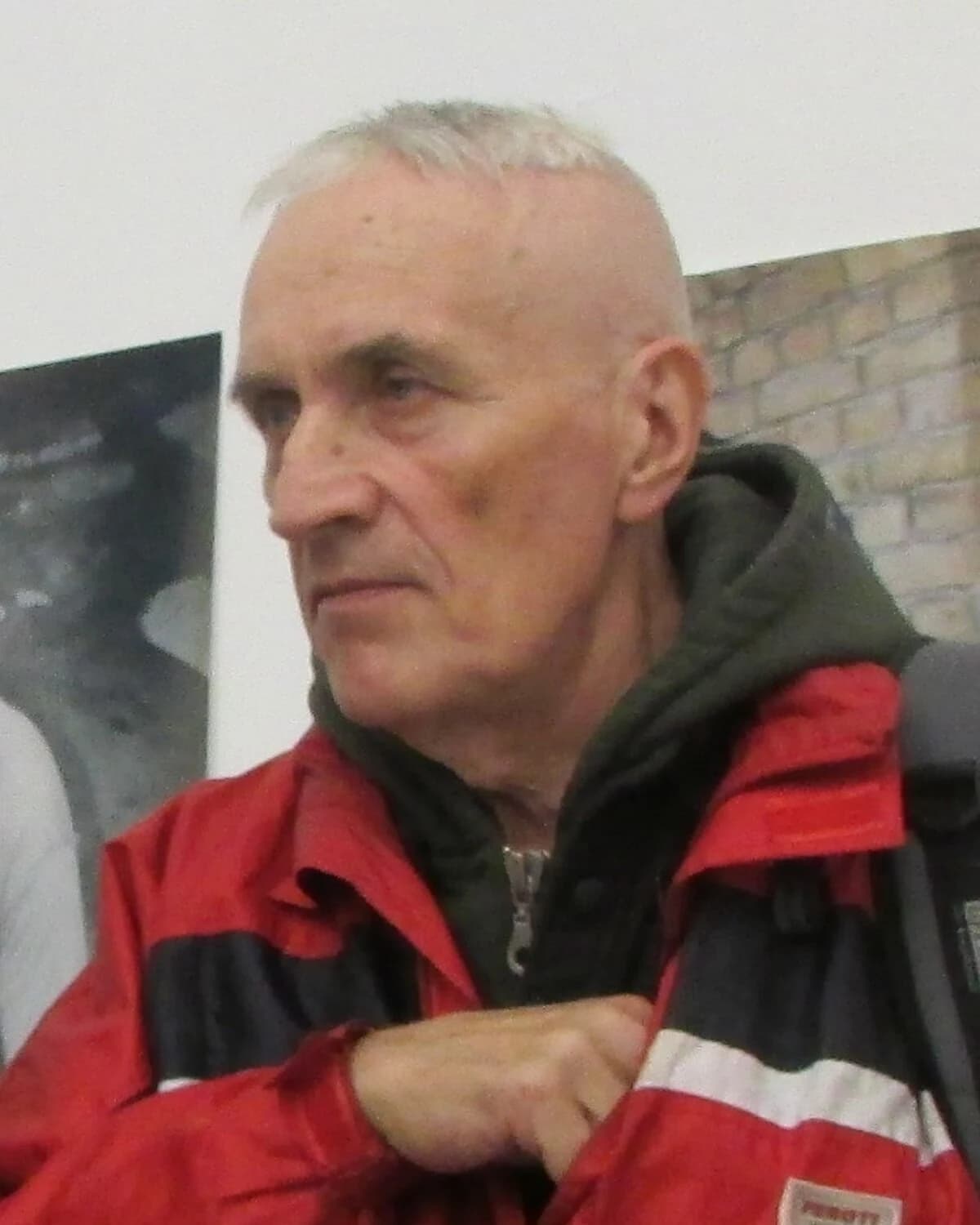
Biography
In 2001, in a huge hall of the Tacheles artists’ house in Berlin, an exhibition of contemporary Belarusian art, “Dach”, opened. Alexandr Rodin was among the participants. By his own account, setting up an easel in the middle of the hall and working until three in the morning in front of the public was a perfectly good way to get to know Berliners.
The exhibition kept him in Berlin for thirteen years.
He was born on 15 May 1947 in Baranovichi, and in 1950 the family moved to Minsk. He learned to draw in the studio of Viktor Versotsky and at Art School No. 1, then at the Belarusian Theatre and Art Institute under Ivan Akhremchik, Natan Voronov and Haim Livshits. The sources disagree on when he graduated: 1971 in some, 1972 in others. His first exhibition, the Exhibition of Young Artists in Minsk, took place in 1971. Among his early works is “Megapolis” (1975); in 1980 Rodin became a member of the Belarusian Artists’ Union, and in the same year a solo show of his work was held in a hall of the Union in Minsk.
For a long time Rodin’s paintings seemed too complicated in Belarus. The figures are drawn almost realistically, but the limbs are stretched, hands and eyes take up nearly the whole canvas, and the scene turns into a hallucination. As a student he tried to break out of the realist school; Chagall and Kandinsky interested him. The rigid conservatism of the art world of the time pushed him towards what art historians later called the “underground quests of the first wave”. One art critic named his method “non-stop panorama”: the whole canvas is covered with a net of small lines and dots, out of which multi-figure compositions and city landscapes emerge. He worked slowly, sometimes for several years on one canvas. He regarded each painting as a sketch that could be finished later or transferred to a larger canvas. I think this habit explains why his cycles run for years: “Mythologeme of the Millennium. Non-stop Panorama” is dated 1986–2000, the diptych “Apocalypse” 1994–1997, and “Syndrome of Rebirth” the mid-1990s.
In the 1990s he began to travel abroad. In the Netherlands, together with a fellow painter, he showed large figurative works on four floors of an exhibition hall in the Watertoren; in Brussels he exhibited at the IFIAC gallery (1996); in Paris he lived at the invitation of the association Rój in a former confectionery factory. There were group shows in France and Italy, and solo shows in Moscow: in 1991 at the Central House of Artists and in 1996 at the House of the Artist.
He stayed at Tacheles from 2001 to 2014 and gradually turned his studio into a place for young Belarusians. Nobody has counted exactly how many people found free shelter there. From 2003, together with Yurkevich, Rodin ran the annual festival DAKH, to which about fifty artists were invited: performance, multimedia, experimental music, sculpture. Festivals were also held in Minsk, at the Palace of Arts. He worked in performance himself. In 1999, at the Novinki festival, he presented with Yurkevich the performance “Connection” by the group Ekledysop, in which spectators watched motionless figures for several hours. From 2003 he took part in the actions of the group Mechanics of Culture.
Besides his large compositions, Rodin painted landscapes in the same small dots, somewhere between abstraction and realism. In his last years he showed “Mythologeme of the Millennium” (2019), “Trans Atlantic Art Message” (2021) and “Stolen Inspiration” (2022) in Minsk.
Rodin died on 19 December 2022 in Minsk. Memorial exhibitions were held in Minsk, Baranovichi, Brest and Bydgoszcz in Poland. His works are held by the National Museum and the Museum of Modern Art in Minsk and in many private collections in Europe and the United States.
Profile notes
Profile and sources
Image
Artist image
Bogatstvo; Wikimedia Commons; CC BY-SA 4.0.
