
23.11.1891–03.12.1956
Alexander Rodchenko
In 1921 Alexander Rodchenko (1891–1956) exhibited three single-colour canvases and declared painting finished, after which he turned to posters, books, furniture and photography. He designed the magazines LEF and Novy LEF and Mayakovsky’s books, drew advertising posters, and as a photographer became famous for shooting from high and low viewpoints. For almost his whole life he worked together with his wife, Varvara Stepanova.
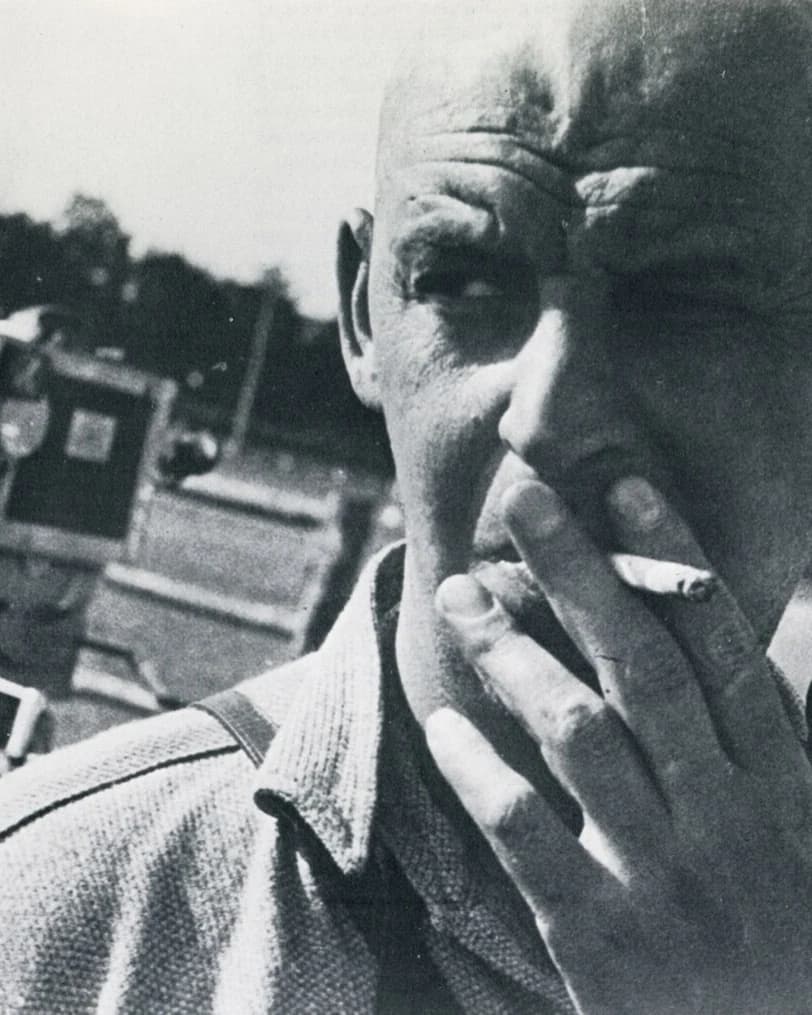
Biography
In 1921, at the Moscow exhibition “5×5=25”, Alexander Rodchenko showed three canvases, each covered in a single colour: red, yellow and blue. Later he said that he had brought painting to its logical conclusion, and summed it up in a single phrase: “I affirmed: it’s all over.”
He did not return to easel painting until the late 1930s.
He was born on 23 November (5 December) 1891 in St Petersburg. His father, Mikhail Mikhailovich, was a theatre props maker, and his mother, Olga Evdokimovna, a laundress. In 1902 the family moved to Kazan, and there, in 1911–1914, Rodchenko studied at the art school under Nicolai Fechin. At the same school, in 1914, he met Varvara Stepanova, with whom he lived in Moscow from 1916. That same year he took part in the exhibition “The Store”, organised by Vladimir Tatlin, and was then called up into the army, serving until early 1917 as quartermaster of a hospital train.
After the revolution he combined work in the new institutions with work in the studio. He was secretary of the youth federation of the painters’ union, decorated the Café Pittoresque together with Georgy Yakulov and Tatlin, in 1918–1921 headed the museum bureau of the Fine Arts Department of the People’s Commissariat for Education, and in 1921 succeeded Wassily Kandinsky as head of the Institute of Artistic Culture. In the manifestos “Everything Is Experiment” and “The Line” he set out his credo: each work is an experiment reduced to a minimal pictorial element. In 1917–1918 he worked with the plane, in 1919 painted “Black on Black”, where only the texture can be told apart, and in 1919–1920 made the line and the point into independent forms. Alongside these came spatial constructions: folding ones of cardboard; the hanging “Planes Reflecting Light”, made of concentric circles, squares and ellipses cut from plywood; and assemblies of identical wooden bars. He drew a line under all this in 1921, announcing his move to “production art”.
From 1920 to 1930 Rodchenko taught in the woodworking and metalworking faculties of the VKhUTEMAS, where he taught students to design objects for everyday life and to reveal their construction instead of decorating them. In 1923–1928 he designed LEF and Novy LEF together with Mayakovsky, and in 1923 illustrated Mayakovsky’s poem “About This” with photomontages. The poster for the Lengiz publishing house, with a young woman shouting “Books in all branches of knowledge” with her hand cupped to her mouth (1924), is perhaps his most recognisable work. With Stepanova he covered the Mosselprom building in Kalashny Lane with painted advertisements (1925), and for the Dobrolyot company he devised a logo with a winged hammer and sickle. For Konstantin Melnikov’s Soviet pavilion at the 1925 Paris exhibition he designed the interior of the “Workers’ Club”, which won a silver medal.
From 1924 he took photographs himself: his mother, Mayakovsky, Lilya and Osip Brik, Melnikov, Lyubov Popova. He shot the building on Myasnitskaya Street from below and from above, and in his articles defended these unexpected viewpoints as a way of seeing the familiar afresh. His well-known formula was to teach people to see ordinary things in an extraordinary way. In those years he also worked as a designer in film and in the theatre, where in 1929 he designed Anatoly Glebov’s “Inga” and “The Bedbug”.
It seems to me that the best of Rodchenko the photographer rests on the diagonal: shot from above or below, a building, a trumpeter, a girl with a camera first read as composition and only then as what they are.
It was precisely such photographs that were held against him. At the exhibition of the October group, which he had helped to found, “Pioneer Girl” and “Pioneer Trumpeter”, shot from a low viewpoint, became the target of devastating criticism in 1931, and their author was accused of formalism. In 1932 he left the group, gave up photography for a time and became a photo correspondent for the Izogiz publishing house. In early 1933 he was sent to photograph the completion of the White Sea–Baltic Canal; by his own account he took more than two thousand pictures there, of which no more than thirty are known today. In December of that year he designed an entire issue of the magazine “USSR in Construction” with his own photographs. With Stepanova he made the photo albums “15 Years of Kazakhstan”, “The First Cavalry”, “The Red Army” and “Soviet Aviation”. In 1934 came “Girl with a Leica”.
In the late 1930s Rodchenko photographed circus performers and went back to painting, and in the 1940s he painted abstract pictures. He died on 3 December 1956 in Moscow and was buried with his wife in the New Donskoy Cemetery. The “Workers’ Club” was lost after the Paris exhibition; in 2021 it was recreated in two copies.
Related context
Associations
Works connected through artistic movements, cultural context and period. Priced works available in this market appear first.








Profile notes
Profile and sources
Image
Artist image
Isaak Brodsky; Wikimedia Commons; Public domain.
