
14.03.1835–16.06.1890
Alexander Litovchenko
Alexander Litovchenko (1835–1890), the son of a poor townsman of Kremenchug, left the Academy of Arts with his comrades in 1863 (the “Revolt of the Fourteen”), joined the St Petersburg Artel of Artists and later the Peredvizhniki. He painted Muscovite Russia of the 16th and 17th centuries, from “The Falconer” to “Ivan the Terrible Showing His Treasures to the Ambassador Horsey”, as well as portraits.
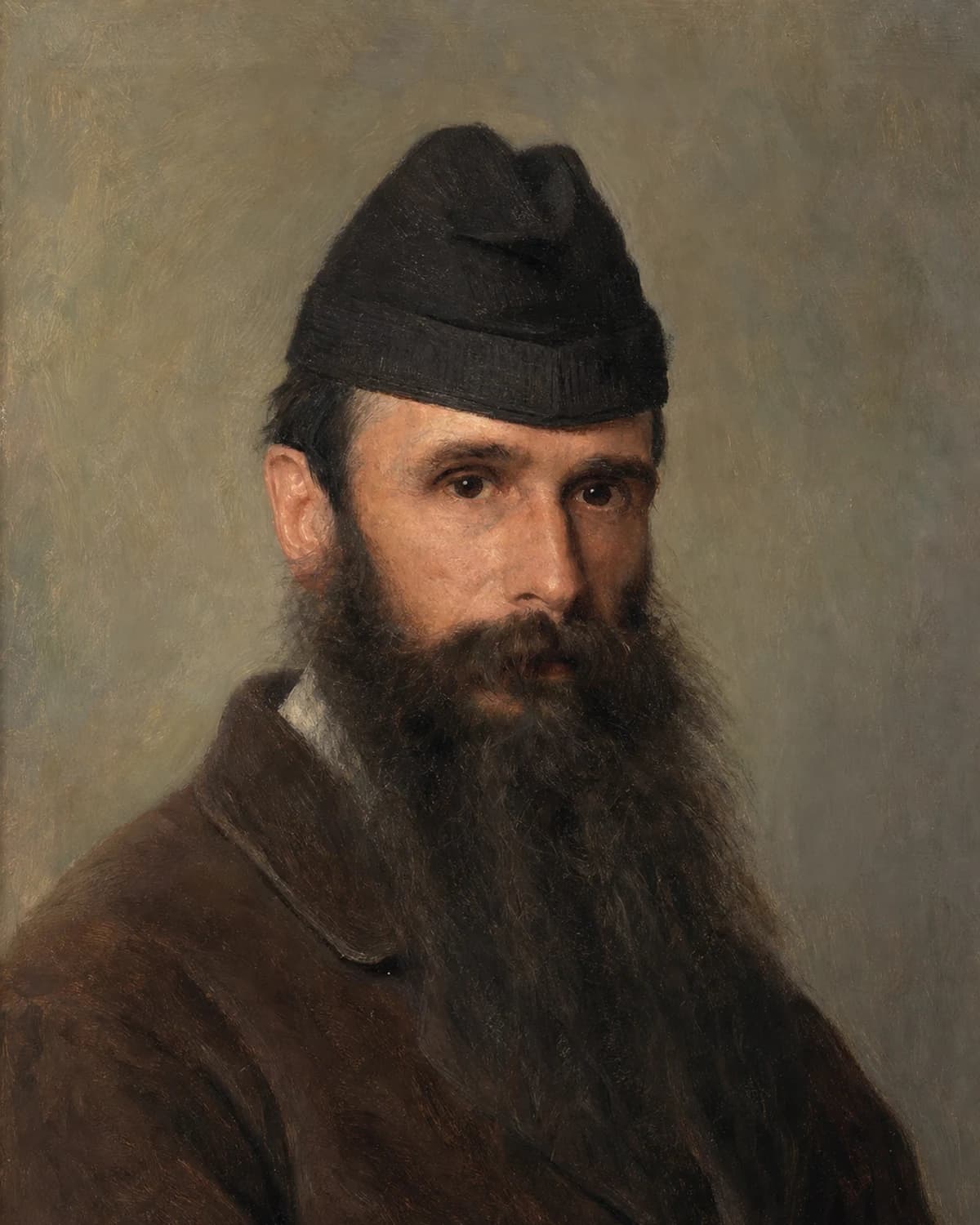
Biography
In 1874 Alexander Litovchenko presented to the council of the Academy of Arts a painting on which he had worked for four years in a studio the Academy had given him: “Tsar Ivan the Terrible Showing His Treasures to the English Ambassador Horsey”. He was counting on the title of professor. The council found the work unsatisfactory in historical and especially in archaeological respects.
The artist asked to be told what exactly was wrong. He was informed that the council saw no need to enter into correspondence with him. From then on Litovchenko kept entirely away from the Academy and to the end of his life spoke of it bitterly and harshly.
He was born on 14 (26) March 1835 in Kremenchug, into a poor family of the townsman class. He spoke of his childhood reluctantly, but recalled that he was drawn to painting early and that, despite the backwater of a provincial town, he quickly got his hand in and was always busy with paints. On arriving in St Petersburg, he entered the Academy, barely passing the examination in general subjects. After that things went well: in 1855, 1857 and 1858 he received two small and two large silver medals for drawing and studies, and in 1861 a small gold medal for the painting “Charon Ferrying the Souls of the Dead”. Life was hard all the same, and he earned his bread as a retoucher at a photographer’s studio.
On 9 November 1863 he was still at the Academy, and he joined the thirteen competitors for the large gold medal who refused to paint the subject set by the council. He left together with them. The Academy gave him a diploma as a class artist of the second degree, with an attached certificate of his “excellent abilities” and the right to paint icons. Litovchenko became one of the founders of the St Petersburg Artel of Artists and, when it broke up, joined the Association of Travelling Art Exhibitions, showing with the Peredvizhniki from 1878. To my mind, this is why the break of 1874 proved so final: it was not his first quarrel with the Academy.
His subject became Muscovite Russia of the 16th and 17th centuries. In 1868, for “The Falconer”, one of several versions of his subject of a falconer at the court of Tsar Alexis, Litovchenko received the title of academician. “Ivan the Terrible”, rejected by the council, was bought by the Tsar for the Museum of Emperor Alexander III in St Petersburg. The painting “Tsar Alexis and Nikon, Archbishop of Novgorod, at the Coffin of the Wonderworker Philip, Metropolitan of Moscow” (1886) was acquired by Pavel Tretyakov, as were his best portraits. This large canvas, measuring 225 by 184 centimetres, spent many decades in storage. In 2009, after restoration, it was at last shown at the Tretyakov Gallery. Litovchenko also painted seven murals for the Cathedral of Christ the Saviour in Moscow and icons for the Crimean War memorial in Sevastopol.
Pyotr Polevoy, who knew him personally, remembered a simple and naive man, somewhat given to boasting but “extremely good-natured and likeable”. What touched Polevoy most was his hunger for Russian antiquity: on seeing new photographs or books on archaeology, Litovchenko would at once ask to borrow them and question him about everything he did not yet know.
The obituary in Vsemirnaya Illyustratsiya was severe: correct, even academic drawing, pleasant colour, a rich manner, dry and monotonous composition, nothing new for the Russian school. But the author at once admitted that Litovchenko would not be forgotten for his part in founding the Association, and called him one of the “chief pioneers of Russian art”.
Alexander Litovchenko died in St Petersburg on 16 (28) June 1890. He was buried in the cemetery of the Novodevichy Convent; the grave has not survived.
Related context
Associations
Works connected through artistic movements, cultural context and period. Priced works available in this market appear first.








Profile notes
Profile and sources
Image
Artist image
На основе открытого изображения: Ivan Kramskoi; Wikimedia Commons; Public domain.
