
28.05.1891–25.08.1961
Alexander Grigoriev
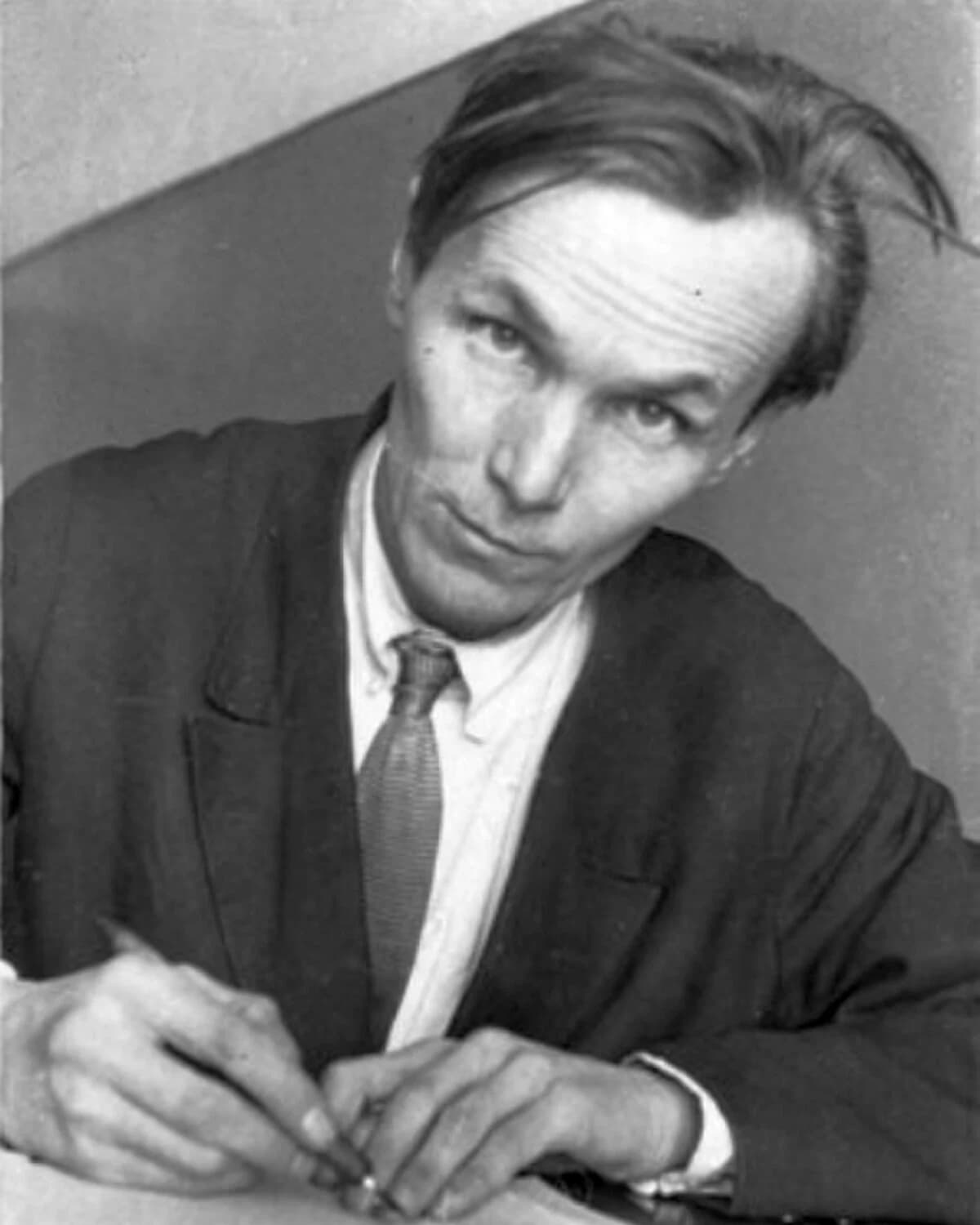
Alexander Grigoriev (1891–1961) was born in a Mari village into a family of rural teachers, studied in Kazan and Moscow, and in 1919 founded a museum with a picture gallery in Kozmodemyansk, which he called the “Small Tretyakov Gallery”. From 1922 to 1927 he headed the Association of Artists of Revolutionary Russia, and was later arrested and spent almost nine years in a camp. He was rehabilitated in 1954.
Biography
In the autumn of 1918 a young teacher, Alexander Grigoriev, arrived in Kozmodemyansk and saw, in the department of public education, paintings that nobody there knew what to do with. They were the remains of the Volga-Kama travelling exhibition: artists from Kazan had been taking it around the Volga towns, but in Kozmodemyansk, according to museum staff, those accompanying it were afraid to go any further because of the war that had begun, and the canvases stayed behind in storage.
Grigoriev made a museum out of them.
He was born on 28 May 1891 in Pertnury, into a family of rural teachers. His father, from a peasant background, understood the value of education and sent his son to study in Kazan. Grigoriev graduated from the agricultural school at Moreny, then from the Kazan teachers’ seminary (1910). According to the recollections of a fellow townswoman, he was expelled from the seminary for taking part in revolutionary demonstrations in 1909 and sent home under police supervision, then reinstated. From 1909 to 1918 he was a member of the Socialist Revolutionary Party; in 1940 he himself claimed he had never belonged to it. The teacher’s path did not attract him: he entered the Kazan Art School, from which he graduated in 1915. There he studied under Pavel Benkov and Nicolai Fechin, and in 1914 he took part in an exhibition for the first time. Then came the Moscow School of Painting, Sculpture and Architecture, where his teachers are said to have included Ilya Mashkov, Konstantin Korovin and Abram Arkhipov, and work as a statistician at the All-Russian Zemstvo Union, an association of local self-government bodies. From December 1918 he was a member of the Russian Communist Party (Bolsheviks).
In Kozmodemyansk he became head of the volost department of public education, in 1919 opened the museum with its picture gallery, founded free art workshops and organised the first local exhibition. In 1920 he became chairman of the district committee of the Party. As a draughtsman he showed himself here in pencil portraits: “Portrait of Father” (1919) and portraits of two local figures, Loktev and Alafuzov (1920).
In 1922 he was summoned to Moscow, where he became an instructor of the Party’s Central Committee and one of the organisers of the Association of Artists of Revolutionary Russia (AKhRR). He was its chairman until 1927, and in 1928–1932 headed the Union of Soviet Artists, which he had founded. Later he worked as deputy director of the Tretyakov Gallery and art editor at the state publishing house Gosizdat, and ran a department of the Museum of the Revolution. From the capital he kept adding to the Kozmodemyansk collection: he bought about fifty paintings, sculpture and porcelain. Through Fechin, who left for America in 1923, he acquired several of Fechin’s works, and Fechin gave him sketches for “Cheremis Wedding”. In 1934 he held a solo exhibition.
From here the sources diverge. According to some, Grigoriev was arrested on the night of 7 November 1937, according to others in November 1938. He was sentenced to eight years and sent to the Karaganda camp; according to museum staff, he spent almost nine years there. His name was removed from the Kozmodemyansk museum and from books, and his face was cut out of photographs of AKhRR. In one book about Ilya Repin, a vase appeared in the place where Grigoriev had been sitting beside the painter. He wrote to Kliment Voroshilov, whom he knew personally, asking for his case to be reviewed, but received no answer.
He was released in 1946 and forbidden to live in Moscow, although his family remained there. He settled in Tarusa, in the Kaluga region, and lived there for about ten years in poverty, earning money by painting signs for canteens and cafés; a few artist friends helped him. In a letter of 1947 he put it himself this way: they took me, tortured me and let me go, live, since you have survived. His wife, Evgenia Baklanova, whom he had married shortly before returning to Kozmodemyansk, wrote petitions all those years, and his eldest son, Veniamin, then nineteen, appealed to Stalin.
The Military Collegium of the Supreme Court rehabilitated him on 16 June 1954. His Party card was returned, he was invited to an enlarged meeting of the USSR Academy of Arts, and in 1956 he was granted a pension of all-Union significance and elected a delegate to the First Congress of Soviet Artists. He was awarded the title of Honoured Art Worker of the Mari Autonomous Soviet Socialist Republic in 1960 (according to other sources, in 1961). To my mind, more important than the title is that to the end of his life he went on collecting for the “Small Tretyakov Gallery”.
He died in Moscow on 25 August 1961 and was buried at the Novodevichy Cemetery. In 1966 his name was returned to the Kozmodemyansk museum, which now bears it; the State Prize of the Mari El Republic in fine arts is also named after him.
Related context
Associations
Works connected through artistic movements, cultural context and period. Priced works available in this market appear first.








Profile notes
Profile and sources
Image
Artist image
Sergey Strunnikov; Wikimedia Commons; Public domain.
