
16.07.1806–03.07.1858
Alexander Andreyevich Ivanov
Alexander Ivanov (1806–1858) lived in Rome for almost thirty years and spent twenty of them painting a single picture, “The Appearance of Christ Before the People” (1837–1857), a canvas measuring 540 by 750 centimetres. For it he made hundreds of studies of people and landscape, which were later prized almost above the painting itself. In the summer of 1858 he brought the picture to St Petersburg and died a month and a half later.
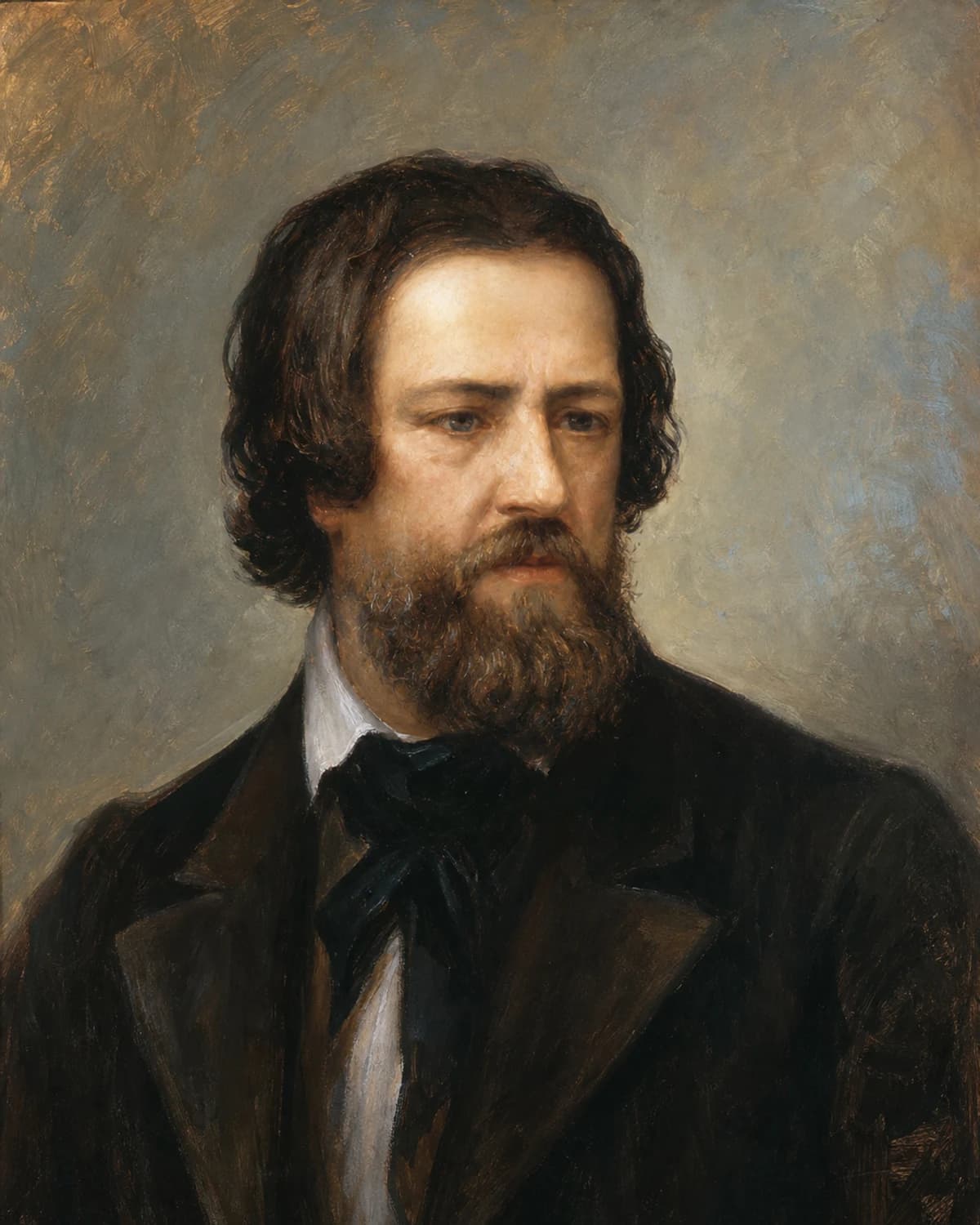
Biography
The engraver Fyodor Jordan recalled how Alexander Ivanov hesitated for a long time to tackle a large canvas, and then one evening came into a Roman café and announced that he would paint a picture bigger than Bruni’s “The Brazen Serpent”. In May 1837 he informed the Society for the Encouragement of Artists that he had ordered a canvas “8 arshins in height and ten and a half in width”. The work took twenty years.
He himself more often called it “The Appearance of the Messiah”, or simply “my picture”.
Ivanov was born on 16 (28) July 1806 in St Petersburg, the son of the painter Andrei Ivanovich Ivanov, a professor of history painting. At eleven he was admitted to the Academy of Arts as an “outside” pupil, that is, one living at home; he was taught by Alexei Egorov, Vasily Shebuev and above all his father, and his studies were supported by the Society for the Encouragement of Artists. In 1824 he received the small gold medal for “Priam Asking Achilles for the Body of Hector”, and in 1827 the large one for “Joseph Interpreting the Dreams of the Cupbearer and the Baker Imprisoned with Him”. The Society agreed to send him abroad, but first required one more painting, “Bellerophon Sets Out against the Chimera”. In 1830 he left for Italy by way of Germany, and from 1831 he lived in Rome.
There he copied Michelangelo’s “Creation of Adam” and spent long hours reading the Gospels. Early in 1833 he wrote to the Society that he had grasped the essence of the Gospel of John: the Baptist was to present the Messiah to the people in person, and “this very last moment” was what he chose as the subject of his picture. To try his strength he first painted the two-figure “The Appearance of Christ to Mary Magdalene after the Resurrection” (1834–1835), and in St Petersburg it was such a success that on 24 September (6 October) 1836 the Academy made its author an academician.
In the summer of 1837, while the primed canvas was drying, Ivanov travelled to northern Italy to look at the old masters and to Livorno to sketch faces, and in the autumn he rented a spacious studio. In December 1838 it was visited by the heir to the throne, Alexander Nikolaevich, together with Zhukovsky, who granted the artist an allowance for three years. Ivanov never saw Palestine, and he painted the biblical landscape in the Roman Campagna: the Tretyakov Gallery holds 86 such studies, the Russian Museum another 15. For Christ he took as his basis a Byzantine mosaic of the Pantocrator that he had sketched in Sicily; for the Baptist he started from Raphael’s “Madonna of Foligno” and an antique head of Zeus, and he painted both figures partly from female models. Christ stands far off, alone, on a hill, and the whole action unfolds in the faces of those who have seen him. At the end of 1841 the strain of the work affected his eyes, and in 1842–1844 he hardly painted. By 1846, according to his brother Sergei, who had come to Rome, the picture was almost finished, except for a few figures.
His chief companion in these years was Nikolai Gogol, whom Ivanov came to know in Rome in the late 1830s. The artist consulted him about many of the figures, especially the slave: Gogol suggested making him one-eyed and branded, and his brother talked him out of such harshness. In 1846 Gogol wrote the article “The Historical Painter Ivanov”. To my mind, the strongest thing in the picture is the pair at the centre: the naked, carefully groomed rich old man and his slave with a rope around his neck, who, reaching for his master’s clothes, has involuntarily turned towards John. In the wanderer with a staff seated under a tree, some scholars see a self-portrait of the artist. From 1849 he worked in parallel on the “Biblical Sketches”: he planned about five hundred subjects and managed to complete more than two hundred.
In the spring of 1857 Ivanov opened his studio to all comers for several days, and so many people came that another day had to be added; among the visitors were the German Nazarenes Overbeck and Cornelius, kindred spirits to him. In May 1858 he set off with the canvas for Russia by way of Civitavecchia, Marseille, Paris, Cologne and Hamburg. At Kiel, where the picture was being loaded onto a naval steamer, he was taken ill, the doctors forbade him to sail, and the canvas went on to St Petersburg without its author.
He himself arrived on 20 May (1 June) 1858, after an absence of twenty-eight years.
The picture was shown to Alexander II in the White Hall of the Winter Palace, and from 10 June it was exhibited with the studies at the Academy of Arts, where more than thirty thousand people saw it free of charge. Some called the author “a Benedictine of our time”, others wrote harshly, and Ivanov told his brother with distress that people brought the article from Syn otechestva to the picture and read it, comparing the two. The decision on the purchase kept being put off. Alexander Ivanov died on 3 (15) July 1858, and a few hours later word came that the emperor was buying the picture and conferring on the artist the Order of St Vladimir. He was buried in the cemetery of the Novodevichy Convent in St Petersburg; in 1936 his remains and gravestone were moved to the Tikhvin Cemetery of the Alexander Nevsky Lavra. In 1861 the emperor gave “The Appearance of Christ Before the People” to the Public Museum in Moscow, and since 1932 it has hung in the Tretyakov Gallery.
Related context
Associations
Works connected through artistic movements, cultural context and period. Priced works available in this market appear first.








Profile notes
Profile and sources
Image
Artist image
На основе открытого изображения: Sergey Petrovich Postnikov; Wikimedia Commons; Public domain.
