
02.12.1951–present
Alexander Aizenshtat
Alexander Aizenshtat (born 1951) studied painting in Moscow with the watercolourist Skulsky, left the USSR in 1974 and now lives in Israel. He paints in pure, strong colour, above all blue, and keeps returning to Kafka’s imagery; in 1989 he founded the Center for Torah Studies in Moscow. His work was shown at the Pushkin Museum and the Tretyakov Gallery in 2016.
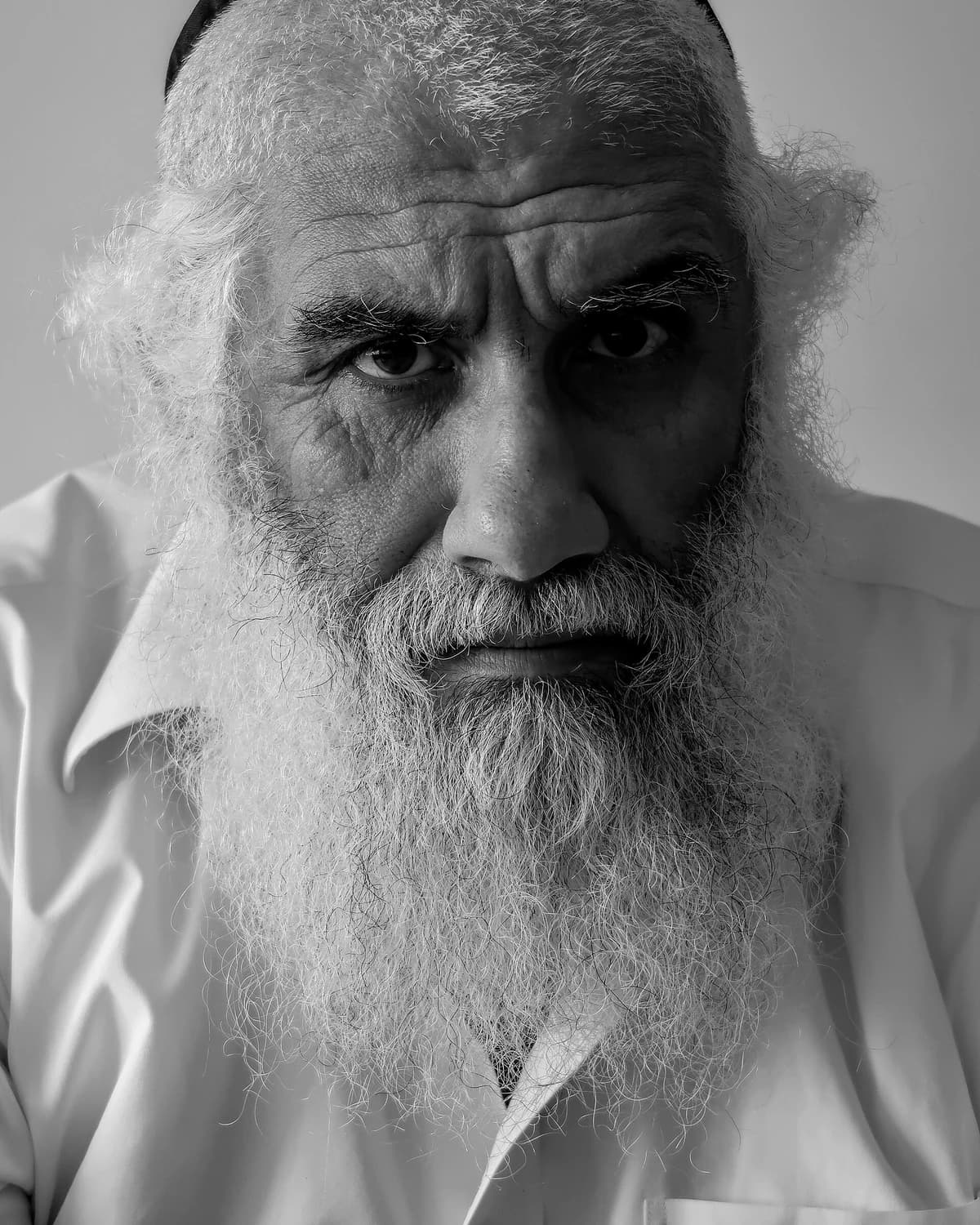
Biography
In 1989, fifteen years after leaving the country, Alexander Aizenshtat returned to Moscow, where he founded the Center for Torah Studies. Since then he has visited Russia regularly.
He was born on 2 December 1951 in Moscow and grew up in the Chistye Prudy district. His father was a lawyer, his mother a teacher of German. In the late 1960s he studied painting at the Serov art school on Prechistenka Street, then in the studio of the watercolourist Stanislav Skulsky. Skulsky was linked to the tradition of the Jack of Diamonds, the Moscow avant-garde group, and had studied with Robert Falk. The future artist spent much of his time in the halls of the Pushkin Museum and copied some of the works there; in his own circle it was said that his teachers could be named as Rembrandt, Van Gogh and Picasso. In 1974 Aizenshtat left the USSR and settled in Israel, where he lived in Safed, a city associated with the study of Kabbalah, and on Kibbutz Manhaim. There he went on painting, then served in the army, after which he turned to religious education and began studying Torah and Talmud at a yeshiva in Jerusalem. In 1980 he moved to Paris; today he is a French citizen living in Israel, and he works in Jerusalem and in the Moscow region. He follows Orthodox Judaism, and this choice shaped his life as well as his range of subjects: “The Rebbe”, “The Jewish Family”.
In the middle and late 1980s his works were shown in private houses in London, Paris, New York, Antwerp and Zurich; they were also sold privately. Public exhibitions in Moscow began in the 2000s. In 2003 his paintings were shown in the house of the collector Moishe (Vyacheslav) Kantor on Bolshaya Ordynka Street, and in 2006 a solo exhibition took place at the Museum of Other Art at the Russian State University for the Humanities (RGGU). In 2009 came “Signs of Moscow” at Svetlana Sazhina’s gallery and “Kafkaesque Motifs” at RGGU, in 2010 “Spectrum of Life” at the Moscow Museum of Modern Art, and in 2012 the same series at the Metropol gallery.
In 2013 there were especially many exhibitions: “Without a Fixed Place of Residence” at the Spiridonov House, “People” at the 1905 gallery, a show of a single painting, “The Old Man and the Cockerel”, “The Jewish Family” at the Jewish Cultural Center, and “Ladies and Gentlemen” at the Seasons gallery. On 25 February 2014 his Moscow studio opened on Chaplygin Street.
In 2016 his works were shown at the Pushkin Museum (10 March) and at the Tretyakov Gallery on Krymsky Val (2 November), with the exhibition “Yellow Flowers” at the Bulgakov Museum in between. In October 2017 “Josephine the Singer and Her Orchestra” was shown at the State Institute for Art Studies, and in June 2018 “Spectrum of Life” travelled to the Jewish Museum in Eisenstadt, Austria. His works are in the collection of the Moscow Museum of Modern Art and in private collections.
Critics describe his colour as Rembrandtian, and his blue, in the words of Vladimir Turchin, “draws everything depicted” into depth. Alexander Yakimovich named three supports of his world: the Jewish, the Soviet and the Western. Of writers, the one closest to the artist is Kafka, to whose imagery he returns again and again. Andrey Yurganov considers him the founder of “metaphysical expressionism”. To my mind, this is rather one critic’s definition than the name of a movement recognised more widely. Aizenshtat himself puts it briefly: “An artist is a craftsman.”
Profile notes
Profile and sources
Image
Artist image
YaakovAizenshtat; Wikimedia Commons; CC BY 4.0.
