
14.03.1716–12.06.1795
Aleksey Antropov
Aleksey Antropov (1716–1795) came out of the “painting team” of the St Petersburg Office of Buildings: he decorated palaces, painted icons for St Andrew’s Church in Kiev, and from 1761 until his death supervised icon painters for the Synod. He is known for his portraits of Peter III, Countess Rumyantseva, Izmailova and Ataman Krasnoshchekov, painted in sharp colour against a dark ground. Dmitry Levitsky was among his pupils.
Biography
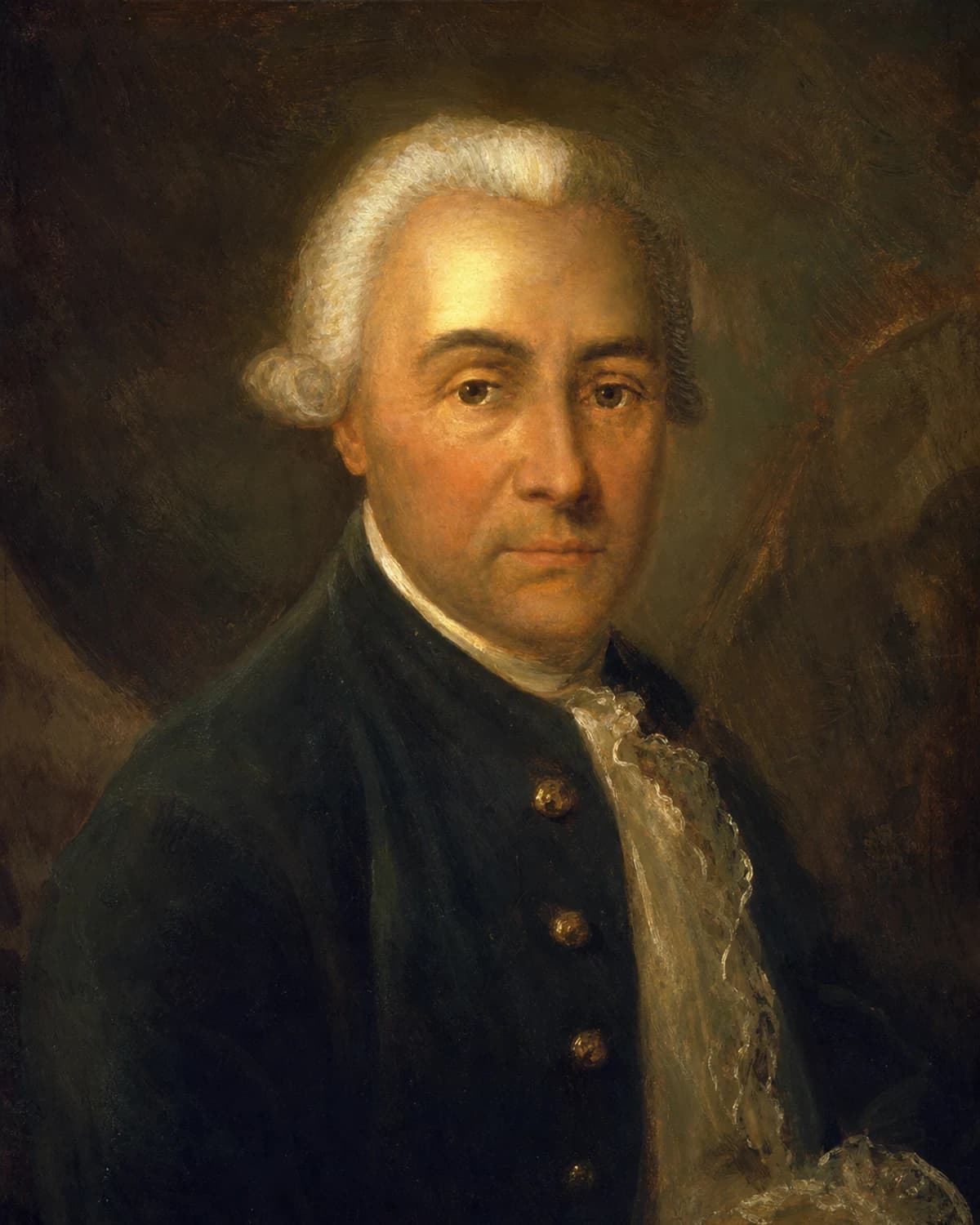
In 1776 Pyotr Drozhdin, a pupil of Aleksey Antropov, painted a portrait of his teacher: Antropov is shown with his son in front of a portrait of his wife, Elena Vasilyevna. The canvas is in the Russian Museum.
Antropov was sixty at the time. Many pupils had passed through his hands by then, and some had lived in his own house.
He was born on 14 (25) March 1716 in St Petersburg, into the family of an official: his father served in the Office of Buildings. Aleksey himself studied there from 1732, under his relative Andrei Matveyev, Louis Caravaque, M. A. Zakharov and Ivan Vishnyakov, and from 1739 he worked in Vishnyakov’s “painting team”. Its masters were expected to be able to do everything. In 1742 Antropov took part in decorating the coronation celebrations of Elizabeth in Moscow; in St Petersburg he painted pictures for the triumphal gates in the Anichkov Sloboda, worked on the ceiling and icons of the Winter Palace, painted in the Summer and Anichkov Palaces under Giuseppe Valeriani, worked at Tsarskoye Selo and Peterhof, and with Valeriani and Peresinotti made scenery for the Opera House. His first portraits depicted Empress Elizabeth; by one account he never saw her and painted from Caravaque’s works. In 1749 he received the rank of journeyman painter.
In 1752 Antropov received a commission of his own: icons “in the cupola and other places” of the new church of St Andrew the First-Called in Kiev, built by the architect Michurin to Rastrelli’s design. He worked there until 1755, supervised the installation of the iconostasis and painted the cupolas and walls. The centrepiece of the ensemble is the altar image “The Last Supper”.
From Kiev he went to Moscow and painted two ceilings in the Golovin Palace on the Yauza. There he met Ivan Shuvalov, curator of Moscow University, founded in 1755; Shuvalov invited him to teach in the future art faculty and in the meantime enrolled him at the university as “painting master”. Still, no permanent work turned up in Moscow, and Antropov returned to St Petersburg, where he took lessons from the court portraitist Pietro Rotari. The portrait of A. M. Izmailova (1759) is sometimes regarded as his graduation piece. With Shuvalov’s help he obtained the post of supervisor of painters and icon painters at the Synod and undertook to take pupils and “teach them without concealment the skilful art of painting, icon painting and enamel”. In 1760 he was certified as a “master”, and from 1761 he held the post for the rest of his life: he oversaw icon painting, decorated churches and painted portraits of hierarchs. Pupils from Ukraine lived in his house, among them Dmitry Levitsky; Pyotr Drozhdin also studied with him, and M. L. Kolokolnikov worked in his studio.
The 1760s were, it seems, his most productive years. From them come the portraits of Archbishop Silvestr Kulyabka (1760), the priest Fyodor Dubyansky and Ataman Fyodor Krasnoshchekov (1761), Princess Tatiana Trubetskaya (1761), A. V. Buturlina (1763), Countess M. A. Rumyantseva (1764), V. V. Fermor (1765) and Catherine II (1766). In 1762 Peter III came to the throne, and Antropov became his favourite painter: by one account, in the six months of the reign he painted at least four portraits of him. Catherine II thought much less of him. The court then liked soft combinations of colour and a little flattery, while Antropov kept to the old training of the icon and the parsuna: sharp contrasts of colour, a dark background. I think this explains why his portraits look by turns naive and merciless today. Nevertheless, in 1762–1763 he took part in decorating Catherine’s coronation in Moscow.
In 1773 he was listed in the Synod’s service as a painter of the 12th class. Later came the portraits of Archbishop Gavriil (1774) and Archbishop Platon Levshin of Tver (1775), and a self-portrait of 1784. In St Petersburg he had a private school. In 1789 he gave his house to the Board of Public Charity for a public school.
Antropov died in St Petersburg on 12 (23) June 1795 and was buried in the Lazarevskoe Cemetery of the Alexander Nevsky Lavra. His tombstone survives. The inscription reads “collegiate assessor and painting artist Aleksey Petrovich Antropov”, and the length of his life is counted to the day: 79 years, 2 months and 28 days.
Related context
Associations
Works connected through artistic movements, cultural context and period. Priced works available in this market appear first.








Profile notes
Profile and sources
Image
Artist image
На основе открытого изображения: Aleksey Antropov; Wikimedia Commons; Public domain.
