
18.01.1882–17.03.1949
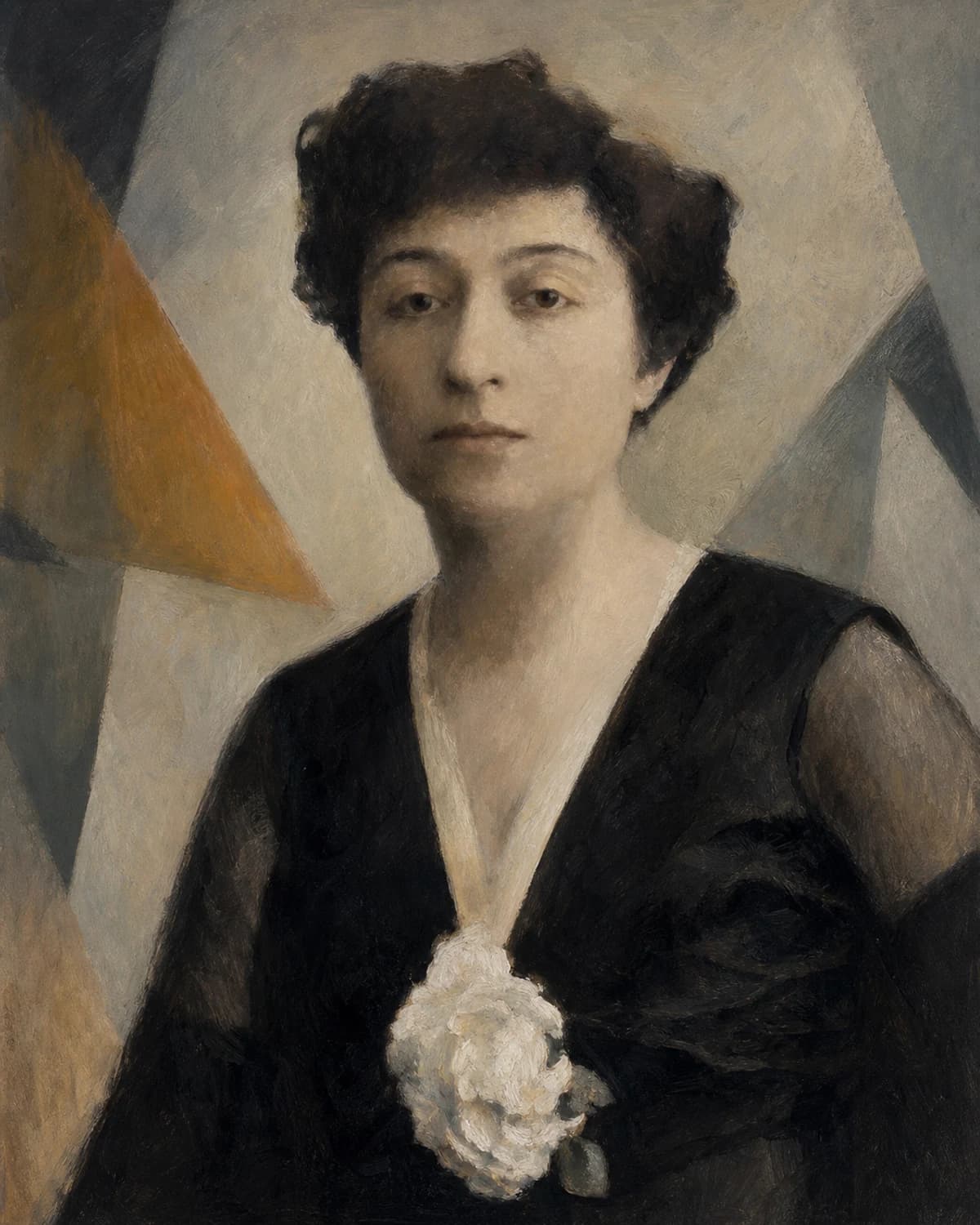
Aleksandra Ekster
Aleksandra Ekster (1882–1949), born in Białystok and raised in Kiev, was friends with Picasso and Apollinaire in Paris and worked in Cubo-Futurism and Suprematism; Tyshler, Meller, Petritsky, Kozintsev and Yutkevich passed through her Kiev studio. She designed productions for the Kamerny Theatre and the film “Aelita”, lived in France from the 1920s and is considered one of the founders of Art Deco.
Biography
In 1918–1919 Aleksandra Ekster’s painting studio worked on the second floor of the house at 1 Gimnazicheskaya Street in Kiev. Vadym Meller, Anatoly Petritsky, Alexander Tyshler, Lyubov and Grigori Kozintsev and Sergei Yutkevich studied there; Ilya Ehrenburg, Benedikt Livshits, Osip Mandelstam and Viktor Shklovsky dropped in. Two of the students, Kozintsev and Yutkevich, would later become well-known film directors.
The mistress of the studio was thirty-six at the time, and she already had behind her Paris, Italy and almost all the major exhibitions of the Russian avant-garde.
She was born Grigorovich on 6 (18) January 1882 in Białystok, Grodno province. Accounts of her father, Alexander Grigorovich, differ: according to some, he was a collegiate assessor; according to others, a well-to-do businessman. In 1885 the family moved to Smela, and then to Kiev. Aleksandra finished the St Olga Gymnasium and studied at the Kiev Art School in 1901–1903 and again, as an auditor, in 1906–1908; there she became friends with Aristarkh Lentulov and Alexander Archipenko. She married her cousin, the Kiev lawyer Nikolai Ekster, and set up a salon-studio at home that became a meeting place for the Kiev avant-garde.
In 1907 Ekster went to Paris, studied at the Académie de la Grande Chaumière and in the class of the portraitist Carlo Delval, and made friends with Pablo Picasso and Guillaume Apollinaire. For the next few years she lived between Moscow, Kiev, Odessa and St Petersburg and travelled constantly around Europe. In 1908, together with David Burliuk, she organised the exhibition “The Link” in Kiev. In 1912 in Italy she met the Futurist Ardengo Soffici, and through him the Italian avant-garde artists, and exhibited with them. That same year she took part in the February exhibition of the Knave of Diamonds and in the Salon des Indépendants in Paris, and in the autumn, under the name Alexandra d’Exter, she showed six works at the Section d’Or alongside Metzinger, Gleizes and Duchamp. Her canvases appeared at the exhibitions of the Union of Youth and “Tramway V”; in 1914 she organised an exhibition of the Ring group in Kiev, and in 1915 she joined Kazimir Malevich’s Supremus.
In 1915–1916, together with other Suprematists, Ekster worked with peasants in the craft artels of the villages of Verbovka (run by her pupil Nina Genke) and Skoptsy (run by Natalia Davydova). Suprematist designs became embroidery on bags, cushions, carpets and belts. The scholar Georgy Kovalenko considers the time at Verbovka decisive for her painting, and she herself, he says, searched the villages for old embroidery and weaving. She also made designs for dresses, scarves, tablecloths, screens and lampshades. In 1916 an album of gouaches, “Rupture. Movement. Weight”, was prepared for the Centrifuge publishing house but never published. The same year saw the start of her work for Alexander Tairov’s Kamerny Theatre: “Thamyris the Cithara Player” (1916), “Salome” (1917), and later “Romeo and Juliet” (1921).
In 1918 her husband died in Kiev. Together with I. Rabinovich, Ekster opened a studio of decorative and applied art, where P. Tchelitchew, A. Tyshler and N. Shifrin studied, and made costumes for the dance numbers of Bronislava Nijinska’s School of Movement. In 1919, with Kliment Redko and Nina Genke-Meller, she painted the streets of Kiev and Odessa for the revolutionary festivals. In 1920 she moved to Moscow and married the actor Georgy Nekrasov. After that came a great many things at once: chintz designs for factories, the Studio of Contemporary Costume and the Moskvoshvei workshops, a dress uniform for the Red Army, teaching colour at Vkhutemas. In 1923, together with Vera Mukhina, she designed the Izvestia and Krasnaya Niva pavilions at the All-Russian Agricultural and Handicraft-Industrial Exhibition; in 1924 she made the costumes for Yakov Protazanov’s film “Aelita” and helped to set up the Soviet pavilion at the Venice Biennale.
Then Ekster left for France and never returned to Soviet Russia. At Fernand Léger’s invitation she taught at his Academy of Contemporary Art until 1930. Solo exhibitions followed at the Der Sturm gallery in Berlin (1927), in London (1928), Paris (1929), New York (1930) and Prague (1937). There was less and less easel painting; she designed interiors, painted ceramics and made books. Some, the “manuscript” books, existed in a single copy, occasionally in three to five, like Horace’s “Ode to Bacchus” (1937). Others, children’s books by Marie Colmont for the publisher Flammarion, folded out like a concertina from square sheets 25 by 25 centimetres; in “My Garden” the trees, flower beds and parts of a fountain had to be cut out and pasted in following a diagram. To my mind these fold-out books, where a river runs from its source to the sea in one continuous picture, show the whole of her theatrical training.
Ekster and her husband spent the war years in great poverty. Nekrasov died in 1945, and her last work was a sculpture of an angel for their shared grave.
Aleksandra Ekster died on 17 March 1949 at Fontenay-aux-Roses near Paris.
Related context
Associations
Works connected through artistic movements, cultural context and period. Priced works available in this market appear first.








Profile notes
Profile and sources
Image
Artist image
На основе открытого изображения: Unknown author Unknown author; Wikimedia Commons; CC BY-SA 4.0.
