
17.02.1863–17.04.1930
Aleksandr Golovin
For fifteen years Aleksandr Golovin (1863–1930) was chief designer of the Imperial Theatres in St Petersburg; with Meyerhold he designed sixteen productions, from “Don Juan” to “Masquerade”, and for Diaghilev’s seasons in Paris he did “Boris Godunov” and “The Firebird”. His portraits of performers in stage costume are painted with a broken, almost mosaic-like stroke.
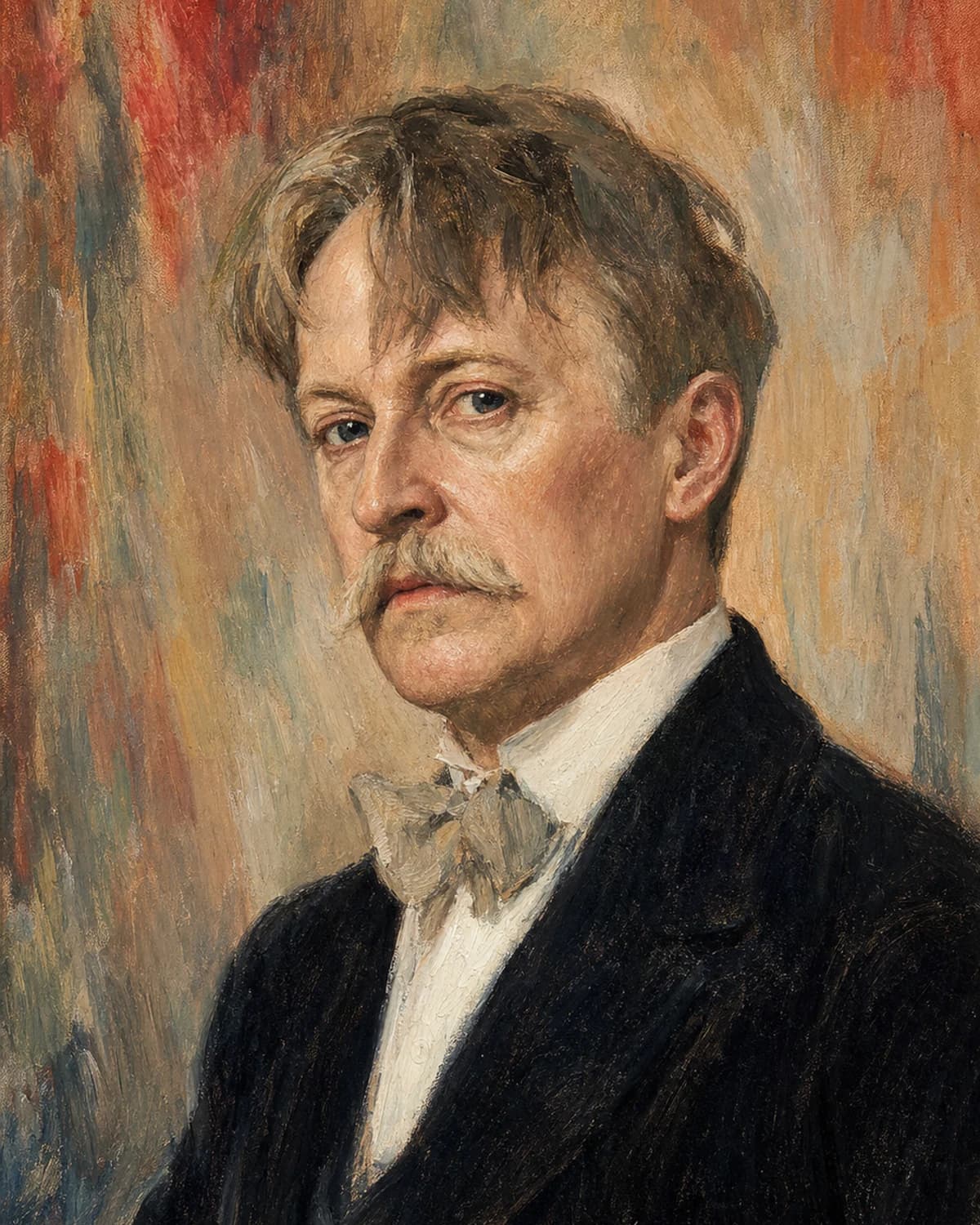
Biography
While working on Lermontov’s “Masquerade” at the Alexandrinsky Theatre, Aleksandr Golovin painted a portrait of the director Vsevolod Meyerhold in a Pierrot costume in front of a mirror. The production opened on 25 February (10 March) 1917. It was one of the last major works of their partnership: altogether the two of them staged sixteen operas and plays on the Imperial stages of St Petersburg.
Golovin was born in Moscow on 17 February (1 March) 1863. His father, the priest Yakov Danilovich Golovin, three years after his son’s birth became professor of Orthodox theology at the Petrovsky Agricultural and Forestry Academy and rector of the academy’s church; his mother, Anna Nikolaevna, née Popova, also came from a family of priests. The household loved the theatre, music and books. The boy turned out to have perfect pitch and studied the piano and singing seriously, while his passion for drawing came only in the upper forms of the gymnasium.
I think this explains a great deal. His contemporaries called his painting “music for the eyes”, borrowing the phrase of the stage designer Pietro Gonzaga.
He was educated at the Katkov Lyceum and the Polivanov Gymnasium, and in 1882–1889 at the Moscow School of Painting, Sculpture and Architecture, where he spent three years in the architecture department before moving to painting, under Illarion Pryanishnikov, Vladimir Makovsky and Vasily Polenov. The Peredvizhniki spirit of the school was alien to him. Money was short, and after graduating he earned a living painting interiors and tried his hand at furniture. In Paris he studied at the Académie Colarossi and the Académie Vitti (1897) and was struck above all by Van Gogh; afterwards he travelled in Italy and Spain and, in his own words, realised that he “had been doing the wrong thing and must work in a new way”. In the 1890s he worked in the Abramtsevo circle, making majolica and wooden objects in the neo-Russian manner, and Vrubel’s influence can be seen in these pieces. With his friend Konstantin Korovin he designed the Russian pavilion at the 1900 World’s Fair in Paris, and in 1900–1903 the two of them prepared designs for the majolica facades of the Hotel Metropol, then under construction in Moscow.
He was brought into the theatre by Vladimir Telyakovsky, who ran the Moscow office of the Imperial Theatres. His first successes came at the Bolshoi: Koreshchenko’s opera “The Ice House” in 1900 and Rimsky-Korsakov’s “The Maid of Pskov” in 1901. In 1901 he moved to St Petersburg and Tsarskoye Selo, and in 1902 he became chief designer of the Imperial Theatres. Then came “Carmen” at the Mariinsky (1908), Hamsun’s “At the Gates of the Kingdom” (1908), “Don Juan” after Molière (1910), Gluck’s “Orpheus and Eurydice” (1911), Ostrovsky’s “The Storm” (1916), “Masquerade” and Dargomyzhsky’s “The Stone Guest” (1917), most of them with Meyerhold. For Diaghilev’s Russian Seasons in Paris he designed Mussorgsky’s “Boris Godunov” (1908) and the first production of Stravinsky’s “The Firebird” (1910). Golovin was a member of the World of Art in 1902–1903 and again from 1910, and became a full member of the Academy of Arts in 1912.
A line of his own was the “theatrical portraits”: actors and singers in stage costume against a setting in which the drapery, accessories and background are painted in small separate strokes that resemble mosaic. Among his other portraits, “Girl with Porcelain” (1916) is in the Tretyakov Gallery.
After the revolution there were far fewer theatre commissions, and Golovin turned more to painting and graphic work. In 1922 he illustrated Hoffmann’s story “The Doubles” and later coloured some copies by hand. His last great success was Beaumarchais’s “The Marriage of Figaro” for Stanislavski at the Moscow Art Theatre: rehearsals began at the end of 1925, it opened on 28 April 1927, and Golovin used a revolving stage to speed up the scene changes. For this work he was made People’s Artist of the Republic in 1928.
He spent his last years in Detskoye Selo and died there on 17 April 1930; he was buried in the cemetery of the Resurrection Novodevichy Convent in Leningrad. “Othello” at the Moscow Art Theatre, in his designs, opened only after his death. Golovin’s memoirs, “Encounters and Impressions”, were published in 1940, and his theatre designs are kept in the Bakhrushin Theatre Museum.
Related context
Associations
Works connected through artistic movements, cultural context and period. Priced works available in this market appear first.








Profile notes
Profile and sources
Image
Artist image
На основе открытого изображения: Aleksandr Golovin; Wikimedia Commons; Public domain.
