
15.07.1889–26.02.1938
Aleksandr Drevin
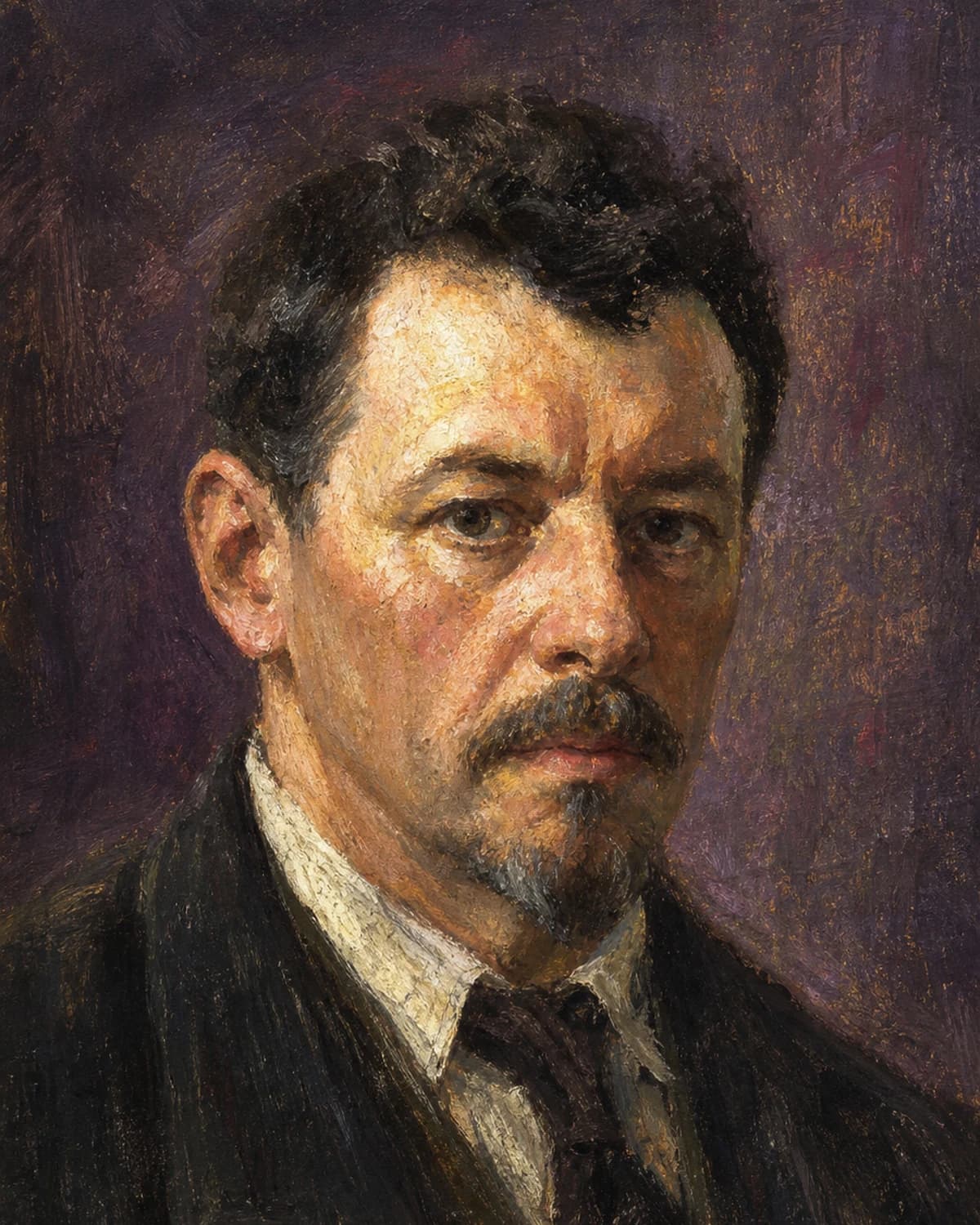
Aleksandr Drevin (1889–1938) had never seen a painting until he was nineteen and was training to be a sailor. He became one of the Moscow avant-garde: the “Refugee Women” cycle of 1915–1917, abstractions, then Ural and Altai landscapes. From 1920 he ran a studio at Vkhutemas. Arrested on 17 January 1938, he was shot at the Butovo firing range.
Biography
In the mid-1930s Drevin’s debts to the All-Russian Artists’ Cooperative and to the Latvian society Prometheus had reached eleven thousand roubles. The society gave him contracts and money at a time when his colleagues were already picking his work apart at meetings as “formalism”. The same connections later brought disaster on him.
He was born in July 1889 in Wenden (the Latvian name of the town is Cēsis), in the Governorate of Livonia, into the family of a locksmith; sources give the date differently, 3 or 15 July in the new style. His birth name was Aleksandrs Rūdolfs Drēviņš. In 1895 the family moved to Riga, to a factory suburb. He wrote later that the black slag heaps and blank factory walls stayed with him for ever, while in his memory there was the valley of the Gauja, from which he had been taken away. After the Catherine School he entered the preparatory navigation school attached to the Magnushof School of Long-Distance Navigation. In 1906 he was arrested for taking part in the revolutionary events and spent half a year in the Governorate of Smolensk. By his own account he came to painting at nineteen, through a friend at the navigation school: they painted studies from nature without knowing a single artist.
In 1908 Drevin entered the Riga City Art School, to study under Vilhelms Purvītis, and became absorbed in the Impressionists. In 1912 he showed three works at the second exhibition of Latvian artists in Riga, and the Riga Art Museum bought one of them. He finished the school in 1914 and grew close to Jāzeps Grosvalds, who had just come back from Paris; together with Kārlis Johansons, Valdemārs Tone and Konrāds Ubāns they founded the association Green Flower.
The war drove him out of Riga.
In 1915 he arrived in Moscow with his family as a refugee, became a member of the Jack of Diamonds the same year and began the “Refugee Women” series. To my mind the best description of it is the wording of the idea itself: what mattered to him was to convey not a scene of departure but the state of a person with severed roots. His paint here is sharp as a poster. At the same time, as he admitted, until 1917 he scarcely knew any Russian artists and had been formed by the Shchukin collection.
After the revolution he worked in the Latvian National Commissariat and took part in an exhibition of the Latvian Riflemen in the Kremlin, showing “primitives” and non-objective pieces. Then Vladimir Tatlin invited him to the Department of Fine Arts, where Drevin worked until 1920. In 1919 he directed the Museum of Pictorial Culture and exhibited abstract compositions that stood closest to Rayonism. In 1920 he was invited to Vkhutemas, the state art and technical school in Moscow, as a professor, and he ran a studio there until it closed in 1930. In that year he also married the painter Nadezhda Udaltsova; in 1921 their son Andrei was born, later a sculptor. In 1922–1924 Drevin returned to painting from nature: self-portraits of 1923, a portrait of his wife, landscapes near Moscow at Sokolniki by Vlakhernskaya station and at Dmitrov. His works were shown at the First Russian Art Exhibition in Berlin and in Amsterdam; some were bought for foreign collections, among them the Société Anonyme, whose collection has been at the Yale University Art Gallery since 1941. In 1924–1925 he briefly joined AKhRR, the Association of Artists of Revolutionary Russia, and left it, joined the Moscow Painters, and in 1931 took part in the group Thirteen.
With Udaltsova he went on working trips: the Urals, to the River Chusovaya (1926–1928), the Altai and East Kazakhstan (1929–1932), Armenia (1933). The Ural landscapes became more panoramic, with larger skies and a dense layer of paint; in the Altai, by the descriptions, an “extraordinary force of light” was at work, and colour began to overrule perspective. A joint solo exhibition of Drevin and Udaltsova was held at the Russian Museum in 1928.
Then everything narrowed. Vkhutemas was closed and the family grew poor: his pupil Boris Rybchenkov remembered only a work table, a few old chairs and two state-issue easels in the flat. In 1932 the artistic associations were dissolved. In 1933 Drevin’s paintings were removed from the Moscow exhibition “Artists of the RSFSR for Fifteen Years”, and Osip Beskin published an article, “Formalism in Painting”, with sharp attacks on him. At a meeting of the Moscow regional Union of Soviet Artists on 10 March 1936, devoted to the campaign against “formalism” and “naturalism”, Drevin’s works were among the main targets.
He was arrested on 17 January 1938, at the height of the “Latvian Operation”. According to one version, the interrogations went on round the clock and he admitted guilt for sabotage in the fine arts; how true this is, it is hard to check. He was sentenced to be shot “for counter-revolutionary activity”, and on 26 February 1938 he was shot at the Butovo firing range. He was rehabilitated on 30 October 1957 for lack of evidence of a crime.
The paintings survived thanks to Udaltsova: during the search she passed them off as her own. They were first shown again after a long interval in Riga in 1959. A solo exhibition of Drevin was held at the Russian Museum in 1979, and in 2003 the Tretyakov Gallery showed about eighty of his works.
Related context
Associations
Works connected through artistic movements, cultural context and period. Priced works available in this market appear first.








Profile notes
Profile and sources
Image
Artist image
На основе открытого изображения: Aleksandr Drevin; Wikimedia Commons; Public domain.
