
02.11.1866–17.08.1934
Aleksandr Borisov
Aleksandr Borisov (1866–1934), a peasant’s son from Vologda Governorate, learned icon painting on the Solovetsky Islands and painting under Shishkin and Kuindzhi. In 1900–1901 he spent fourteen months on Novaya Zemlya, mapped its bays and turned his studies into large canvases that he showed in Europe and the United States. Later he worked on the economy of the North: railway projects and the Solonikha spa near Krasnoborsk.
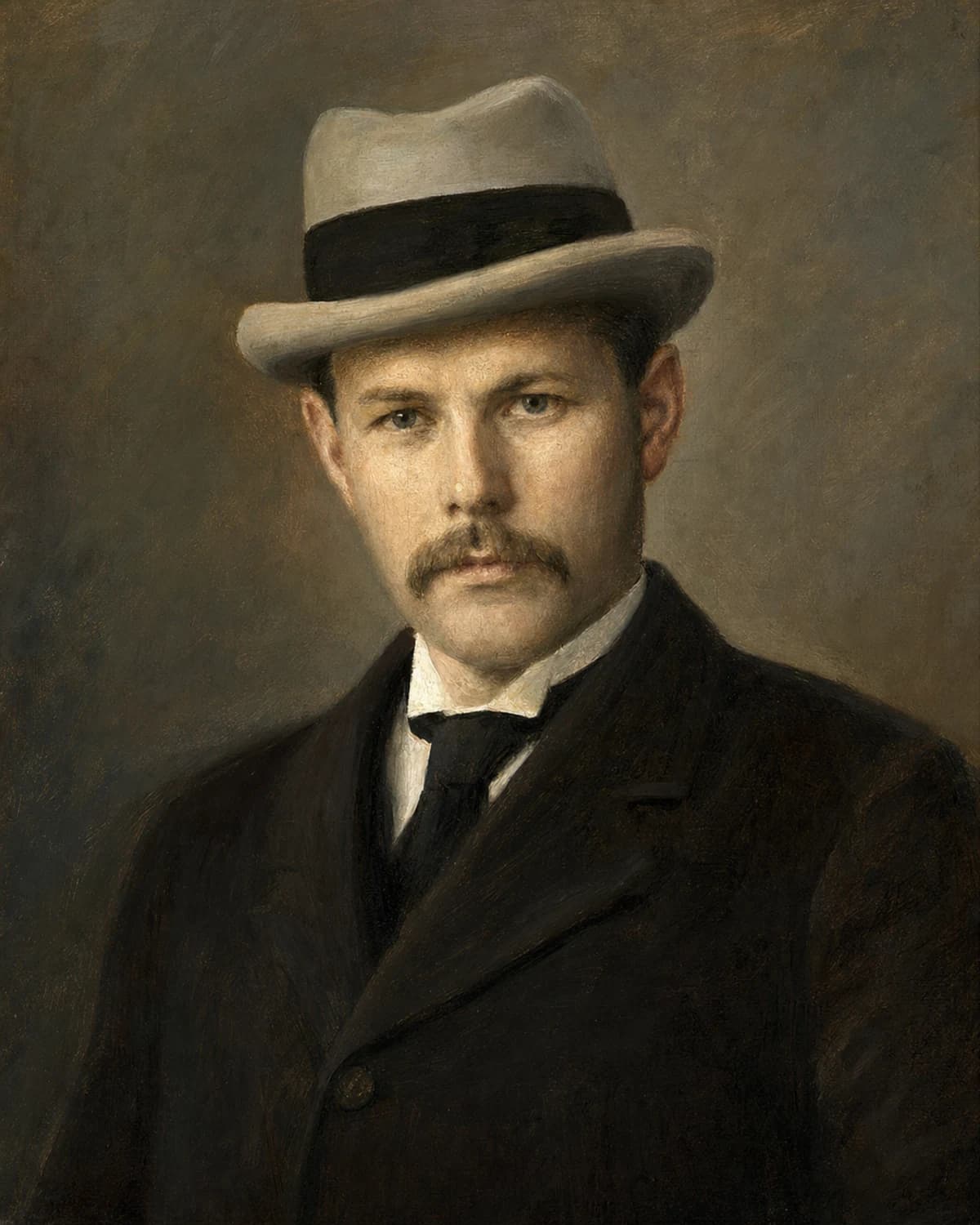
Biography
On the map of Novaya Zemlya there are capes named after Shishkin, Kuindzhi, Kramskoy, Vasnetsov, Vereshchagin and Repin, a Tretyakov Glacier and the Kazi Mountains. They were named by the painter Aleksandr Borisov, who in 1900–1901, with eight companions, surveyed the eastern shore of the Northern Island and the Chekin, Neznayemy and Medvezhy bays.
He reached the Academy of Arts by way of a monastery. Borisov was born on 2 (14) November 1866 in the village of Gluboky Ruchey in Vologda Governorate, into a peasant family. At fifteen he came to the Solovetsky Monastery and worked at a fishing station attached to the Savvatievsky hermitage, then became an apprentice in the icon-painting workshop. The archimandrite, having seen his pencil drawings, took the young man to the main monastery, and there the novice studied drawing and icon painting. His work was shown to visitors to Solovki: Grand Duke Vladimir Alexandrovich, president of the Academy of Arts, and General A. A. Bogolyubov, a collector of paintings. Borisov was granted a stipend, and on 20 September 1886 he arrived in St Petersburg.
He studied at the Academy from 1888 to 1892, won two small silver medals and one large silver medal of encouragement, and from June 1892 received a stipend “as a state peasant”. In the mid-1890s he worked in the studio of Ivan Shishkin, then under Arkhip Kuindzhi. Already then he had decided to devote himself to the Arctic.
In the summer of 1894 Borisov was taken on as draughtsman for Sergei Witte’s tour of the North aboard the steamer “Lomonosov”: he sketched the harbours and bays of the Murman coast. Some of the roughly one hundred and fifty studies he brought back were shown at the Academy exhibition of 1897. Vasnetsov was delighted, Stasov wrote approvingly, and Pavel Tretyakov bought several works. Repin wrote of “the love of this Russian Nansen for the black water of the ocean with its white ice floes”. According to some accounts, in 1896 Borisov again travelled along the coasts of the White and Barents seas and visited Novaya Zemlya with a scientific expedition; the Nenets taught him how to survive on the ice and how to drive a dog sled.
The expedition of 1900 was, it seems, his third and last. Borisov wintered on Novaya Zemlya, kept meteorological records, collected minerals, plants and animals, and mapped the shores, naming capes and inlets after artists, scientists and people who had helped to open up the North. For him its chief result was hundreds of sketches and studies. In 1901 he returned to the mainland and from them painted large pictures, which he showed at the spring exhibitions in St Petersburg in the first half of the 1900s. In 1902, at the invitation of the Vienna artists’ society, he held an exhibition in Vienna, then in Prague, Berlin, Hamburg, Cologne, Düsseldorf, Frankfurt and Paris. The French government bought one of his paintings (now in the Musée d’Orsay) and awarded him the Legion of Honour. In 1907, in London, Fridtjof Nansen visited his exhibition and presented him with the Order of St Olav; the British government gave him the Order of the Bath. Early in 1908 Borisov took his paintings to the United States. There are reports that the exhibition in Washington was held in the White House and that the President received the artist in person; I have not been able to verify these details.
On his return he settled in his home country, in a house of his own near Krasnoborsk.
Now, besides the Arctic, he painted Solovki, the Pechora and the lands along the Northern Dvina; a large exhibition of this work was held in St Petersburg in February 1914. Even earlier Borisov had begun to publish travel sketches: “Among the Samoyeds. From the Pinega to the Kara Sea” (1907), “In the Land of Cold and Death” (1909), “The Great North-Eastern Route. The Great River Route from Siberia to Europe” (1910). In them he wrote about the natural wealth of the region and the plight of its indigenous people, and in his reports he argued that the North needed a railway and canals linking the northern and Siberian rivers. In 1915–1916, together with V. M. Vobly, he drew up a project for the Ob–Murmansk railway and published a book about it. The project was backed by the tsarist government and, after the revolution, by the Council of People’s Commissars, but because of the Civil War construction began only decades later, and without relying on his surveys. In the 1920s and 1930s Borisov took part in planning the Ob–Kotlas–Soroka railway. I think this second life mattered to him no less than painting.
In 1922, on his initiative, the Solonikha spa opened at a salt spring not far from Krasnoborsk, and its first manager was the artist himself.
Aleksandr Borisov died on 17 August 1934 in his house near Krasnoborsk and was buried in the Ust-Evda cemetery. His paintings are in the Tretyakov Gallery, the Russian Museum, the Museum of the Arctic and Antarctic, the museums of Arkhangelsk and Vologda and the Nenets Museum of Local History. In 1973 an unnamed peninsula on the eastern shore of the Northern Island of Novaya Zemlya, between the Chekin and Neznayemy bays that he had once put on the map, was named Borisov Peninsula.
Related context
Associations
Works connected through artistic movements, cultural context and period. Priced works available in this market appear first.








Profile notes
Profile and sources
Image
Artist image
На основе открытого изображения: Unknown; Wikimedia Commons; Public domain.
