
30.08.1866–04.02.1946
Alejandro Christophersen
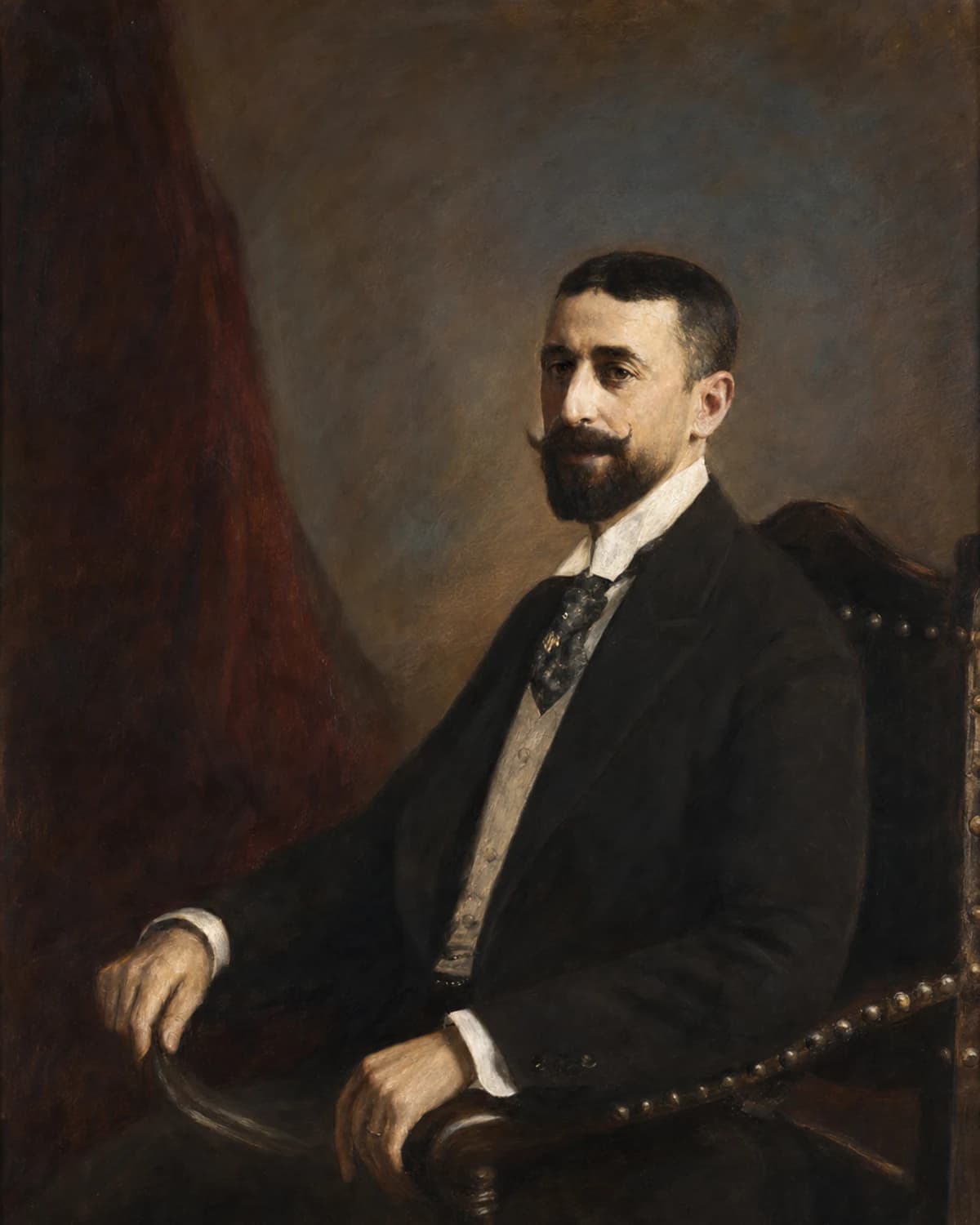
Alejandro Christophersen (1866–1946) was born in Cádiz, the son of a Norwegian consul, studied architecture in Brussels and Paris, and from the late 1880s worked in Buenos Aires. There he built the Anchorena Palace, the Stock Exchange, the Hotel Astoria and the Basilica of Santa Rosa de Lima, taught at the university and painted portraits.
Biography
The palace at 761 Arenales Street was commissioned by the family of Mercedes Castellanos de Anchorena. Building began in 1909, and the architect hoped to finish in time for the centenary of the May Revolution in 1910. He did not make it: the palace opened only in 1916, and the first ball held there was for the centenary of independence. Today it houses Argentina’s Ministry of Foreign Affairs.
The author of the building was Alejandro Christophersen.
He was born on 30 August 1866 in Cádiz. His father, Thorvald Christophersen, was Norway’s consul in Spain; his mother was called Fanny Younger. In 1877 the boy was sent to Norway for his schooling. In 1885 he graduated from the school of architecture and scenography at the Royal Academy of Fine Arts in Brussels, then went to Paris, to the atelier of Pascal in the architecture section of the École des Beaux-Arts. In 1887 he spent a short time in Uruguay and then settled in Buenos Aires; by other accounts, he came to Argentina in 1888.
In his first years he worked in partnership with Carl Kihlberg, an already established architect who had taken part in designing the Casa Rosada. The first commissions came from the Bahía Blanca and North Western Railway through the Hume brothers, engineering contractors, and then from wealthy families who needed town houses. Around 1892 the partnership ended, and Christophersen began an independent practice that lasted almost five decades.
The list of his buildings is long. In 1893–1896 came the Dr Ricardo Gutiérrez Children’s Hospital; in 1893–1895 the building at 902 Avenida de Mayo, now the Hotel Astoria; at about the same time the Unzué house and the façade of the Café Tortoni on the same avenue. In 1898 he built the pantheon of the Spanish Mutual Aid Society in the Chacarita cemetery. He was involved as an architect with the Russian Orthodox Church of the Holy Trinity in Buenos Aires: by one account the design is his (1905), by another the design was by Mikhail Preobrazhensky and Christophersen supervised the work on site (1898–1901). Then came the Leloir residence on Libertad Street (1908; now the Circolo Italiano), the building of the Argentine Association of Actors (1914), the Dassen Palace with a sixty-metre tower for astronomical observation, the third home of the Buenos Aires Stock Exchange on Sarmiento Street (opened in 1916), the Basilica of Santa Rosa de Lima at the corner of Belgrano Avenue and Pasco Street (1926–1934) and the Transradio Building on Corrientes Avenue (1940), built for a company on whose board he sat. He also built outside the capital: branches of the Banco de la Nación in Bahía Blanca, Chacabuco, Dolores and Corrientes, houses and pantheons in Rosario, a house in Montevideo. Some of his buildings have been demolished: the Norwegian Seamen’s Church in Buenos Aires; the Scandinavian Argentine Bank has been altered beyond recognition.
His early work is linked to French Second Empire architecture, his later projects are closer to Rationalism. He is regarded as the central figure of eclectic architecture in Argentina. He was a professor at the School of Architecture of the Faculty of Natural and Exact Sciences at the University of Buenos Aires, took part in founding the school of architecture together with Paul Hary and Joaquín Mariano Belgrano, and in refounding the Central Society of Architects.
In the 1920s he argued with the avant-garde architect Alejandro Virasoro. The dispute was about what should underlie the look of a building: academic decorative ornament, which Christophersen defended, or Rationalism and Art Deco, which were gaining strength.
He painted in oil as well. His portraits of society ladies in an Impressionist manner brought him recognition.
Christophersen died in Buenos Aires on 4 February 1946.
Related context
Associations
Works connected through artistic movements, cultural context and period. Priced works available in this market appear first.








Profile notes
Profile and sources
Image
Artist image
На основе открытого изображения: Unknown author Unknown author; Wikimedia Commons; Public domain.
