
21.05.1471–06.04.1528
Albrecht Dürer
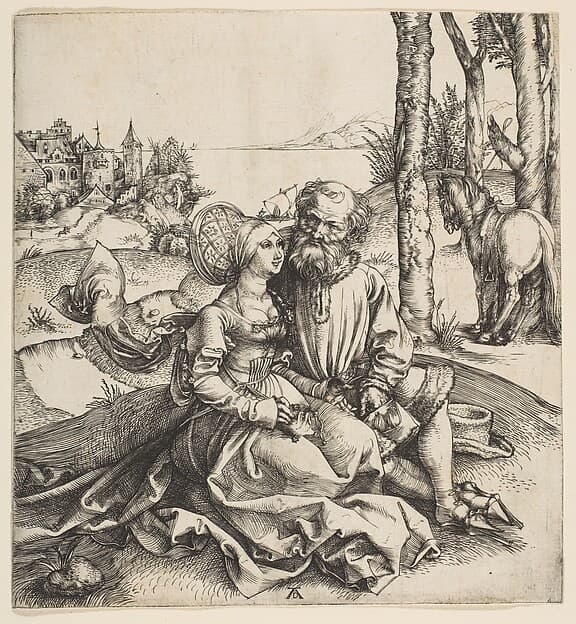
Albrecht Dürer (1471–1528) of Nuremberg painted altarpieces and portraits, but his fame rests above all on his prints: the “Apocalypse”, “Melencolia I”, “Knight, Death and the Devil” and the “Rhinoceros” spread across Europe in his own lifetime. He worked twice in Venice, served Emperor Maximilian I, kept a diary of his journey to the Netherlands and towards the end of his life wrote treatises on geometry, fortification and human proportion.
Biography
The Albertina in Vienna holds a silverpoint drawing: a long-haired boy pointing off to one side. Later its author added in the corner that he had drawn himself from a mirror in 1484, “when I was still a child”. He is thirteen. European art knows almost no childhood self-portraits of this quality.
Dürer was born on 21 May 1471 in Nuremberg. It was a rich free imperial city of the Holy Roman Empire, full of workshops and printing houses (Nuremberg became part of Bavaria only in 1806, so calling Dürer a “Bavarian artist” is inaccurate). His father, Albrecht Dürer the Elder, was a goldsmith who had moved to Nuremberg from the Hungarian village of Ajtós near Gyula. The surname itself is a German translation of the Hungarian “Ajtósi”: ajtó is Hungarian for “door”, and a door would later appear on the family coat of arms. Eighteen children were born in the family, and three survived. Albrecht’s godfather was Anton Koberger, who in the very year of his birth gave up goldsmithing for printing and became the most successful publisher in Germany.
At first the son trained with his father, but in 1486 he was placed in the workshop of the painter Michael Wolgemut. Then, as a journeyman should, he set off on his travels and was away for about four years. He arrived in Colmar in 1492, hoping to work for Martin Schongauer, the finest engraver in Northern Europe, but Schongauer had died shortly before. His brothers took the visitor in, and afterwards Dürer lived in Basel with yet another brother, the goldsmith Georg.
In 1494 he married Agnes Frey and almost at once left for Italy. From Venice he came back with a new understanding of the body and of perspective, and from the road across the Alps he brought watercolour landscapes, to my mind the freest things of his youth. In 1498 the “Apocalypse” came out, a series of large woodcuts, and Dürer published it himself. He did not wait for a patron: he printed the edition and sold it himself, and the prints made his name known far beyond Nuremberg.
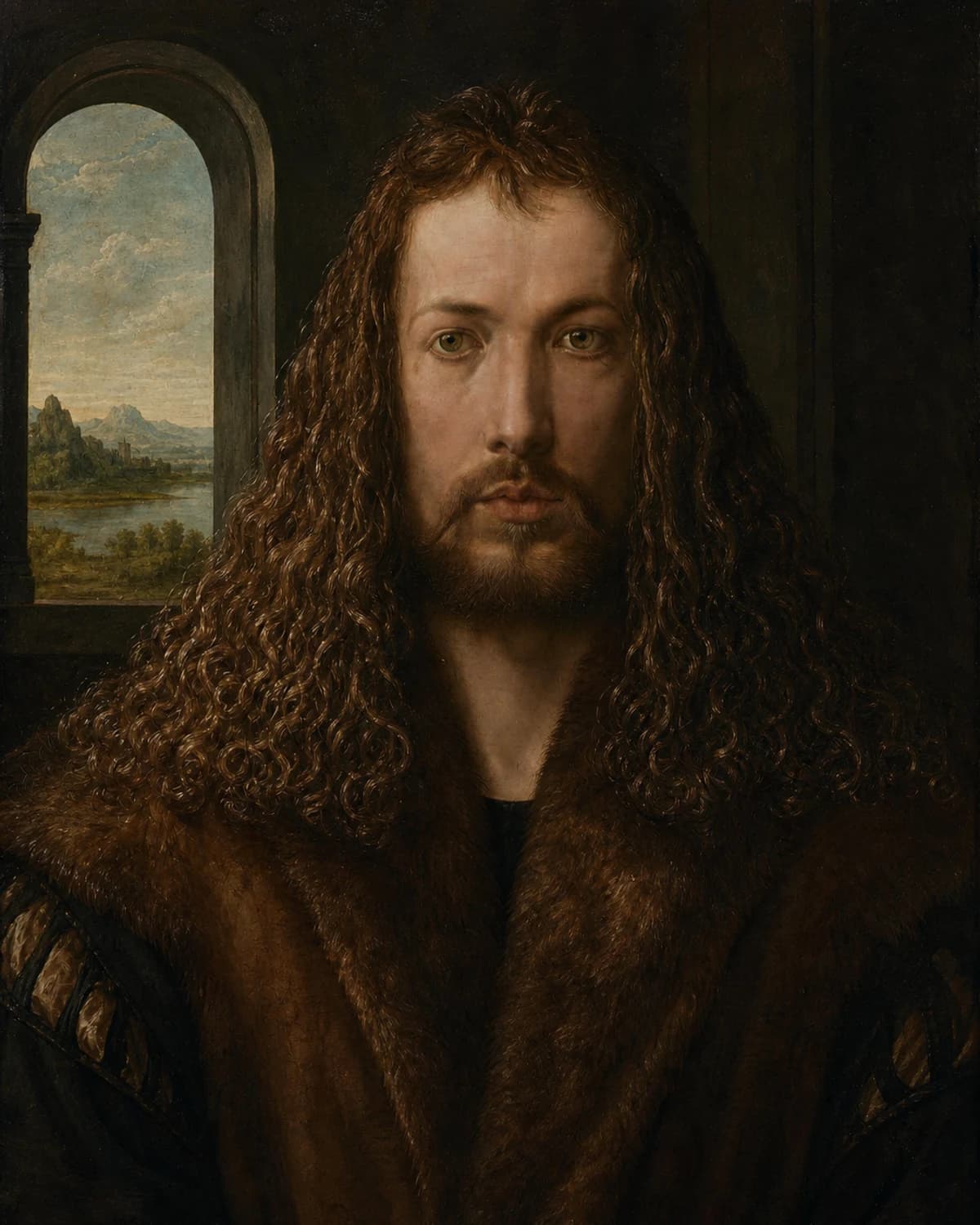
The three painted self-portraits are best looked at in sequence. 1493, the Louvre: a young man holding a prickly sprig of eryngo. 1498, the Prado: the same man, dressed as a fashionable nobleman. 1500, the Alte Pinakothek in Munich: strictly frontal, the hair falling symmetrically, a hand touching the fur collar. The resemblance to the iconography of Christ is obvious and, of course, intended. There is no blasphemy in it; Dürer is saying that the artist’s gift comes from the Creator.
He came to Venice a second time in 1505 and stayed until 1507. German merchants commissioned from him the altarpiece “Feast of the Rose Garlands”, now in the National Gallery in Prague. To his friend the humanist Willibald Pirckheimer, Dürer wrote from Venice that here he was a gentleman and at home a sponger.
“Young Hare” (1502) and “Great Piece of Turf” (1503) I would call studies. The blades of grass, the fur, the window reflected in the hare’s eye are rendered with a naturalist’s attention. The “Rhinoceros” (1515) turned out more comically. Dürer never saw a rhinoceros: the animal was brought to Lisbon, and only a letter and a sketch reached Nuremberg. From these he cut the beast in scaly armour, with an extra horn on its withers. For a very long time Europeans pictured the rhinoceros exactly like that.
The years 1513–1514 produced three engravings usually called the “Master Engravings”: “Knight, Death and the Devil”, “Saint Jerome in His Study” and “Melencolia I”. Erwin Panofsky read them as three kinds of virtue, moral, theological and intellectual, and that reading is still the most influential, though not the only one. “Melencolia” is argued over most of all. A winged figure sits among a pair of compasses, scales, an hourglass and a strange polyhedron, and on the wall hangs a magic square whose bottom row hides the date, 1514. The anguish of the creative mind, or the limit of human knowledge? Every scholar answers in their own way.
Emperor Maximilian I drew Dürer into his enormous print projects such as the “Triumphal Arch” and granted him an annual pension. In 1519 the emperor died, the pension had to be confirmed by Charles V, and in 1520–1521 Dürer travelled to the Netherlands. His diary of that journey reads like an account book crossed with travel notes: how much he paid, what he gave to whom, whom he dined with. And suddenly, in the middle of it all, an ecstatic entry about golden objects sent from Mexico. The skill of craftsmen unknown to him overwhelmed him.
His last years went into theory. The “Instruction in Measurement” (1525) is a geometry textbook for artists and craftsmen; then came a treatise on the fortification of towns (1527) and the “Four Books on Human Proportion”, published after the author’s death, in 1528. Dürer wanted to give German masters what the Italians had long had. In 1526 he presented the Nuremberg council with the two panels of the “Four Apostles”, and many see in those heavy, stern figures his response to the religious disputes of the Reformation.
He died in Nuremberg on 6 April 1528 and was buried in St John’s Cemetery. His monogram, a large “A” with a “D” set under its crossbar, was forged even in his lifetime, and he sought to stop copyists from putting his mark on their sheets.
Artist works
Works by the artist
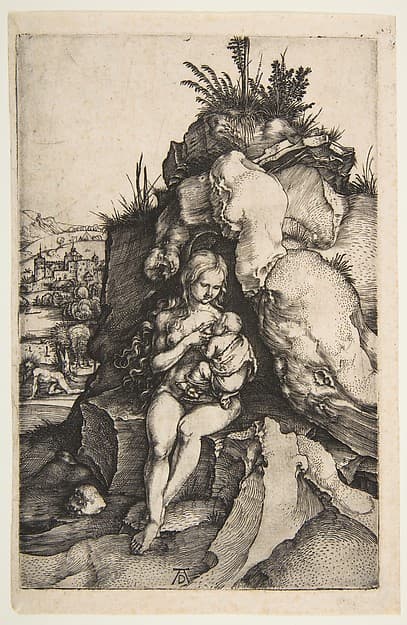
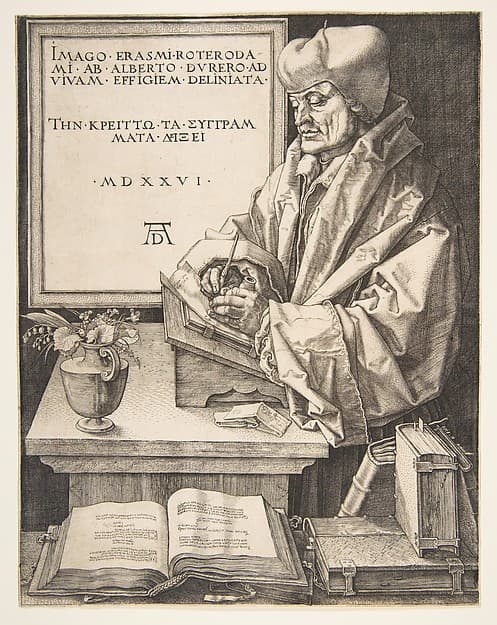
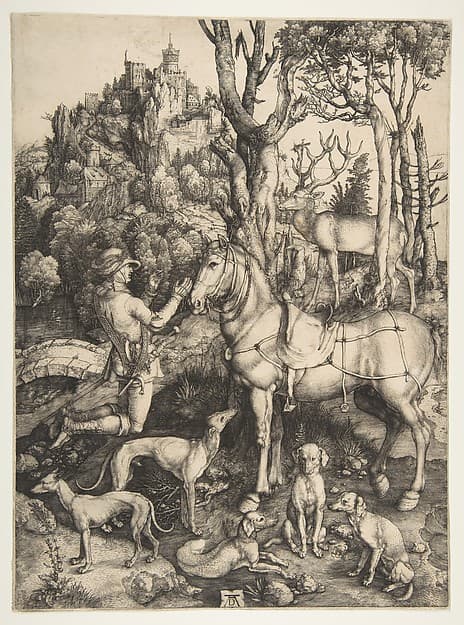
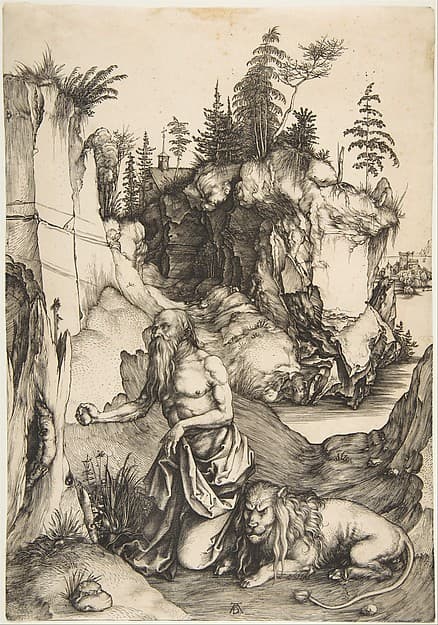
Works by Albrecht Dürer available in this edition of NEOARCA.
Related context
Associations
Works connected through artistic movements, cultural context and period. Priced works available in this market appear first.
Profile notes
Profile and sources
Image
Artist image
На основе открытого изображения: Albrecht Dürer; Wikimedia Commons; Public domain.
