
10.10.1901–11.01.1966
Alberto Giacometti
In 1938–1944 Alberto Giacometti’s sculptures never grew taller than seven centimetres: that was how the model looked from the distance at which he stood. After the war he stretched his figures into thin bronze silhouettes, and in 1962 he won the grand prize for sculpture at the Venice Biennale. He lived in Paris, in a studio in Montparnasse that he moved into in 1926.
Biography
In 1938–1944 Giacometti’s sculptures did not exceed seven centimetres. He explained it himself: he wanted to make from memory what he had seen, and, to his terror, the figures kept getting smaller. Their size matched the distance between him and the model.
He was born on 10 October 1901 in Borgonovo, in the municipality of Stampa in Switzerland. He was the eldest of four children in the family of the painter Giovanni Giacometti. His brothers Diego and Bruno also became artists and architects; Diego later shared his Paris studio with him for many years and often posed for him. His interest in art showed early: as a child he modelled and drew, and his father and godfather encouraged him. In 1919–1920 he studied in Geneva, at the School of Fine Arts and the School of Arts and Crafts, in the sculpture class. In 1920 and 1921 he travelled in Italy and became acquainted with classical art and the monuments of ancient Rome.
From 1922 he lived mainly in Paris, but regularly returned to Borgonovo to see his family. Until 1925 he studied under Antoine Bourdelle at the Grande Chaumière studio. In 1926 he moved into a plain studio on the rue Hippolyte-Maindron in Montparnasse; it served as his home as well, and he never wanted to leave it. His early pieces are realistic; then came the influence of Cubism (“Torso”, 1925) and an interest in the art of Africa and Oceania (“Spoon Woman”, 1926). His circle was wide: Miró, Max Ernst, Picasso, and later Jean-Paul Sartre, Samuel Beckett and Jean Genet.
From 1929 or 1930 (sources differ) he grew close to André Breton and the Surrealists and for several years took an active part in the group. The works of this time he himself called “objects of symbolic function”: “Hour of Traces, or The Suspended Ball” (1930–1931), “Cage” (1930), “Woman with Her Throat Cut” (1932), “Surrealist Table” (1933). His first solo exhibition took place in 1932.
In 1935 he was expelled from the group. He himself called this direction in his work “a complete dead end”.
He then returned to working from life. By his own account the task seemed to him a matter of two weeks: to study the structure of a head and a figure, and then go back to his compositions. He worked with a model from 1935 to 1940, and nothing turned out as he had imagined: the head became for him an object unknown and without dimensions. He modelled heads, concentrating on the sitter’s gaze, and chose people close to him: his sister and the artist Isabel Rawsthorne. The figures stretched, and the sculptures grew as thin as nails. A friend said that if Giacometti decided to sculpt you, your head would look like the blade of a knife.
He spent the war in Switzerland, in Geneva. There in 1946 he met Annette Arm, who worked for the Red Cross; they married on 19 July 1949, and Annette became his main model for the rest of his life. After the marriage the figures began to grow, but the taller they became, the thinner. This is how “Walking Man” (1947), “Three Men Walking” (1949), “Portrait of Annette” (around 1950) and “Bust of Diego” (1954) came about. Painting makes up a smaller part of his legacy, but after 1957 his figurative paintings, almost monochrome, stood alongside the sculptures. The Metropolitan Museum of Art notes that he rarely strayed from three subjects: the walking man, the standing nude woman and the bust. Francis Ponge wrote an article on his statuettes and figures, published in the “Cahiers d’Art” in 1951. Sartre and Genet saw him as an existentialist artist. To my mind, that reading is better tested against the works themselves than against the inspired quotations of critics.
In 1958 he was commissioned to make a monumental sculpture for the Chase Manhattan Bank building in New York, that is, a large work for a public square. He had never been to New York and had never seen a skyscraper. The result was four standing women, “Grande femme debout I–IV” (1960), his largest sculptures. The commission was never completed: the artist was not satisfied with the relationship between the sculpture and the site, and abandoned the project.
In 1962 he was awarded the grand prize for sculpture at the Venice Biennale, and worldwide fame followed. He still reworked his models, destroying them or setting them aside for years. In 1965 he travelled to New York for an exhibition at the Museum of Modern Art. His last work was the text for the book “Paris sans fin”: 150 lithographs containing memories of the places where he had lived.
Giacometti died on 11 January 1966 at the cantonal hospital in Chur. He was buried in Borgonovo, near his parents. He had no children; Annette became his heir, and after her death in 1993 the French state established the Fondation Alberto et Annette Giacometti.
Related context
Associations
Works connected through artistic movements, cultural context and period. Priced works available in this market appear first.








Profile notes
Profile and sources
Image
Artist image
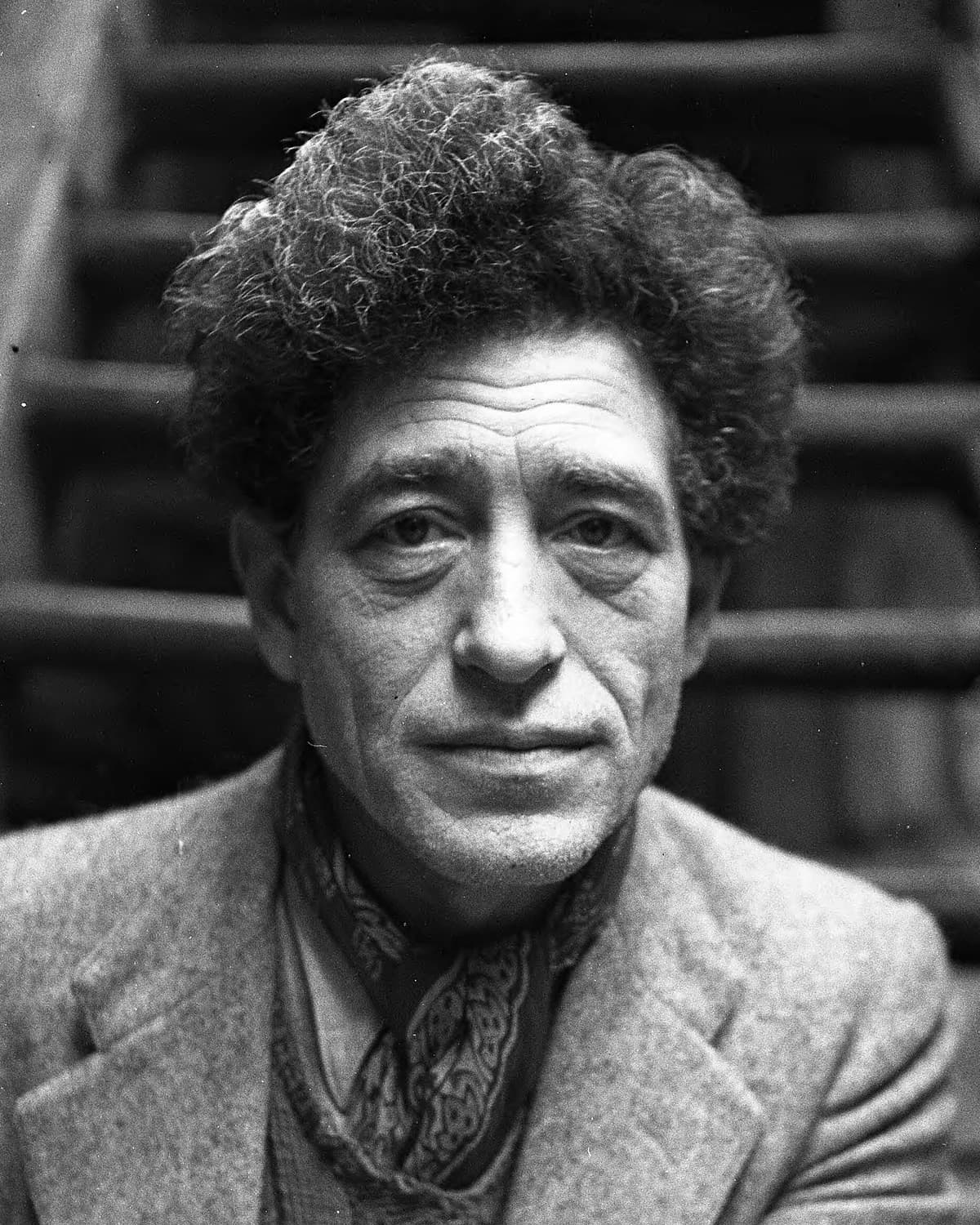
Emmy Andriesse; Wikimedia Commons; Public domain.
