
14.03.1852–16.05.1936
Albert Nikolayevitch Benois
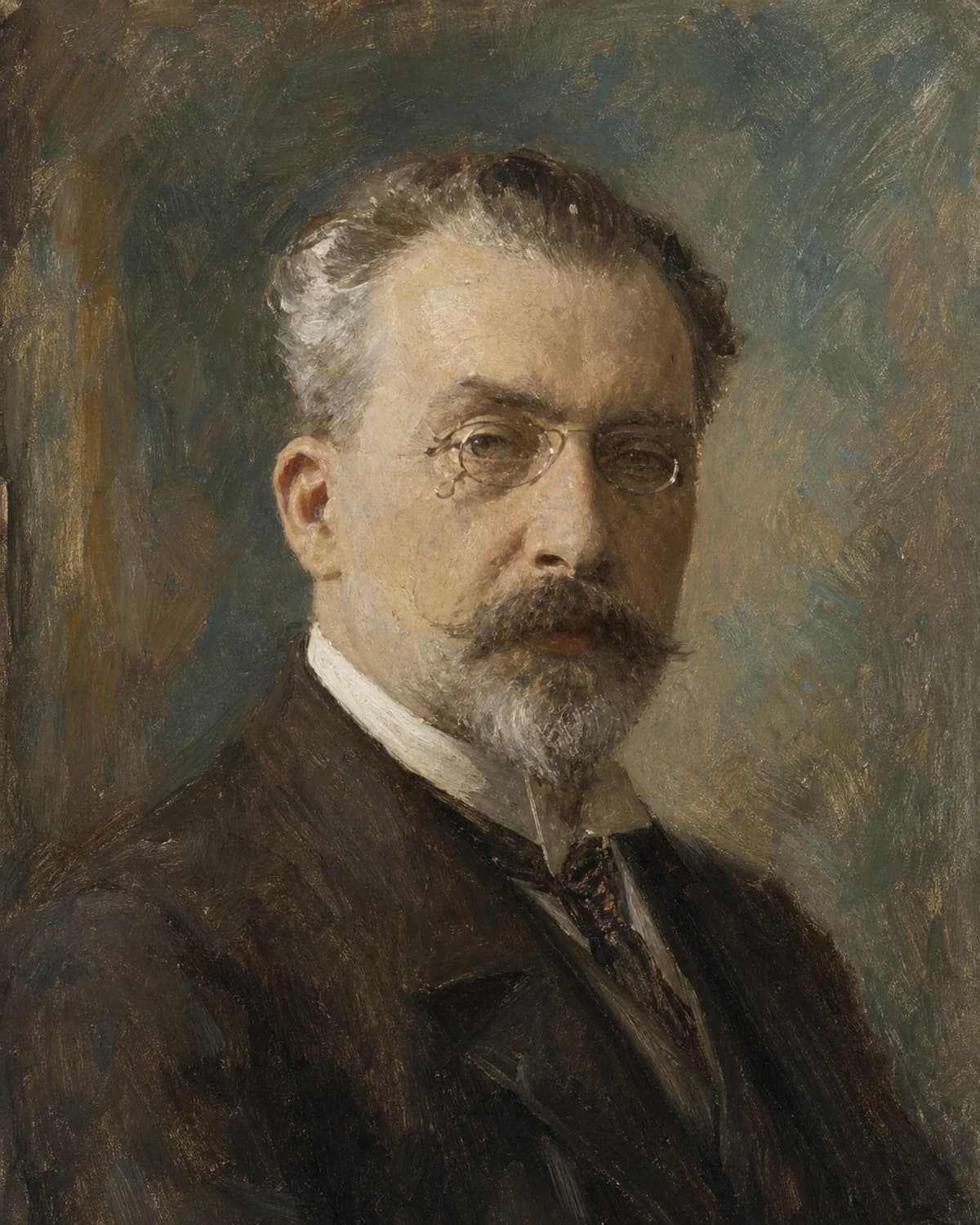
Albert Benois (1852–1936), elder brother of Alexandre and Leonty Benois, graduated from the Academy of Arts as an architect but devoted himself to watercolour. He was a founder of the Society of Russian Watercolourists, an academician and a teacher of watercolour at the Academy, and served as a curator of the Russian Museum. He travelled from Spain and North Africa to Japan and Korea, and in 1924 joined his daughter in Paris, where he died.
Biography
In the summer of 1883, at the invitation of Alexander III, Albert Benois sailed with the imperial family through the Finnish skerries aboard the yacht “Tsarevna”. He was thirty-one; he had received his architect’s diploma six years earlier, and since then he had been working in watercolour.
Architecture ran in the family. Albert was born on 14 (26) March 1852 in St Petersburg, the eldest son of the architect Nikolai Leontievich Benois; his mother, Camilla Albertovna, née Cavos, was the daughter of Alberto Cavos, the builder of the Mariinsky Theatre. Of his younger brothers, Leonty became an architect and Alexandre a painter and stage designer, and Zinaida Serebriakova was his niece. In 1871 he graduated from the Fifth St Petersburg Gymnasium.
That same year Benois entered the architecture department of the Academy of Arts and at the same time studied watercolour with Luigi Premazzi. In 1876 he received a large medal of encouragement and the small gold medal for his programme “Design for a University”, and in 1877 he graduated as a class artist-architect of the first degree. While still a student, in 1875–1876, he designed a dacha for Ts. A. Cavos in Peterhof. After graduating he took up watercolour. In 1880, together with like-minded colleagues, he founded the Circle of Russian Watercolourists, from 1887 a Society, where he sat on the board for ten years and remained an honorary member until 1918.
In 1883–1885 he travelled through Italy, France and Spain to perfect his technique, and in 1884 he was made an academician for the watercolours “Balye” and “The Town of Sanremo”, among others. On his return he began teaching watercolour at the Academy and at its Higher Art School. From 1894 he was a full member of the Academy and, until 1905, a member of its Council. In 1895 he was appointed a curator of the Russian Museum of Emperor Alexander III, and from 1897 he also served as inspector for artistic matters at the Department of Trade and Manufactures.
He travelled widely. In the 1890s to the 1910s he painted the coast of the Gulf of Finland, the Caucasus, the Volga region, the Crimea (including Simeiz), North Africa and the Mediterranean, Siberia, Manchuria, China, Japan and Korea. A large series is devoted to St Petersburg and its suburbs. He held solo exhibitions in St Petersburg in 1903, 1909 and 1915 and in Kiev in 1904 and 1909. I must admit that less is known about the watercolours themselves than about his posts and journeys: the titles are mostly topographical, and they show where he went rather than how he painted.
In February 1891 he married for the second time; his bride was Maria Shpak, a painter and pianist who had studied at the Drawing School of the Society for the Encouragement of the Arts alongside Léon Bakst. The marriage lasted four months: she died that same year in Puumala, in Finland. In 1896 Benois gave her self-portrait of 1890 to the Tretyakov Gallery.
After the revolution he stayed in Petrograd. In 1918 he was appointed head of the Museum of Applied Art under the Commissariat of Trade and Industry, and he took part in setting up the Museum of Nature of the Northern Shore of the Neva Bay.
In 1924 Benois left for Paris at the call of his elder daughter, the opera singer Maria Tcherepnina, wife of the composer Nikolai Tcherepnin, and stayed in France. According to some accounts, he gave his works to charitable societies that helped Russian émigré artists. In his last years his daughter and son-in-law looked after him. The composer and pianist Alexander Tcherepnin was Albert Benois’s grandson.
Albert Benois died on 16 May 1936 in a nursing home near Paris, at Fontenay-aux-Roses, and was buried in the suburb of Issy-les-Moulineaux. His watercolours are in the Russian Museum and the Tretyakov Gallery.
Related context
Associations
Works connected through artistic movements, cultural context and period. Priced works available in this market appear first.








Profile notes
Profile and sources
Image
Artist image
На основе открытого изображения: Брокгауз, Ф.A.; Wikimedia Commons; Public domain.
