
28.07.1902–08.08.1959
Albert Namatjira
Albert Namatjira (1902–1959), a Western Arrernte artist from the Lutheran mission of Hermannsburg in Central Australia, painted the MacDonnell Ranges, gorges and white-trunked ghost gums in watercolour. His 1938 exhibition in Melbourne marked the beginning of the Hermannsburg school of watercolour. In 1957 he became the first Aboriginal person in the Northern Territory to receive full citizenship rights, and soon afterwards he found himself in court.
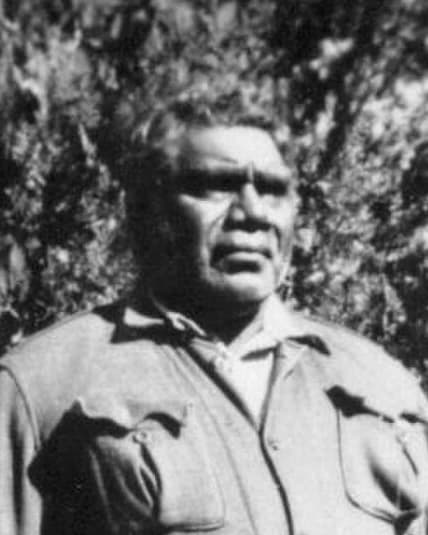
Biography
In the winter of 1936 the painter Rex Battarbee came back to the Hermannsburg mission: he wanted to paint the landscapes of Central Australia. His guide and camel driver was a local man of thirty-four, who showed him the best views and asked him to teach him to paint. That is how Albert Namatjira took up watercolour in earnest. Two years later his first solo exhibition, in Melbourne, sold out completely.
He was born on 28 July 1902 at the Lutheran mission of Hermannsburg (Ntaria), a little over a hundred kilometres west of Alice Springs. The family belonged to the Western Arrernte. At birth the boy was called Elea; when his parents became Christians he was baptised Albert. He went to the mission school and lived in a dormitory, apart from his parents, and at thirteen he went out into the bush, where he was initiated and became a member of the Arrernte community; later he would be one of its elders.
At eighteen he married Ilkalita, a Kukatja woman, who took the name Rubina at her baptism. The marriage broke Arrernte kinship rules, and in 1928 he was cast out of the community for several years. He spent that time as a camel driver and travelled over much of Central Australia, the very country he would later paint. He also worked as a blacksmith, a carpenter and a stockman on the mission and on the stations round about.
He first saw Western painting in 1933, at a charity exhibition that the sisters Violet and Una Teague organised to raise money for a water supply for Hermannsburg. He evidently held Violet Teague in high regard: he named a daughter after her. In 1934 Rex Battarbee and John Gardner exhibited at the mission, and then came the trips with Battarbee. Namatjira’s early works are quite unlike the ones that made him famous: designs from the sacred tjurunga objects, biblical subjects, figures, carving and painting on wood.
In 1937 the mission superintendent, Friedrich Albrecht, took ten of his watercolours to a Lutheran conference at Nuriootpa, and Battarbee showed three works at the Royal South Australian Society of Arts in Adelaide. After Melbourne in 1938, his exhibitions in Sydney and Adelaide sold just as quickly. In 1944 he was included in “Who’s Who in Australia”. In 1953 he received Elizabeth II’s Coronation Medal, and in 1954 he met the Queen in Canberra. In 1956 William Dargie’s portrait of Namatjira won the Archibald Prize; no portrait of an Aboriginal person had won it before. Reproductions of his watercolours hung at that time in a great many Australian homes. Even so, Hal Missingham, director of the Art Gallery of New South Wales, at first refused to take his work, saying he would come back to it when it was up to standard.
How did he paint? “Central Australian Landscape” of 1936 shows soft green hills; “Ajantzi Waterhole” (1937) is painted close up, with the reflection in the water; in “Red Bluff” (1938) red rocks stand against green trees. In the background he almost always has the sharp geology of the range, in the foreground plants: prickly scrub and old white-trunked ghost gums, which he painted in such detail that they were called portraits rather than landscapes. The best-known example is “Ghost Gum, Glen Helen” (about 1945–1949). His colours are close to the ochre with which his ancestors depicted the same land. The horizon is high; motifs repeat like a pattern. Soon after his death some critics declared this style a product of assimilation, but that view was abandoned long ago. Today his landscapes are read differently. His father’s country lay around Mount Sonder and Glen Helen Gorge, his mother’s in Palm Valley, and these are precisely the places he painted again and again. To my mind this reading is the more convincing: a man who knew from song and ceremony what this land “contains” painted it as its owner, not as a tourist with a paintbox.
Money brought him more than freedom.
By Arrernte custom everything must be shared, and at one point he alone was supporting more than six hundred relatives. He was granted a lease on a cattle station for his family, and then the lease was withdrawn; the plot for a house in Alice Springs that he was sold turned out to lie on a flood plain and was no good for building. The family settled in shacks in the dry creek bed at Morris Soak. The story got into the newspapers.
In 1957 Namatjira and his wife became the first Aboriginal people in the Northern Territory to receive the full rights of citizens: to vote, to own land, to move about freely, to buy alcohol. These rights did not extend to their children or other relatives. When a woman was killed at Morris Soak, the inquest blamed Namatjira for the alcohol in the camp. He was charged with leaving a bottle of rum on the seat of a car where a clansman of his, the artist Henoch Raberaba, could take it, and was sentenced to six months in prison. The Supreme Court of the Northern Territory cut the term to three months, and the High Court of Australia refused leave to appeal. After a wave of protest in Australia and abroad, the minister Paul Hasluck directed that he serve his sentence on the Papunya reserve; he was released after two months.
He stayed on at Papunya with Rubina. When he was already in hospital in Alice Springs, he gave Battarbee three landscapes and promised him more. Namatjira died in Alice Springs on 8 August 1959. In all he painted about two thousand pictures.
The rights to his work also went a long way after his death: he had sold part of them in his lifetime in return for royalties, and the rest were sold by the Public Trustee in 1983, contrary to his will, which left everything to his widow and children. In October 2017 the rights returned to the family’s Albert Namatjira Trust. His great-grandson Vincent Namatjira, also an artist, won the Archibald Prize himself in 2020. In 2012 the electoral division around Alice Springs was renamed Namatjira.
Related context
Associations
Works connected through artistic movements, cultural context and period. Priced works available in this market appear first.








Profile notes
Profile and sources
Image
Artist image
Poyt448 Joan Woodard; Wikimedia Commons; Public domain.
