
1974–present
Aïda Muluneh
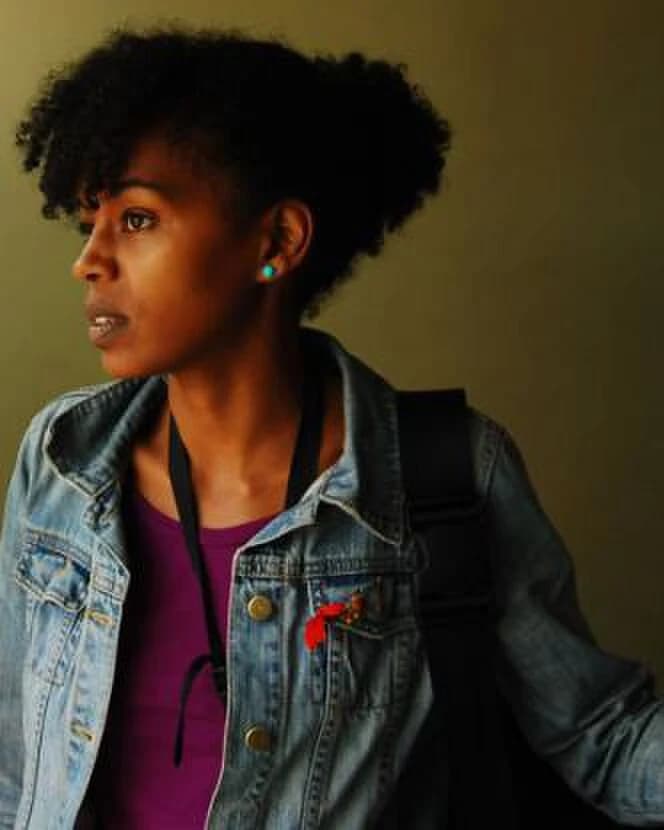
Aïda Muluneh, a photographer from Addis Ababa (born 1974), grew up in Canada, studied at Howard University and worked as a photojournalist for “The Washington Post”. Her staged pictures of bodies painted blue, white and red have been shown at the Museum of Modern Art in New York and Tate Modern in London. In Addis Ababa she founded a photography festival and an organisation devoted to photographic education.
Biography
A woman stands against a white background, her skin painted a bright sky blue. A trail of white dots runs down her face, neck and chest. On her head is a canary-yellow scarf that falls over her chest, and she wears a long red dress. The photograph is called “The Past, the Present and the Future”: a single figure is meant to hold three ages of a woman. It belongs to the series “The World is 9”, with which Aïda Muluneh opened her first solo exhibition in 2016, at David Krut Projects in New York. The title comes from the artist’s grandmother, who used to say that the world is a nine: it is never complete and never perfect. The series consists of twenty-eight works, some of the pictures were taken at Legehar station in Addis Ababa, and the same year a book of the same name came out in Johannesburg with a text by the poet Lemn Sissay.
Muluneh was born in 1974 in Addis Ababa. Her childhood was spent on the move (Cyprus, Greece, Britain, Yemen), and in 1985 she ended up in Canada. At high school in Alberta an art teacher opened an abandoned darkroom to his students and gave her a camera; that was how photography began for her, although she did not yet think of it as a profession. In 2000 Muluneh graduated from Howard University in Washington in film, radio and television, and became a photojournalist at “The Washington Post”. One of her first exhibitions was also connected with Washington: in 2003 her work was shown at the Smithsonian’s National Museum of African Art in the exhibition “Ethiopian Passages: Dialogues in the Diaspora”, and it is now in that museum’s collection.
Afterwards she went back to Ethiopia and stayed on to work in Addis Ababa.
In 2007 she received the European Union Prize at the African Photography Encounters in Bamako, in 2009 her book “Ethiopia: Past/Forward” was published in Brussels, and in 2010 came the award of the Italian Centre for Research and Archiving of Photography (CRAF) in Spilimbergo. Since 2010, every two years in December, she has run Addis Foto Fest in Addis Ababa: exhibitions, portfolio reviews, workshops for beginning photographers. Alongside it works her non-profit organisation DESTA (Developing and Educating Societies Through the Arts), which deals with photographic education and exchanges.
Muluneh builds her pictures like a film set. By her own account everything starts with a sketch, and the character, set, lighting and costume are put together as in a film production. The colours are primaries, a dense red, blue and yellow, and they are linked to the wall paintings of Ethiopian churches. The painting of face and body refers to traditions of body ornament in Ethiopia and beyond. Almost always there is a woman in the frame. I think this is where the recognisability of these pictures comes from: they read from a distance, like a poster, yet one can look at them for a long time.
In the series “99” a young woman is covered entirely in white make-up, with only her hands dark red. This make-up has been compared to the white clay with which young Xhosa men cover themselves after their initiation rite, and writers speak of a theme of transition and transformation. Such a reading is hard to verify, and the series itself explains nothing.
In 2018, together with the charity WaterAid and the H&M Foundation, she made the series “Water Life”: twelve photographs taken in Dallol, in the hot northern region of Afar, about women who have to walk a long way for clean water. The series was shown at David Krut Projects, then at the Women Deliver conference in Vancouver in 2019 and at Somerset House in London. In that same year, 2018, her work appeared in the exhibition “Being: New Photography” at the Museum of Modern Art in New York, and the park of the Aga Khan Museum in Toronto hosted her exhibition “Reflections of Hope”.
When the World Food Programme received the Nobel Peace Prize in 2020, Muluneh made a series for the Nobel exhibition about hunger, which has been used as a weapon of war throughout history. In the same year the Royal Photographic Society gave her its award for photographic curatorship. In 2023 her pictures were included in the exhibition “A World in Common: Contemporary African Photography” at Tate Modern in London.
Profile notes
Profile and sources
Image
Artist image
Africultures, auteur non mentionné, contenu sous licence CC-BY-SA sauf mention spécifique (ce qui n'est pas le cas); Wikimedia Commons; CC BY-SA 3.0.
