
22.09.1932–10.04.2012
Afewerk Tekle
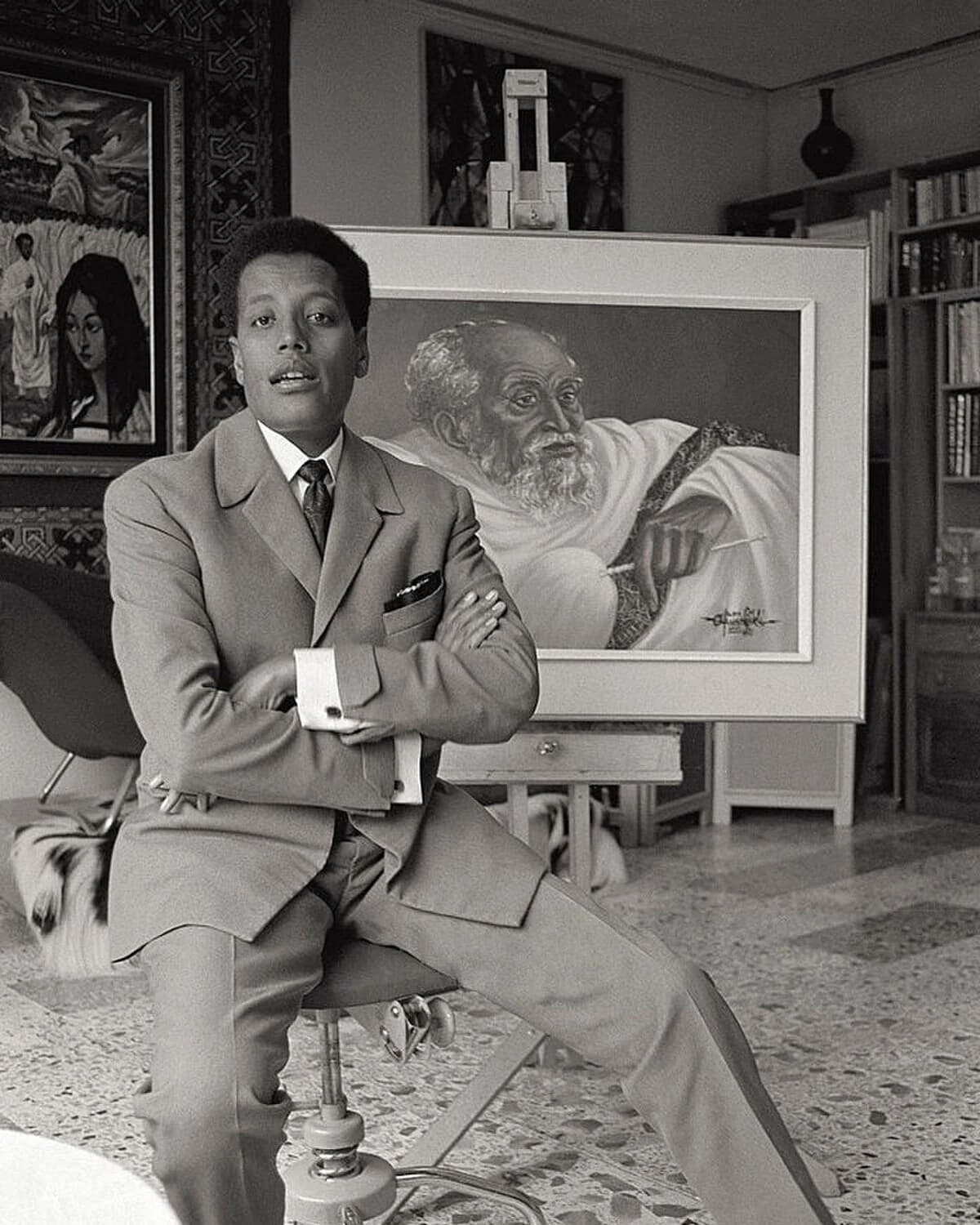
Afewerk Tekle (1932–2012) studied in London, at the Central School of Arts and Crafts and the Slade, and on returning to Ethiopia worked above all as a monumental artist: the stained glass of Africa Hall in Addis Ababa, the murals and mosaics of St George’s Cathedral, the monument to Ras Makonnen in Harar. In 1981 his self-portrait became the first work by an African artist to enter the Uffizi collection.
Biography
In 1947, before they left to study abroad, a group of Ethiopian students was received by Emperor Haile Selassie. Afewerk Tekle remembered his charge: on their return they were not to tell what tall buildings and wide streets they had seen in Europe, but to bring back the knowledge and skill to rebuild Ethiopia. The young man was going to England to study mining engineering.
He was born on 22 September 1932 in Ankober, in the province of Shewa, into an Amhara family, and his childhood fell in the years of the Italian occupation. He began drawing early, and as a boy painted several walls in his home town. At Leighton Park, an English boarding school, his teachers noticed his gift and persuaded him to give up engineering. He entered the Central School of Arts and Crafts in London and then the Slade School of Fine Art at the University of London, where he studied painting, sculpture and architecture.
At home the graduate was offered a post in a ministry. He turned it down and travelled through the provinces to get to know better the country he meant to paint. It seems to me that this was his own way of carrying out the emperor’s charge. In 1954 his first solo exhibition was held at the Municipality Hall in Addis Ababa; with the proceeds he spent two years travelling in Europe, learning to make stained glass and studying Ethiopian illuminated manuscripts in the British Library, the Bibliothèque nationale in Paris and the Vatican Library. On his return he set up a studio in the National Library of Ethiopia. Government commissions followed: murals and mosaics for St George’s Cathedral in Addis Ababa, designs for postage stamps, statues of famous Ethiopians. Of the statues only the monumental figure of Ras Makonnen in Harar was completed. In 1959 he made an altar cross for the Royal Chapel in the Tower of London.
His best-known work, the stained glass “Total Liberation of Africa”, is in Africa Hall, the building of the United Nations Economic Commission for Africa in Addis Ababa. Its three windows, 150 square metres in all, tell of the sorrow of Africa’s past, the struggle of its present and the hope for its future.
In 1961 a large retrospective in Addis Ababa opened the way to international exhibitions for the painting “Maskal Flower”: it was shown in the USSR, the United States and Senegal. Tekle could now travel across Africa, where many countries were only just emerging from colonial rule, and the theme of liberation and independence entered his painting for a long time. This produced “Backbones of African Civilization”, “African Unity”, “Tribute to Patrice Lumumba” (1960) and a portrait of Kwame Nkrumah (1963). In 1964 he became the first laureate of the Haile Selassie I Prize for Fine Arts. Then came an exhibition in Moscow and lectures across the Soviet Union; the American government responded with an invitation to hold solo exhibitions in Washington and New York and to lecture at universities. After that came Senegal, Turkey, Zaire, the United Arab Republic, Bulgaria, Munich, Kenya and Algeria. In 1965, at the First Festival of Negro Arts, he received the Senegalese Order of Merit.
In the 1970s he painted murals and laid mosaics in public and church buildings all over Ethiopia. In the cathedral at Adigrat in Tigray he painted “The Last Judgement”, and at Debre Zeyit the mural “The Victory of Ethiopia”. His “Unity Triptych” won the gold medal at the International Festival in Algiers in 1977.
The early 1980s brought a second exhibition in Moscow and one in Bonn. In 1983 Tekle became the first African artist to be made an honorary member of the USSR Academy of Arts, and from 1992 he was an honorary member of the Russian Academy of Arts. In 1997, at the Biennale of Aquitaine, he won first prize in the international competition for a stained-glass study, “The Chalice and the Cross in the Life of the African People”, and was admitted to the French International Academy of Arts.
Afewerk Tekle died in Addis Ababa on 10 April 2012. His funeral was arranged by a national committee, and he was buried in the cemetery of Holy Trinity Cathedral in Addis Ababa.
Profile notes
Profile and sources
Image
Artist image
Unknown (Mondadori Publishers); Wikimedia Commons; Public domain.
