
20.10.1620–15.11.1691
Aelbert Cuyp
Aelbert Cuyp of Dordrecht painted golden river views, herds at sunset and horsemen against a low sun. He was active for about two decades, from 1639 to 1660, and after his marriage almost gave up painting for church and civic offices. His name is borne by a market in the Pijp district of Amsterdam.
Biography
Aelbert Cuyp’s face is unknown. The engravings in old art books are partly invented and partly derived from a portrait of an unidentified man by Johannes Verspronck, which was once taken for a portrait of Cuyp by Frans Hals. The “self-portrait in youth” in the Museum Bredius turned out not to be one either: the clothes in it belong to the middle of the seventeenth century, when Cuyp was already past thirty, and it was not painted by him.
He was born on 20 October 1620 in Dordrecht (this date seems to be that of his baptism). He was the only child of the portraitist Jacob Gerritszoon Cuyp. His grandfather and uncle designed church stained glass. His father probably taught him to paint, and in the early 1640s they carried out commissions together: Jacob painted the portraits, Aelbert added the landscape backgrounds. He lived and worked for most of his life in the house “Huis Samson” on the Wijnstraat.
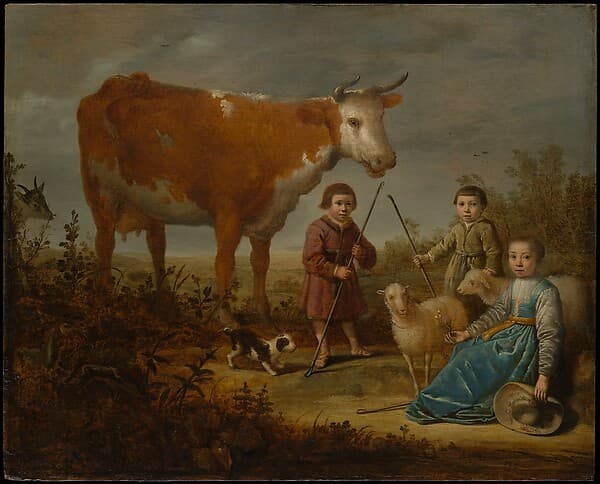
His early pictures, small in format, show views of his native Holland with figures and animals, in ochre and greenish-brown tones. The influence of Jan van Goyen is visible in them, although there are no documents showing that he studied with him. Cuyp also took up biblical and mythological subjects, still lifes and portraits, in which an echo of Rembrandt is seen, but it was the landscapes that brought him recognition.
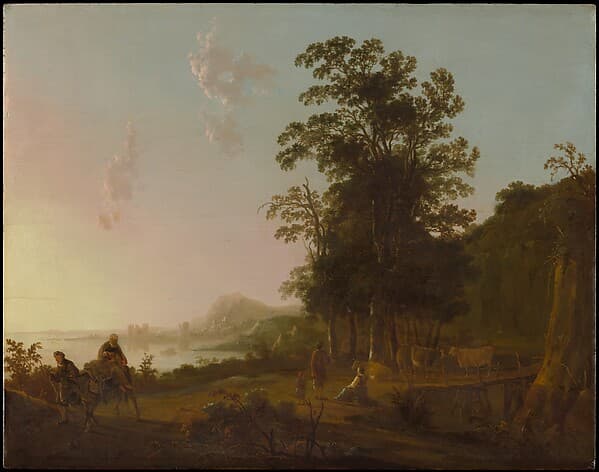
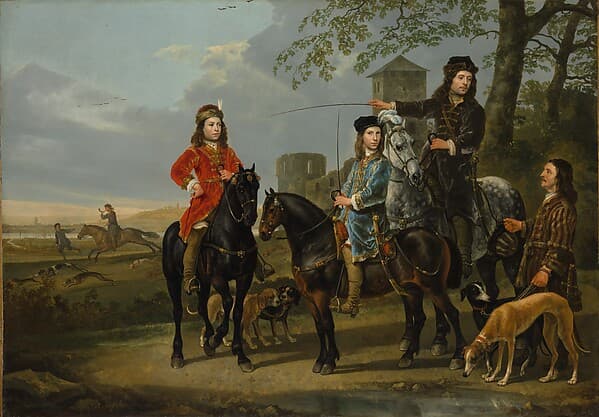
In the mid-1640s his manner changed. Jan Both of Utrecht had returned from Italy, and in Cuyp’s work the light begins to travel diagonally from the depth of the picture, the sun stands almost opposite the viewer, and the shadows lengthen. Scholars suppose that Cuyp visited Utrecht and knew Both personally, and that he came to know the discoveries of Claude Lorrain through him; this is hard to prove. The second half of the 1640s and the 1650s produced his best pictures: the banks of the Maas and the Waal near Dordrecht with boats on the water, herds resting under an evening sky, Rhine views with horsemen. “The Maas at Dordrecht” (about 1650) is in the National Gallery of Art in Washington.
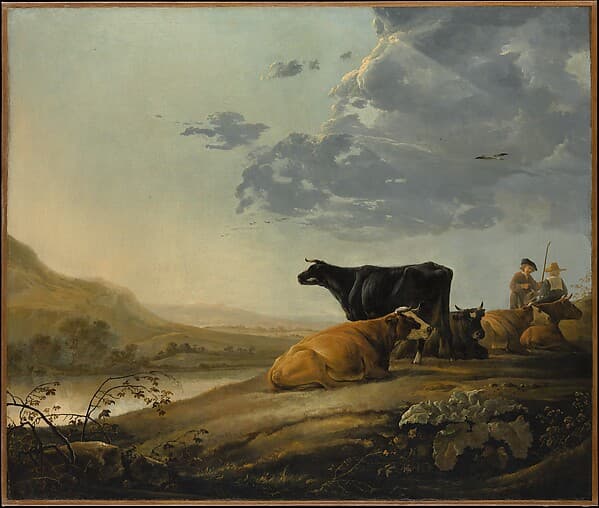
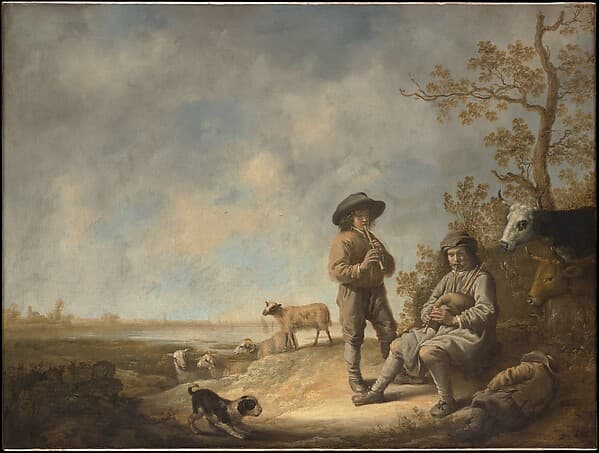
His light picks out small things: a blade of grass, a horse’s mane, the horn of a cow bending over a stream, a peasant’s hat. His compositions are mostly seen from a low viewpoint, which makes the space seem wider. He painted the sea too, and moonlit night landscapes. He never went to Italy, yet his sea views are bathed in Mediterranean light. There are no documents of journeys outside Dordrecht, but judging by the places he depicted he probably travelled in Holland, to Arnhem, Rhenen and Kleve, and possibly to Westphalia. Drawings made from nature, often finished sheets in brown ink, served him as material for his paintings, and the same part of a sketch turns up in several works. A few prints also survive.
His father died in 1651 or 1652 and left a considerable fortune.
In 1658 Cuyp married Cornelia Boschman, the widow of Johan van den Corput, who had three children; a daughter was born a year later. After this there are very few works, and the last known date from 1665. The reasons are a matter of guesswork: he held church offices (in 1659 he became a deacon, later an elder of the Reformed congregation), his wife was very devout, and he had no need to earn. In 1682 he joined the court of appeal. After his death, according to Arnold Houbraken, his house contained no paintings by other artists.
His workshop is poorly known. His pupil was Barent van Calraet, and possibly also Barent’s brother Abraham, who followed Cuyp’s manner so closely that his pictures were long attributed to the master, all the more because their initials, “A. C.”, are the same. Signatures on the canvases cannot be trusted: many were added later by owners, the works are seldom dated, and a chronology has still not been established with confidence. The Rijksmuseum has reattributed a good many “Cuyps”. It seems to me that the notion of him as a prolific painter owes a great deal to this confusion.
In the eighteenth century the English discovered him, and, so the story goes, a Swiss watchmaker traded watches for paintings in Holland to get his pictures. Most of the works ended up in Britain.
His wife died in 1689, and Cuyp spent the last year of his life with his daughter and her husband, the owner of a brewery. He died in 1691 and was buried in the Augustinian church in Dordrecht. In 2006 a monument to him was set up on the Bagijnhof in Dordrecht; since his appearance is unknown, an abstract sculpture was chosen.
Artist works
Works by the artist
Works by Aelbert Cuyp available in this edition of NEOARCA.
Profile notes