
19.03.1819–1888
Adolf Jebens
Adolf Jebens (Gebens in Russian spelling), born in Elbing, studied in Berlin and Paris under Paul Delaroche, and from the 1840s worked in St Petersburg: he painted portraits, taught at the drawing school of the Society for the Encouragement of the Arts and created a series of 137 known paintings of the Russian army. He became an academician in 1861, returned to Germany in 1863 and died in Berlin.
Biography
A hundred and thirty-seven paintings of the Russian army: that is how many were known as of 2006. Some are lost and are judged by later lithographs. This is what is chiefly associated with the name of Adolf Jebens, although in Germany he remained above all a portrait painter.
He was born on 19 March 1819 in Elbing (now Elbląg). His surname is spelled in various ways in Russian texts: Gebens, Iebens, Ebens; in German he is Adolph, or Adolf, Jebens, and the patronymic Ivanovich belongs to his St Petersburg period. From 1832 he studied at the Köllnisches Gymnasium in Berlin, then at the Prussian Academy of Arts. In 1836–1839 he lived in Paris, studying at the École des Beaux-Arts and in the studios of Carl von Steuben and Paul Delaroche. From 1839 he worked as a portrait painter in Elbing, Danzig and Berlin, and in 1841 he returned to Paris to Delaroche. In 1842 he was in Rome, and exhibited at the Paris Salon and at the exhibition of the Berlin Academy. Among the works shown then were scenes from Goethe’s “Egmont”; where they are now is unknown. In 1843–1846 he travelled through Warsaw, Danzig and Elbing, painting portraits of Danzig society.
Then he turned up in St Petersburg (by some accounts the move came in 1844, by others in the second half of the 1840s). His work as a portrait painter there went well. From 1848 Jebens taught painting at the drawing school of the Imperial Society for the Encouragement of the Arts, in its men’s and women’s sections. At the same time he began to receive commissions from His Majesty’s Own Cabinet, the emperor’s private office: he painted Alexander Sergeyevich Stroganov, Sergey Sergeyevich Lanskoy, Mikhail Vasilyevich Ogarev and others. His portrait of Nicholas I, from 1853, is in the Tsarskoye Selo State Museum and Heritage Site.
Military subjects occupied him from the end of the 1840s and through the 1850s and 1860s. A large part of the people shown in them have been identified, and I think this makes the series a valuable source on the faces and uniforms of the period, but it is hard to judge it in detail from the material I have. Some of the works were later reproduced as lithographs. In 1861 the Imperial Academy of Arts awarded him the title of academician; shortly before, he had become a member. Jebens’s paintings are in the Hermitage, the Russian Museum, the Artillery Museum, the Suvorov Memorial Museum, the Central Military Medical Museum and the palace collections at Gatchina, Tsarskoye Selo and Peterhof.
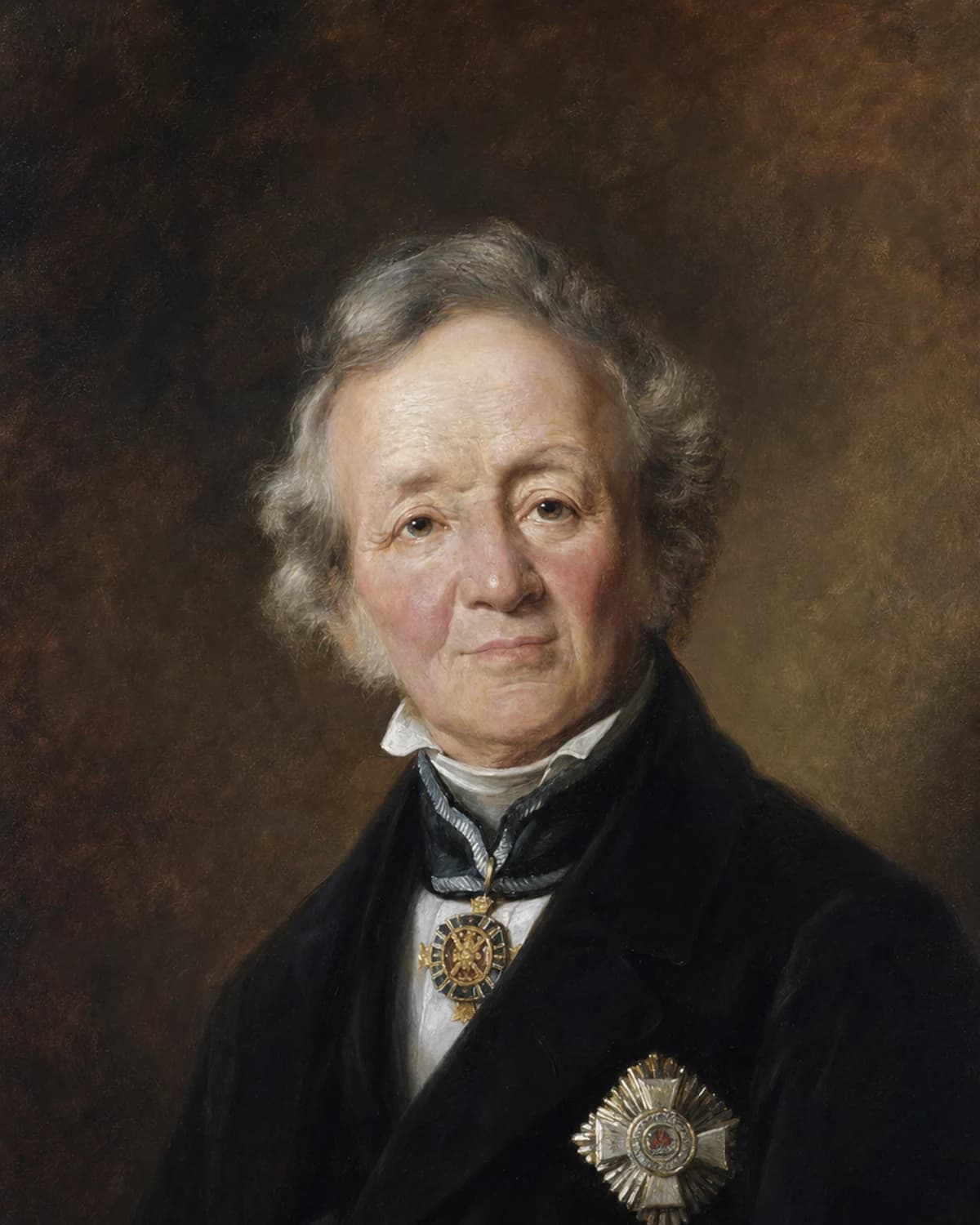
In 1863 he left for Germany; on the way, passing through Warsaw in 1863–1864, he carried out commissioned portraits of soldiers, and then settled in Berlin. He continued with the Russian military theme until 1869. In Berlin he kept to the end of his life the reputation of a good portrait painter; his portraits are in museums in Germany and Poland. Among his best-known works are portraits of the historian Leopold von Ranke (a copy of 1875 after an original by Julius Schrader, in the Märkisches Museum in Berlin) and of Friedrich Curschmann.
Adolf Jebens died in Berlin on 8 May 1888.
Related context
Associations
Works connected through artistic movements, cultural context and period. Priced works available in this market appear first.








Profile notes
Profile and sources
Image
Artist image
На основе открытого изображения: After Julius Schrader / Adolf Jebens; Wikimedia Commons; Public domain.
