
31.01.1860–07.04.1933
Adolf Hirémy-Hirschl
Adolf Hirémy-Hirschl (1860–1933) grew up in Vienna, won the Imperial Prize in 1891 for paintings on subjects from ancient history, and around 1900 moved to Rome, where he spent the last three and a half decades of his life. Many of his large history paintings are lost, and the drawings and sketches from his studio became known only in the early 1980s.
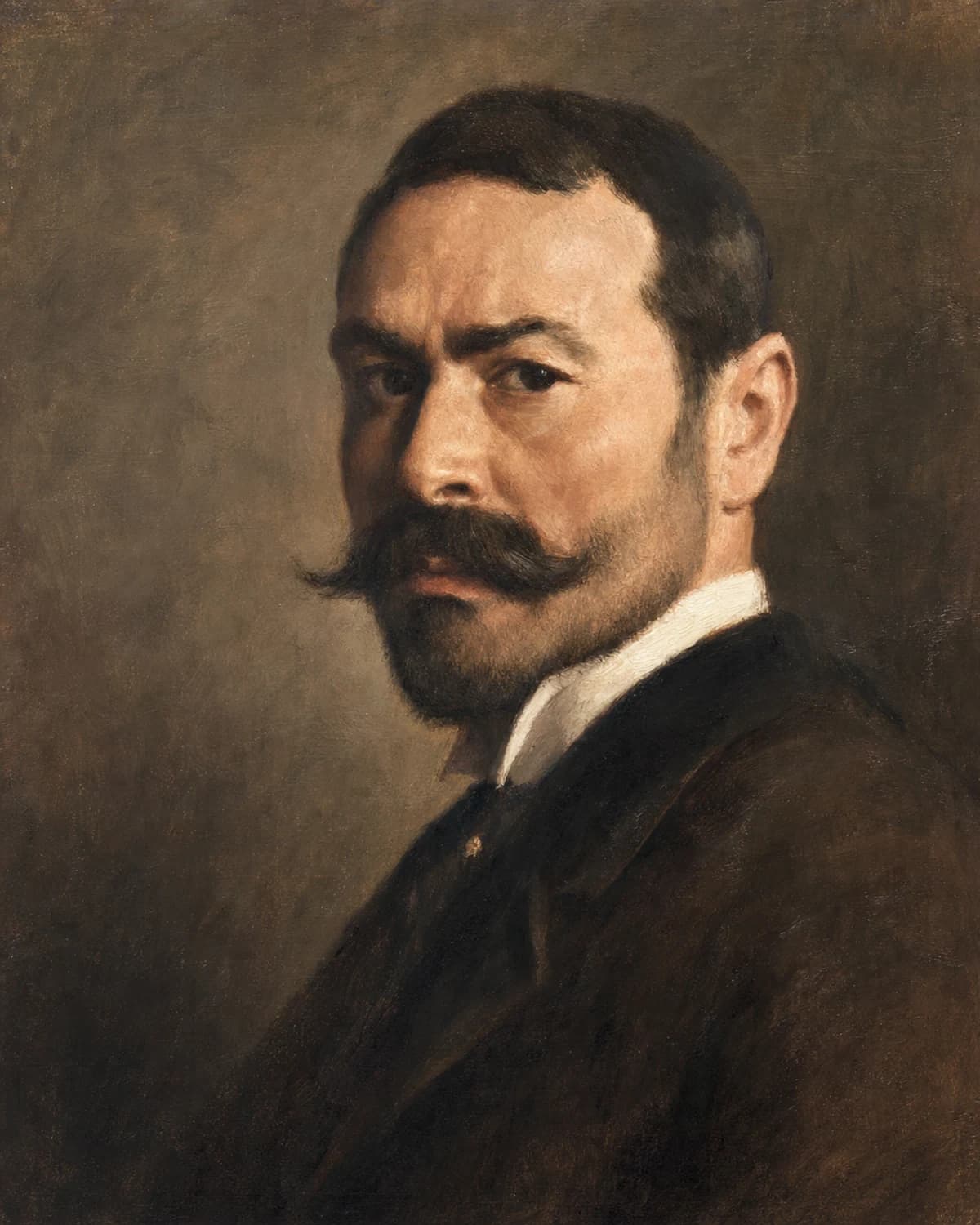
Biography
In 1904 seventy works by Adolf Hirémy-Hirschl were shown in Rome. It was a retrospective of an artist who had by then lived in Italy for several years and had changed his name.
He was born on 31 January 1860 in Temesvár (now Timișoara) into a Jewish family. His surname at birth was simply Hirschl. As a child or teenager he found himself in Vienna. Accounts of his years of study differ: by some, he studied at the Academy of Fine Arts from 1874 to 1882; by others, he received a scholarship to it in 1878. In 1880 he was awarded a prize for history painting for his canvas “Farewell: Scene from Hannibal Crossing the Alps”. The next prize enabled him to go to Rome, where he lived from 1882 to 1884; according to some accounts, he also visited Egypt and belonged to the German Artists’ Association in Rome. Rome shaped his subjects. After returning to Vienna he painted the large canvas “The Plague in Rome” (1884), which critics praised; it is now lost, like most of his other important history paintings. Commissions followed for elaborate historical and allegorical compositions: “The Vandals Entering Rome”, “The Tomb of Achilles”, “Between Scylla and Charybdis”, “Souls on the Banks of the Acheron” (1898). In 1891 he received the Imperial Prize, and in 1898, according to some accounts, the Great Gold State Medal. He was regarded as one of the most successful artists in Vienna.
Some of his works are close to Symbolism. “Ahasuerus at the End of the World” (1888) is painted in a restricted palette of blue, grey, black and white with touches of gold; the last man in the polar wilderness stands between the angel of hope and the spectre of death, a female figure personifying dead humanity lies at his feet, and crows circle above her. To my mind this picture shows him better than the long run of antique scenes: here he tells a story almost without costumes or scenery.
In the 1890s his affair with a married woman, Isabella Henrietta Victoria Ruston, caused a stir in Viennese society; after her divorce in 1898 they married.
Around 1900 (in 1899, according to some accounts) he added the Hungarian element “Hirémy” to his surname, took up Hungarian citizenship again and moved to Rome. At the same time Gustav Klimt and the Vienna Secession, the group of artists who broke away from the academic establishment, were gaining strength, and beside them his academic manner began to look old-fashioned. According to one version, he had known Klimt and been friendly with him before the Secession was founded, but went a different way. In Rome he painted portraits, Mediterranean landscapes and subject pictures, took part in 1904–1908 in the exhibitions of the society Amatori e Cultori di Belle Arti, and in 1911 was admitted to the Accademia di San Luca. In 1913–1915, according to some accounts, he was chairman of the German Artists’ Association in Rome. He remained indifferent to the newest movements, in Vienna and in Rome alike, and worked in his own manner. One of his last large works was the polyptych “Sic Transit …”, completed in 1912 and shown in Vienna in 1913: an allegory of the fall of the Roman Empire and the rise of the Christian era.
He is considered a very accomplished draughtsman. His studies of figures and drapery in charcoal or chalk, preparatory to paintings, among them “Sic Transit …” and “Souls on the Banks of the Acheron”, were often made on blue, lavender or orange paper so that light would play more strongly on the forms. There are also landscape studies in pastel and watercolour. His female nudes are described as direct and frankly sensual.
Hirémy-Hirschl died in Rome on 7 April 1933 and was buried in the Protestant Cemetery. His heirs kept his studio and a large part of his drawings, watercolours, pastels and oil sketches for decades; they became accessible to the public only in the early 1980s.
Related context
Associations
Works connected through artistic movements, cultural context and period. Priced works available in this market appear first.








Profile notes
Profile and sources
Image
Artist image
На основе открытого изображения: Chatsam; Wikimedia Commons; CC BY-SA 3.0.
