
08.12.1826–31.01.1901
Adolf Charlemagne
Adolf Charlemagne (1826–1901), grandson of a sculptor from Rouen, studied at the Academy of Arts under Bruni and Willewalde and painted Suvorov in the Alps, Peter I, and Catherine II in Falconet’s studio. In the mid-1860s he designed playing cards for the Expedition for the Preparation of State Papers, known as the “Satin Deck”; versions of them are still produced. He illustrated a lot: fables, Lermontov, Pushkin.
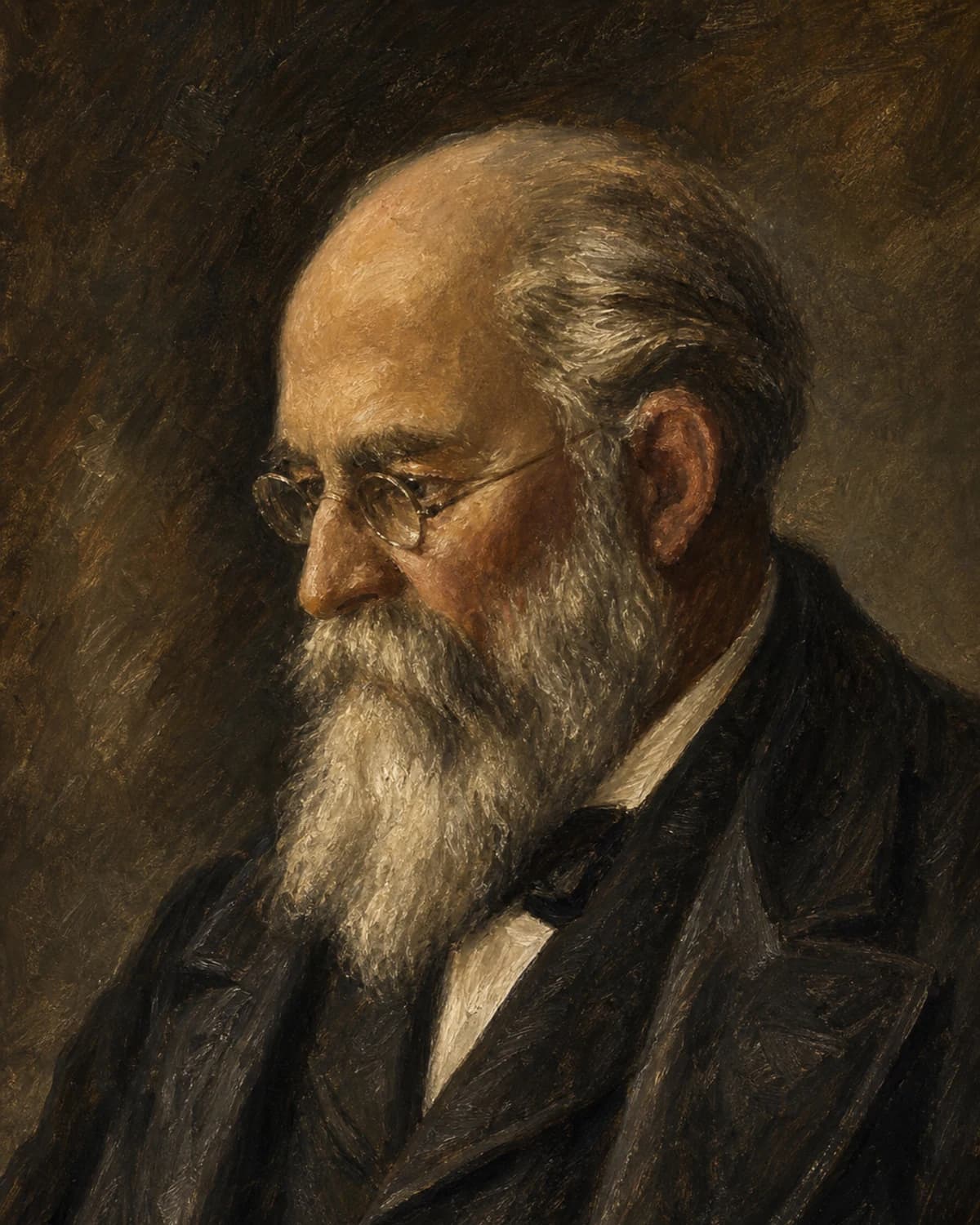
Biography
In the mid-1860s the Expedition for the Preparation of State Papers commissioned new designs for playing cards from Adolf Charlemagne. The deck later came to be called the “Satin Deck”; some versions of it are still printed today, and it is the best-known card design in Russia. I suspect few players know the name of its author.
He had been trained for something quite different: history and battle painting.
Charlemagne was born in St Petersburg on 8 (20) December 1826 (according to other sources, a year later). His father, Iosif Ivanovich Charlemagne, was an architect who had himself been brought up at the Academy of Arts; his grandfather, the sculptor and decorative artist Jean-Baptiste Charlemagne-Baudet, had come from Rouen in the reign of Catherine II. Adolf received his general education at the Petrischule, where he studied together with his brother Iosif, who also became an artist and architect. In 1848 he entered the Academy of Arts, studying history painting first under Fyodor Bruni and then moving to Bogdan Willewalde’s battle-painting class.
The medals came one after another. In 1852 the small silver medal for the sketch “Chevalier Guards at Krasnoye Selo”, in 1853 the large silver for “An Episode from the Battle of Austerlitz”, in 1854 the small gold for the programme piece “An Episode from the Hungarian Campaign of 1848”. In 1855 the large gold medal went to a picture with a very long full title: “Monks of the Augustinian Order Meet the Field Marshal Count on the Summit of the St Gotthard in Switzerland in 1799”; it is now in the Great Gatchina Palace.
The medal gave him the right to a pensioner’s journey abroad, and that same year Charlemagne left for Munich, where he had the advice of the battle painter Alexander Kotzebue. Suvorov would not let him go: there he painted “The Ceremonial Reception of Suvorov in Milan on 18 April 1799” (1858, also at Gatchina; the sketch is in the National Art Museum of Belarus in Minsk) and “Suvorov’s Last Night in Switzerland”, for which he became an academician in 1859. In 1858 came “The Tsar’s Hunt in the Sixteenth Century”, now in the Tretyakov Gallery, and in 1860 “Peter I Publicly Announces the Conclusion of Peace with Sweden”, in the Hermitage since 1950. From Munich he went to Paris and studied the Pompadour style he had grown fond of in its Versailles examples, then visited Stuttgart and other German cities. He returned to St Petersburg in 1861.
His first commissions at home were for churches and interiors: icons, including altarpieces, for the Catholic churches of the Page Corps and of the cemetery on the Vyborg Side, and ceilings and wall panels in the houses of Prince Meshchersky in Moscow and A. Polezhaev in St Petersburg. Then came the cards.
His most notable painting was “Catherine II in Falconet’s Studio” (1867). It brought Charlemagne the title of professor, it was bought by Empress Maria Alexandrovna, and from then on the artist’s reputation grew quickly. For more than twenty years the publishers of illustrated magazines were eager to reproduce his compositions. He illustrated the fables of Krylov, Khemnitser, Dmitriev and Izmailov (first edition 1865), Lermontov’s “Song of the Merchant Kalashnikov” (reissued with his drawings in 1866, 1872 and 1881), “The Captain’s Daughter” and “Eugene Onegin”, and V. Genkel’s four-volume album “Northern Lights” (1862–1865). In 1870, together with M. A. Shishkov, he published designs for the sets of “Boris Godunov” for the Imperial theatres and drew on stone an album for the centenary of the military Order of St George, and in 1883–1888 he made vignettes for the history of the Preobrazhensky Life Guards Regiment.
From 1871 Charlemagne served as an artist at that same Expedition for the Preparation of State Papers. At the same time he was invited to act as consultant to the drawing workshops of the Chief Intendant Directorate, where military scenes, ceremonies and manoeuvres were painted in watercolour for the albums of Alexander II, and in 1873 he received the title of Artist to His Imperial Majesty. He also designed the uniform of the court “arapy”, attendants of the imperial household. Among his late paintings is “Peter I in 1697 Surprising the Conspirators in Tsykler’s House” (1884), in the Russian Museum since 1923.
His wife, Elizaveta Ivanovna, née Gokh, was a portrait painter and a pupil of Kramskoy, and his sons Iosif and Ivan also became artists. Charlemagne himself worked as an artist and teacher to the end of his days.
He died in St Petersburg on 31 January (13 February) 1901 and was buried in the St Paul section of the Vyborg Catholic Cemetery. Under Soviet rule the cemetery was destroyed, and his grave with it.
Related context
Associations
Works connected through artistic movements, cultural context and period. Priced works available in this market appear first.








Profile notes
Profile and sources
Image
Artist image
На основе открытого изображения: И.А. Шарлемань; Wikimedia Commons; Public domain.
