
29.09.1958–present
Adam Hlobus
Adam Hlobus (real name Vladimir Adamchyk) graduated from the Minsk art school and the Belarusian Theatre and Art Institute and worked as a draftsman and art restorer, but he is known above all for his poetry and short prose. In 1986–1990 he was among the founders of Tuteishyja, an association of young writers, and later published books through his own publishing house, Suchasny litaratar. He won the Russian Yugra prize.
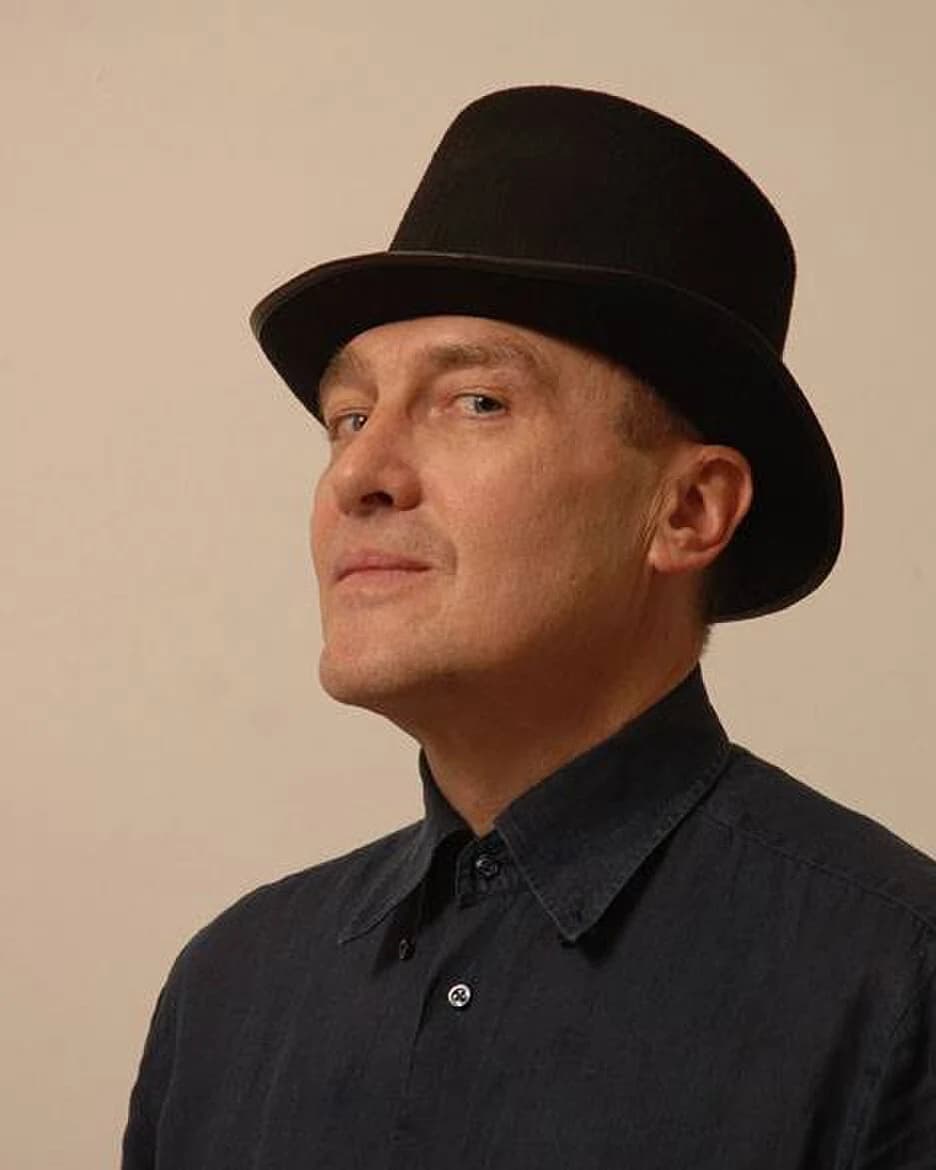
Biography
Adam Hlobus’s real name is Vladimir Vyacheslavovich Adamchyk (in Belarusian, Uladzimir Vyachaslavavich Adamchyk). He took the pseudonym while living in a family where words were a profession: his father, Vyacheslav Adamchyk, was a well-known Belarusian writer.
He was born on 29 September 1958 in Dzyarzhynsk, in the Minsk Region. In 1959 the family moved to Minsk, and he has lived there ever since.
He studied in the pedagogical department of the Minsk Art School named after Alexey Glebov and graduated in 1977. He then entered the art department of the Belarusian Theatre and Art Institute and graduated in 1983. By some accounts, he studied with the painter Algerd Malishevsky. He worked as a draftsman, an art restorer and a graphic designer, and from 1987 he edited the magazine Krynitsa (it is also called Belarus and Biarozka). I think this kind of jobbing artistic practice shows in his prose: it rests on detail, not on plot.
His first poems were printed in 1981 by the weekly Literatura i Mastatstva and the magazine Maladost. A collection, Grud, which came out in 1985, was, by some accounts, banned and destroyed. Park (poetry, 1988) and Loneliness at the Stadium (stories, 1989) followed, then Death Is a Man (1992), Crossroads (1993) and Demonokameron (1994), Only Don’t Tell My Mother (1995), Koidanovo (1997) and The New Demonokameron (1998). In 2000 a volume called Texts gathered all the earlier books, and after it came The Braslau Stigmata (2001), Notebooks (2003), the novel The House (2005) and Contemporaries (2006). From 2008 his own collections have also appeared from Suchasny litaratar, for example Convolutus (lyrics and prose, eight books in eight years), followed by fairy tales, literary portraits and stories about Minsk and its surroundings.
In 1986 he was one of the founders of Tuteishyja (“The Locals”), an informal association of young writers that lasted until 1990. It was involved in public action as well as literature. In October 1988 its members organised the Dziady (Forefathers’ Eve) march in memory of the victims of Stalin’s repressions; the march drew thousands of people and later became a tradition. In 1988 he joined the Writers’ Union of the USSR, and since 1989 he has been a member of the Union of Belarusian Writers. The association’s collective volume, Tuteishyja, was published in 1989.
His work has been translated into English, German, Slovenian, Czech, Polish, Russian, Ossetian and Catalan. In London, the translator Vera Rich rendered Death Is a Man (1993) and Demonicameron (1996); a Polish edition of Demonokameron appeared in Bialystok in 1998. In Russian the books are Werewolves (1991), Demonokameron (1993) and the thick volume Lyrics BY (2007): its poems were translated by Alexander Eremenko, Alexey Parshchikov, Vyacheslav Kupriyanov and Dmitry Mizgulin, its lyrical prose by Svyatozar Barchenko and Alexey Andreev.
In 2010 he received the Yugra international literary prize in the “Slavic Book” category for Lyrics BY. In 2013 he was awarded the Boris Kornilov Medal, and in the Jerzy Giedroyc Literary Prize the book Skazy (2012) took third place; in 2017 Reverse Perspective took the same place. Besides books, he has released a music album, Songs (Kovcheg); its year is given differently, as 1998 and as 2003.
Profile notes
Profile and sources
Image
Artist image
Masik Yadya; Wikimedia Commons; CC BY-SA 4.0.
