
25.05.1891–19.09.1955
Adalbert Erdeli
Adalbert Erdeli (1891–1955) was born in a Transcarpathian village to a schoolteacher and given the name Béla Hryts at birth. He studied in Budapest and Munich, and in 1927 opened a drawing school in Uzhhorod with József Boksay, from which the Transcarpathian school of painting grew. He painted portraits, landscapes and still lifes; in 1949 he was accused of formalism and removed from teaching.
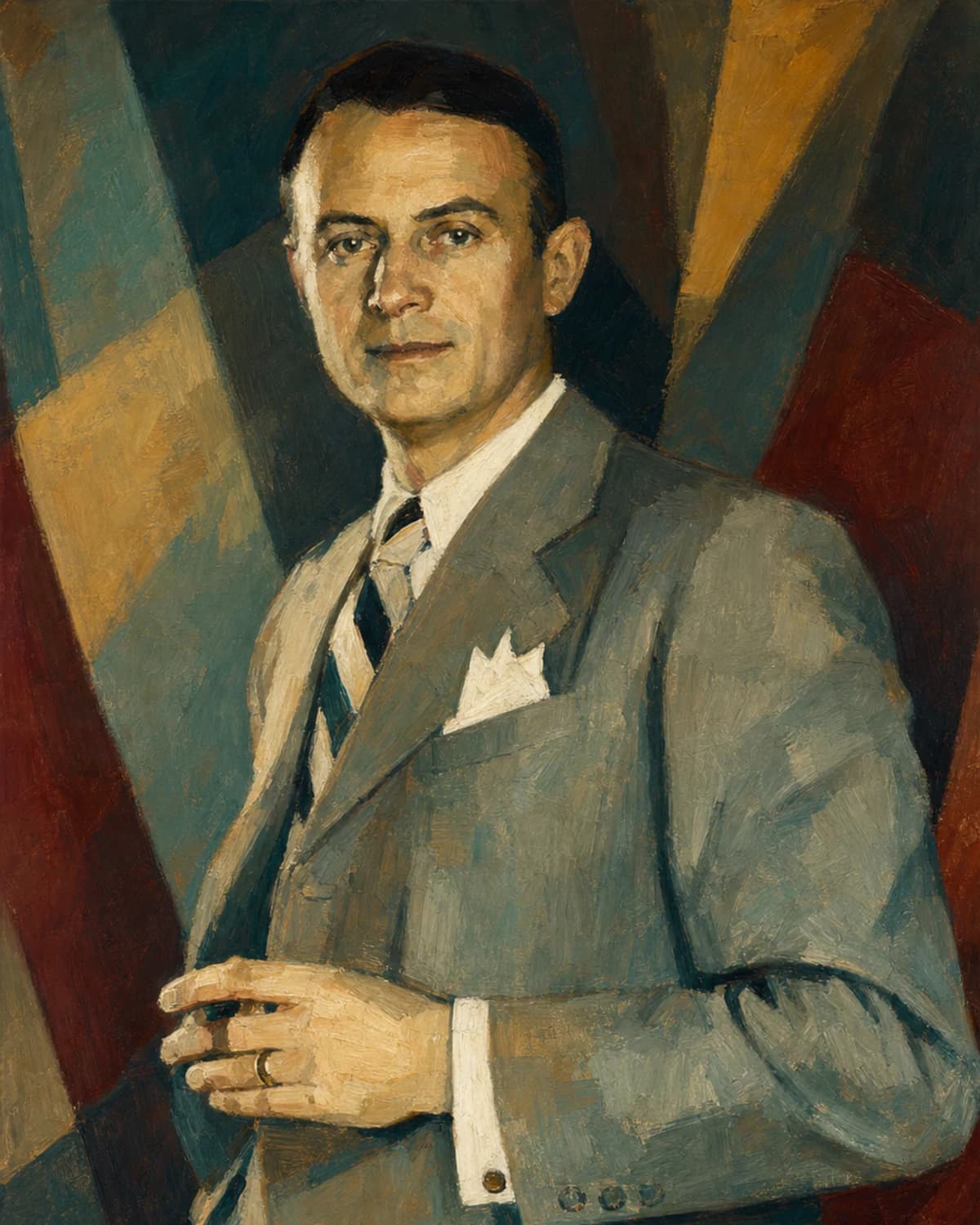
Biography
On the night of 21 March 1949, or more exactly at a meeting of the intelligentsia in the hall of the regional council in Uzhhorod, the poet Yuriy Hojda called Erdeli’s canvases formalist and accused the artist of smuggling “rotten Western culture” into Transcarpathia. Two days later the speech was printed in the newspaper Sovietskoye Zakarpaty. Erdeli was stripped of all his posts, including his teaching post, and sent into retirement.
He was born on 25 May 1891 to a village schoolteacher, Mykhailo Hryts; his birth is linked with a village in the Irshava district, which the sources name differently: Klymovytsia, Zahattia, Hátmeg. His mother, according to family tradition, was German. At ten, in 1901, his father changed his first name and surname to Hungarian ones: in Austria-Hungary this was often done to make a son’s life easier. Later, under Soviet rule, the step was held against the painter as a reproach. He considered himself a Hungarian, and I have no documents that would settle the dispute: the artist’s nephew, also a painter, says simply that everyone chooses his own nationality.
From 1911 to 1915 Erdeli studied in Budapest under Imre Révész and Károly Ferenczy; in 1913 he received a scholarship to work at the artists’ colony in Kecskemét. From 1916 he taught drawing at the secondary school in Mukachevo. In 1922–1926 he worked in Munich, and in 1924 he attended the trial of the Beer Hall Putsch participants and made courtroom sketches for a newspaper. Then came trips to Prague, Rome and Paris, where he got to know Impressionism and Fauvism and took part in exhibitions; the sources disagree both on the dates and on the number of years he spent in France. His painting in this period drew on Cézanne, whom he regarded as his teacher.
In 1926 Erdeli moved to Uzhhorod. In 1927, together with József Boksay, also a graduate of the Budapest academy, he founded the private Public School of Drawing. The school required its pupils to master drawing and painting step by step. It produced a generation of Transcarpathian artists: Andriy Kotska, Adalbert Boretsky, Ernest Kontratovych, Zoltán Sholtes, Volodymyr Mykyta, Ferenc Seman, Pavlo Balla and others. In 1931 Erdeli founded the Association of Artists of Transcarpathia (then Subcarpathian Rus) and became its head. He taught at the teacher training school in Uzhhorod, organised exhibitions in Prague, Bratislava and Košice, and in 1941–1942 was the main organiser of the Uzhhorod Art Days. By the mid-1930s he had painted more than a thousand pictures. Around him formed what was later called the Transcarpathian school.
He lived through Austria-Hungary, Czechoslovakia, Horthy’s Hungary and the USSR, knew several languages, kept his diaries in Hungarian and wrote an autobiographical novel in German.
After 1944, according to the Hungarian literature, he registered as a Ukrainian to avoid deportation. The authorities backed his idea of founding an art school in Uzhhorod, which opened in 1945. Erdeli headed it and in 1946 became the first chairman of the Transcarpathian regional branch of the Artists’ Union of Ukraine. He dreamed of a “Transcarpathian Barbizon”.
The campaign of 1949 against “cosmopolitans”, as Soviet officials labelled artists and writers open to Western culture, put an end to all this. To live, he took commissions from a building and decorating cooperative and heavy manual work, copied and painted portraits of party leaders, and recanted in the press. His real position he left in his diaries; in an entry made in June 1954 he writes of beauty and of God. Shortly before his death attitudes towards him softened: according to tradition, the portrait of the young dancer Klara Balog (1951) drew the authorities’ attention, and with his “realist” works he exhibited again. In 1954 and 1955 solo exhibitions of his work were held in Uzhhorod.
Erdeli died on 19 September 1955 in Uzhhorod and was buried in the Calvary cemetery. Official art history rehabilitated him only a decade and a half later; the first album appeared in Kyiv in 1972. In Uzhhorod there stands a monument to Boksay and Erdeli, and the art college bears his name.
Related context
Associations
Works connected through artistic movements, cultural context and period. Priced works available in this market appear first.








Profile notes
Profile and sources
Image
Artist image
На основе открытого изображения: Unknown author Unknown author; Wikimedia Commons; Public domain.
