
1589–1700
Abu'l-Hasan
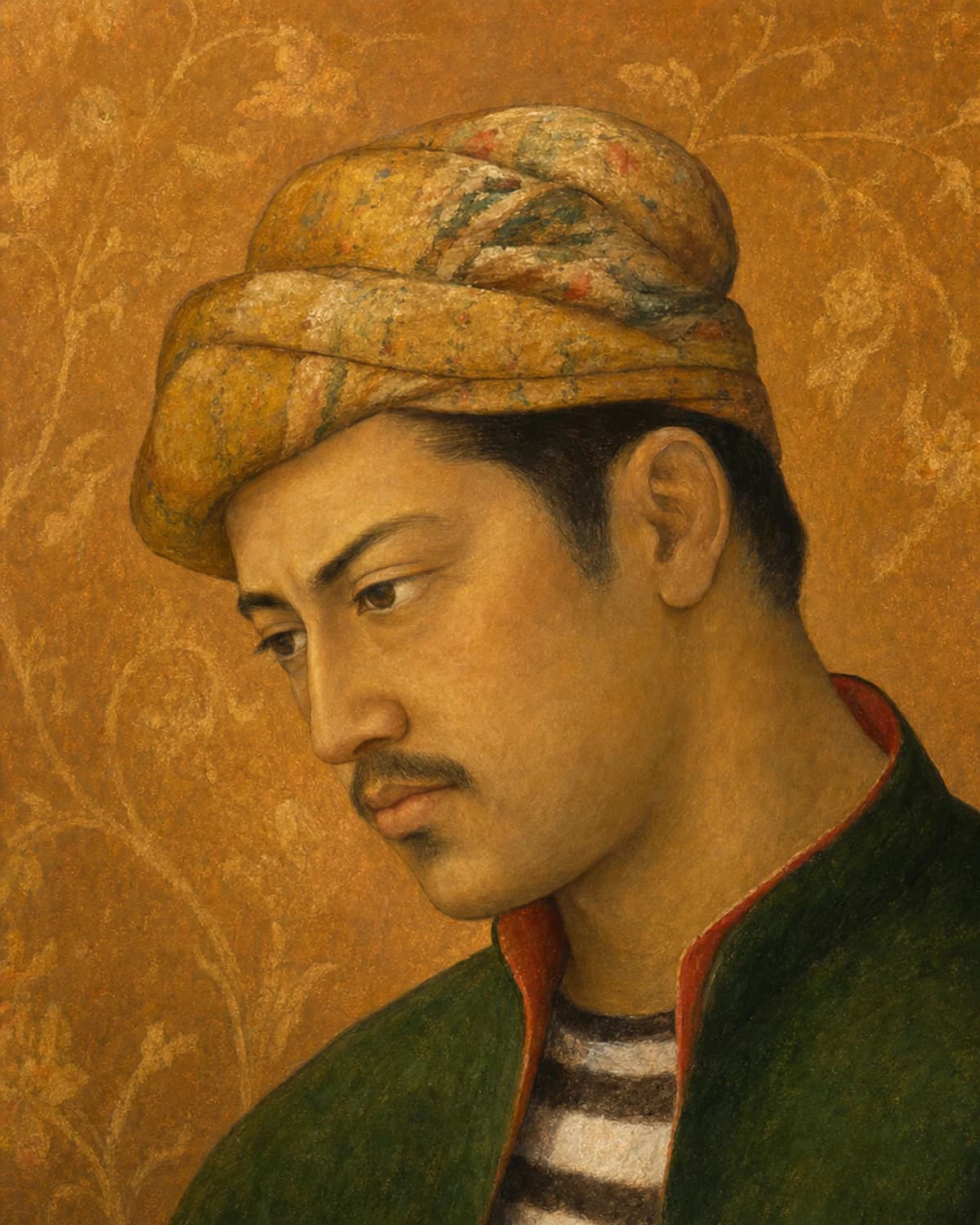
Abu'l-Hasan, son of the Herat painter Aqa Riza, grew up at the court of Prince Salim, the future Mughal emperor Jahangir, and at twelve copied an engraving by Dürer. In 1618, for a frontispiece to the emperor’s memoirs, he received the title Nadir al-Zaman, “Wonder of the Age”. He painted portraits and political allegories of Jahangir; after 1628 his trail is lost.
Biography
The Saint John in a drawing of 1600 is copied from an engraving by Albrecht Dürer, and copied by a boy of twelve. His father, the court painter Aqa Riza, trained him in the Persian tradition, but the son was drawn to European prints and the way they model volume. Two years later, at fourteen, he painted a miniature, “Dialectic”, after an engraving by Jan Sadeler from a composition by Maarten de Vos, and carefully reproduced everything that creates depth: hills one behind another and figures growing smaller. The sheet is now in the Institute of Oriental Manuscripts of the Russian Academy of Sciences in St Petersburg.
It did him little good. Jahangir, who came to power in 1605, liked gold grounds and flat landscapes with ornamental rather than living vegetation.
Abu'l-Hasan was born in 1588 or 1589. Aqa Riza came from Herat and had entered the service of Prince Salim, the future Jahangir, before his accession; he ran the prince’s kitabkhana, his workshop for books. In 1599 the boy moved with the prince to Allahabad, where Salim set up a court of his own. His first known work in a major manuscript dates from 1604: in the “Anvar-i Suhaili” (1604–1610, British Library) the sixteen-year-old painted “King Dabshalim Visits the Brahmin Bidpai”, with lively, almost naturalistic faces set against a fairy-tale Persian landscape in his father’s manner. Around 1610 came the famous “Squirrels in a Plane Tree” (British Library): twelve squirrels race through the branches while below a hunter tries in vain to climb the trunk. The volume of the tree, the hunter and the animals is painted in the European way, the background stays Persian, gold with coloured stones, and the composition itself is probably borrowed from Abd al-Samad. An inscription records that the animal painter Mansur helped; how much is unclear, and Stuart Cary Welch thought the squirrels were entirely his. Against this stands the “Spotted Forktail” (1610–1615, Metropolitan Museum), a bird that Abu'l-Hasan painted himself, and no less well. The squirrel scene is now read as an allegory: a bad deed attempted by unfit means is doomed to fail. To me this reading seems possible, but it is hard to verify. Around 1608 Daulat included the young Abu'l-Hasan in a group portrait of the best masters of the kitabkhana, and Jahangir pasted the sheet into his album, the “Muraqqa-e Gulshan”. The portrait shows that the painter was left-handed.
Only a few works from 1607–1615 can be firmly attributed to him, but after 1615 his years of fame begin. From this time come “Saadi Presenting a Book of His Poems” (1615, Walters Art Gallery, Baltimore), a leaf from a lost manuscript, and “The Old Pilgrim” (1615–1620), a portrait of a weary old man. For the “Jahangirnama”, the emperor’s memoirs, he made a double-page frontispiece, “The Celebration of Jahangir’s Accession” (1618, held in St Petersburg): in the crowd of courtiers and diplomats one can recognise Sir Thomas Roe, ambassador of King James I of England. In the same year, 1618, Jahangir granted him the title Nadir al-Zaman, “Wonder of the Age”, and wrote in his memoirs that he now had no equal, that there was no point in comparing him with his father, and that the emperor himself had brought him up until he reached this level. Probably at about this time Abu'l-Hasan succeeded his father at the head of the imperial workshop.
His main task was the chronicle of the court, above all portraits. He was also trusted with the most delicate subjects, political allegories: “Jahangir Symbolically Destroying Malik Ambar” (c. 1615–1620), the “Allegorical Representation of Emperor Jahangir and Shah Abbas of Persia” (c. 1618, Freer Gallery, Washington), where the Mughal emperor appears as a lion and the Persian shah as a lamb, and “Emperor Jahangir Triumphing over Poverty” (c. 1620–1625, Los Angeles County Museum of Art). The allegories with the shah promised Persia friendship, but as the junior partner; that dream ended in 1622, when the Persians took Kandahar from the Mughals. Abu'l-Hasan also retouched other artists’ miniatures. For all the European naturalism of his faces he remained a conservative master: his landscapes stayed flat.
In 1628 Shah Jahan came to the throne, a son who had long opposed his father. Abu'l-Hasan painted several portraits of him, but the new emperor preferred the painter’s younger brother, Abid. After the portraits of the first years of the new reign, no work by Abu'l-Hasan is known.
Related context
Associations
Works connected through artistic movements, cultural context and period. Priced works available in this market appear first.
Profile notes
Profile and sources
Image
Artist image
На основе открытого изображения: Daulat; Wikimedia Commons; Public domain.
