
07.03.1905–27.10.1924
Abraham Ángel
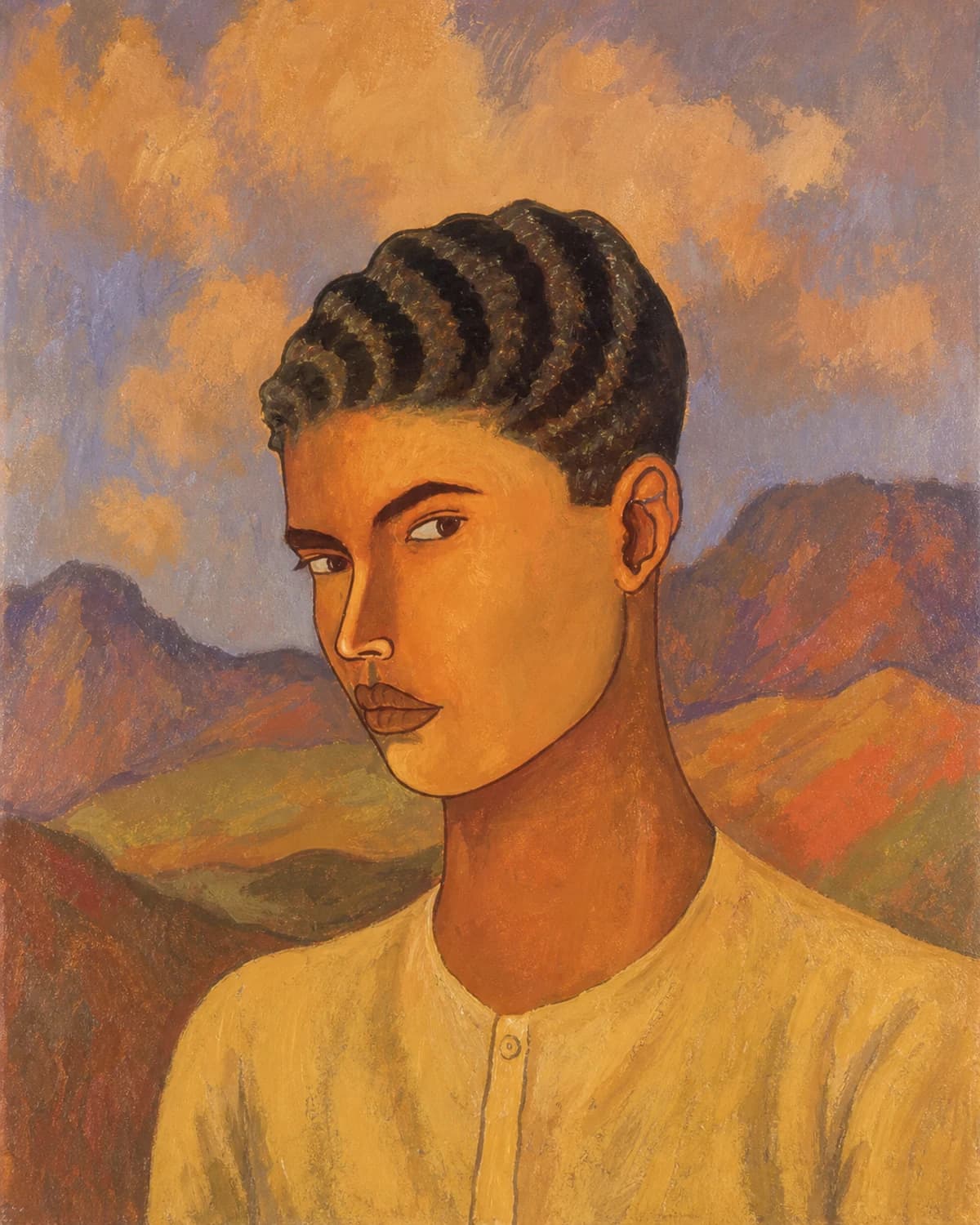
Abraham Ángel Card Valdés painted for only about three years: at sixteen he was thrown out of his home for wanting to study painting, and he gave up his surnames, keeping only his given names. His portraits and landscapes in the spirit of naive art were praised by Salvador Novo, and Alfonso Reyes compared him to Rimbaud. He died in 1924, at nineteen; about thirty of his paintings are known.
Biography
On 19 June 1924, at an exhibition organised by the magazine “El Universal Ilustrado”, several paintings by the nineteen-year-old Abraham Ángel were shown. The poet Salvador Novo wrote about him with admiration.
Four months later the artist was found dead.
He was born on 7 March 1905 in El Oro, in the State of Mexico, the youngest of five children. His father, Lewis Edward Card Burke, a Welshman, miner and fortune-seeker, travelled all over the country in search of gold and silver mines and left the family early; his mother, Francisca Valdez, came from Sinaloa. The elder brother, Adolfo, became head of the household. The family moved from El Oro to Puebla, from there to the capital and back again, and Abraham’s childhood was spent in his father’s strict Protestant faith, which Adolfo had embraced with particular zeal. In the end the mother, Adolfo and the youngest son settled in Mexico City, and the brother began preparing him to become a clerk at the electric company where he himself worked.
In 1921 Abraham began attending the painting classes of Adolfo Best Maugard, who was then working in the department of drawing and manual work of the Ministry of Public Education; the young man’s first dated painting is still full of his teacher’s lines and colours. When he announced that he wanted to study seriously at the Academy of San Carlos, Adolfo objected, and when Abraham refused to obey, he threw his sixteen-year-old brother out of the house, although their mother and sister were against it. Abraham’s teacher became the painter Manuel Rodríguez Lozano, who taught drawing by Best Maugard’s method. Abraham gave up his surnames, began signing himself simply Abraham Ángel and moved into Rodríguez Lozano’s home on Bucareli street in the centre of the city. Rodríguez Lozano introduced him to the artists of the capital and, it seems, himself began to compose a legend about him, presenting his pupil as the best painter in America, newly arrived from Argentina. In 1923 Rodríguez Lozano obtained a post as drawing teacher at the ministry, and in January 1924 he succeeded Best Maugard as head of that very department. By then the eighteen-year-old Ángel was regarded as one of the most prominent pupils and assistants, and he was counted among the “revolutionary artists” who opposed the academicism of Alfredo Ramos Martínez; this circle included Diego Rivera, José Clemente Orozco, David Alfaro Siqueiros and the poet Carlos Pellicer.
His painting is linked to French naive art transplanted into the soil of the nationalism by which Mexico lived after the Revolution. One of the first scholars of his work, Agustín Velázquez Chávez, wrote of his extremely fine, rhythmic lines and of colour made of ochre, purple, green, opalescent, blue and pink tones. Ángel painted portraits of family and acquaintances, his sister Amelia, Rodríguez Lozano himself (1922), a self-portrait (1923), a waitress, “La Mulita”, and landscapes of Cuernavaca, Iztapalapa and the Tepito district. In 1924 came “La Chica”, a portrait of Amelia, and the large portrait of Hugo Tilghman known as “The Tennis Player”, painted in oil on cardboard; it is in the National Museum of Art in Mexico City. That same year Rodríguez Lozano took another young artist, Julio Castellanos, under his patronage, and Ángel was left on his own.
When an exhibition organised by Rodríguez Lozano and Castellanos came to Paris, Alfonso Reyes, the Mexican ambassador to France, called the dead painter “the marvel and flower of Mexican painting” and compared him to Rimbaud; he is still called “the Mexican Rimbaud”. The scholar Daniel Cosío Villegas wrote soon after his death that Ángel had perhaps made the most Mexican painting of all. About thirty of his paintings are known. The revival of his name began in the 1980s: in the autumn of 1981 his works were shown at the Palacio de Bellas Artes in an exhibition honouring the movement of open-air painting schools, and then came the first solo exhibition, “Abraham Ángel, His Work and His Time”, at the San Carlos Museum in Mexico City, in Monclova and in Toluca. In 1995 a biography by Luis Mario Schneider was published, and in 2024 the Museo de Arte Moderno in Mexico City showed a retrospective of nineteen paintings.
On 27 October 1924 the nineteen-year-old Abraham Ángel was found dead in the house he shared with Rodríguez Lozano. He was buried in the Panteón Civil de Dolores in Mexico City. In the 1940s, when the cemetery was being enlarged, his grave was destroyed.
Related context
Associations
Works connected through artistic movements, cultural context and period. Priced works available in this market appear first.








Profile notes
Profile and sources
Image
Artist image
На основе открытого изображения: Abraham Ángel (1905 - 1924) – Painter (Mexican) Born in State of Mexico. Details on Google Art Project; Wikimedia Commons; Public domain.
