
14.01.1936–16.12.2014
Abdulmari Imao
Abdulmari Imao (1936–2014) grew up in Sulu in a family of boat builders going back generations, studied sculpture in Manila, Kansas and Rhode Island, and received a grant from the Museum of Modern Art in New York. He brought the okir ornament, the sarimanok bird and the naga serpent from Tausūg and Maranao tradition into Philippine art. In 2006 he became the first Moro to be named a National Artist of the Philippines.
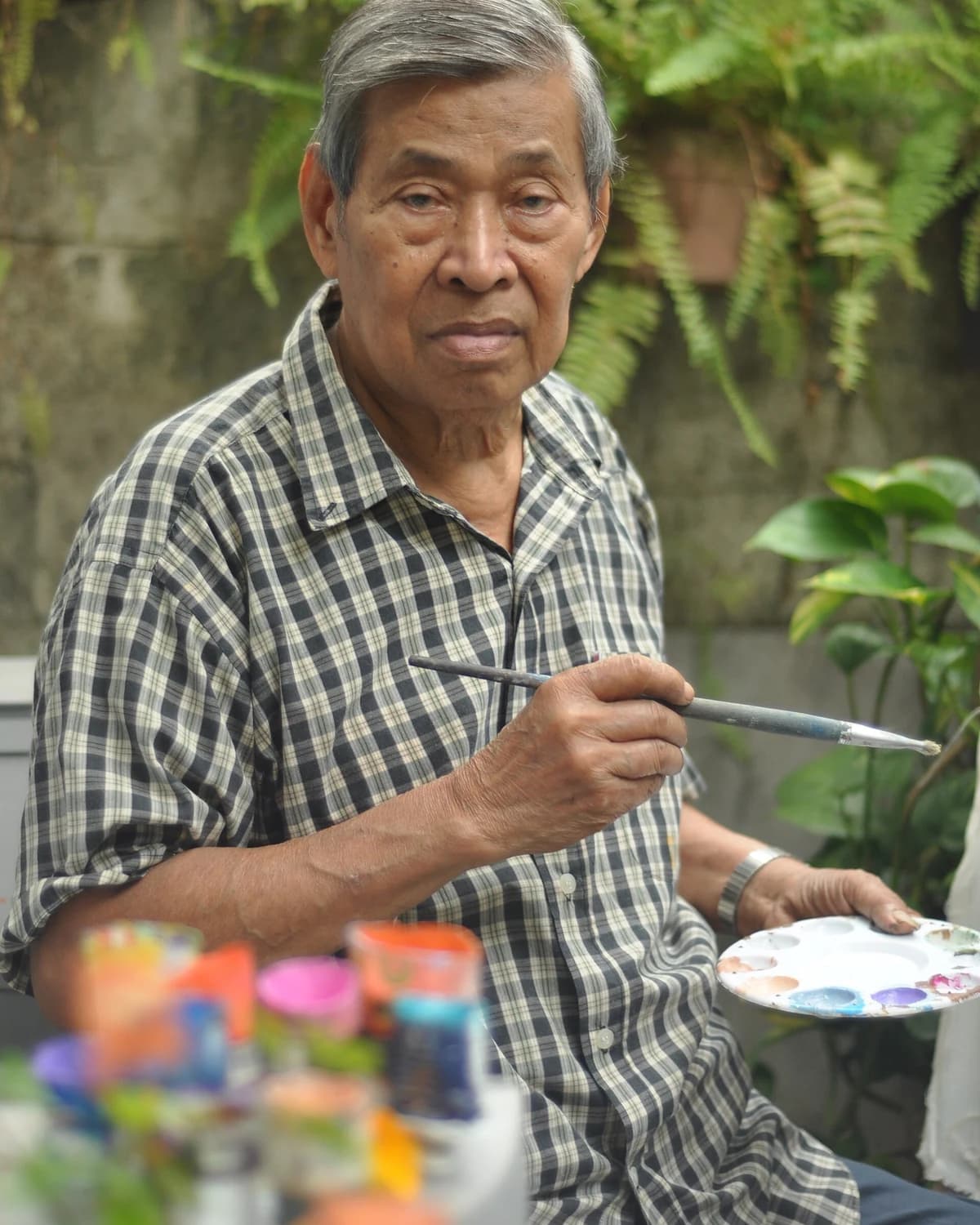
Biography
His first works were trophies for swimmers. As a boy he carved a figure of a swimmer on a pedestal for each of them: in those years the swimmers of Jolo were regarded as the country’s best hope at the Olympics.
Abdulmari Asia Imao was born on 14 January 1936 in Siasi, in the Sulu archipelago, and spent his childhood in the neighbouring town of Pata. He was a Tausūg. His family, it is reported, descended from generations of tokang, boat builders, going back to the precolonial era. His interest in art showed itself at the age of nine. He finished high school in 1956, and in that same year his fate was settled by chance: the Philippine Navy held a floating exhibition on the ship LST with works by Fernando Amorsolo, Carlos “Botong” Francisco and Vicente Manansala. The exhibition was run by Tomas Bernardo. Imao spoke with him about painting, showed him his own work, and Bernardo took him to Manila.
After that he acted directly: he wrote to President Ramon Magsaysay asking for a study grant. The president’s aide, Jose Maria Ansaldo, helped him enter the University of the Philippines in Diliman, Quezon City. He studied as a pensionado of the Commission on National Integration. Among his teachers were Guillermo Tolentino and Napoleon Abueva, both later National Artists, and at that university he took his Bachelor of Fine Arts degree in sculpture.
In 1960 Imao went to the United States, to the University of Kansas, as a Smith-Mundt and Fulbright scholar; in the competition he placed among the top twenty. In 1962 he received his Master of Fine Arts in sculpture, specialising in brass casting. In 1962–1963 he continued his training at the Rhode Island School of Design, where he studied ceramic technology. He also studied at Columbia University in New York under Lloyd Burden, taking documentary film and photography. In 1963 he received a grant from the Museum of Modern Art in New York for travel in Europe and Scandinavia, becoming the first Asian to be awarded it.
Later he worked as a consultant to the United Nations on brass casting. Besides sculpture he painted, took photographs, made ceramics and documentary films, wrote, and carried out research on the culture of Muslims in the Philippines.
Three motifs return constantly in his work: the okir, the sarimanok and the naga. He is credited with bringing these images into the national consciousness of Filipinos. He named as his sources the art of the Tausūg and the Maranao, and also his faith: some of his sculptures are composed of elements of Arabic calligraphy that form the name of Allah. To my mind, this combination of the boat builders’ craft tradition, American foundry training and Islamic script is his own handwriting, though I have no detailed descriptions of individual works at hand.
On 9 June 2006 Imao was proclaimed a National Artist of the Philippines, the first from the Moro people.
He died on 16 December 2014 at his home in Marikina, at the age of 78. The farewell and ceremony customary for National Artists were held on 21 December in the Main Theater of the Cultural Center of the Philippines. He was buried at the Libingan ng mga Bayani.
Profile notes
Profile and sources
Image
Artist image
Sarah Imao; Wikimedia Commons; CC BY-SA 4.0.
