
1500–1593
Abd al-Samad
Abd al-Samad, a native of Shiraz nicknamed Shirin Qalam, “sweet pen”, met the exiled Mughal emperor Humayun in Tabriz in 1544 and followed him to Kabul and then to India, where he taught the young Akbar to draw. Around 1572 he took charge of the imperial workshop and in seven years brought the enormous “Hamzanama” to completion; under him Mughal miniature painting settled into a style of its own. His dates of birth and death are unknown; his last work is dated 1595.
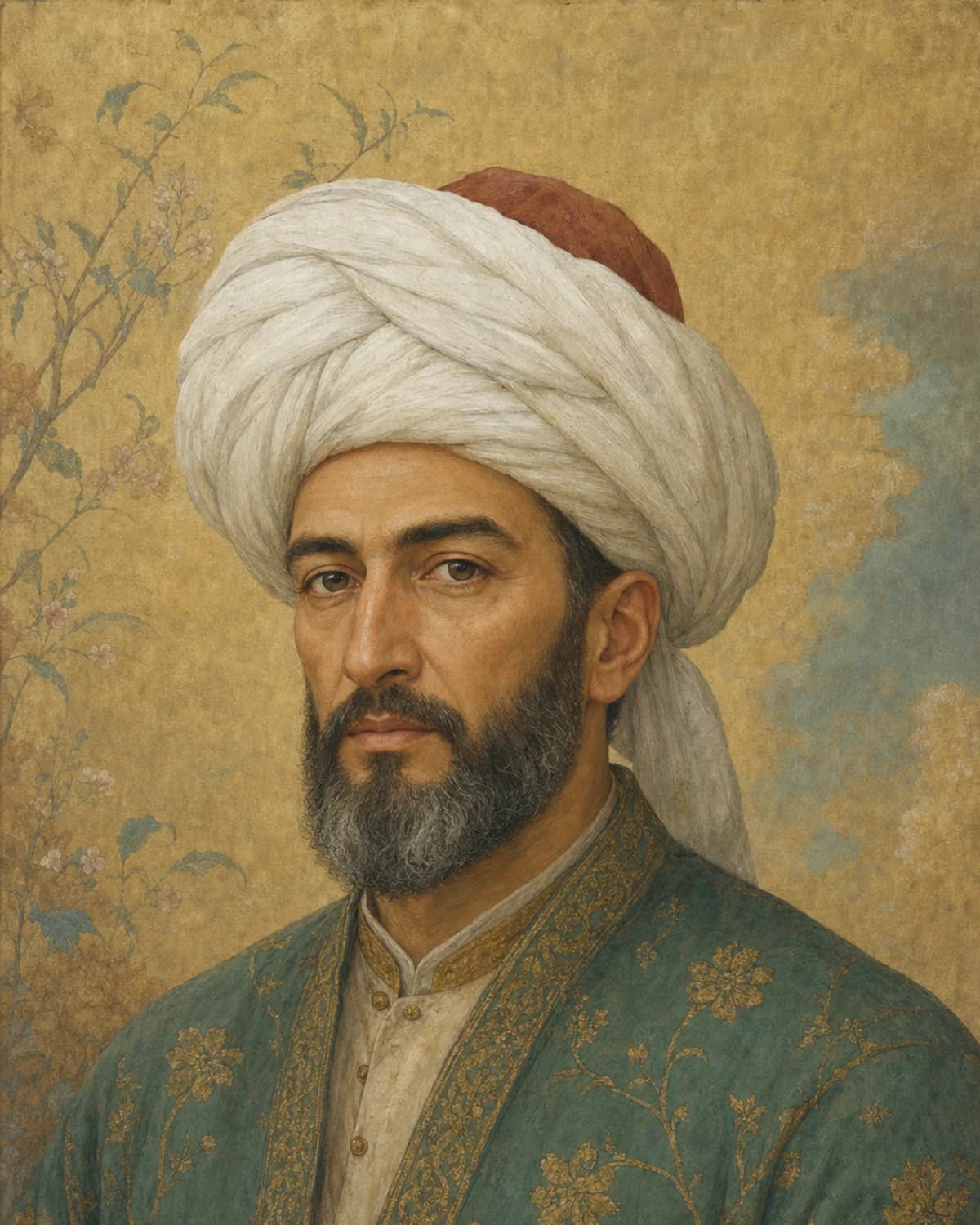
Biography
A drawing in the Bodleian Library in Oxford, lightly tinted and bearing Abd al-Samad’s name, shows the arrest of Abdu’l Ma’ali, the troublesome favourite of the late emperor Humayun: a burly courtier seizes him from behind. It happened three days after Akbar’s accession, in 1556; the painter saw the change of power with his own eyes and set it down like a chronicler.
Nothing is known of his birth. He came from Shiraz, became a master in the court kitabkhana of Shah Tahmasp I in Tabriz and, besides painting, practised calligraphy. Barbara Brend has suggested that before leaving for India he worked under the name of Mirza Ali, son of the painter Sultan Muhammad: Mirza Ali’s documented career breaks off just when Abd al-Samad appears among the Mughals, and the similarity of compositions with courtyards, grilles and open-work screens argues for a single author. This is hard to verify, and not everyone agrees.
In 1544 Humayun, who had lost India after his defeats by Sher Shah, found refuge with Tahmasp; at a reception in Tabriz he met the painter whom the chronicle “Akbarnama” calls Khwaja Abd al-Samad Shirin Qalam. Humayun asked the Shah to release Abd al-Samad and Mir Sayyid Ali to him, and around 1549 both reached Kabul, where the emperor kept a temporary court while he fought to regain his possessions. In Kabul Abd al-Samad taught drawing to Humayun’s son Akbar and possibly to the emperor himself. On festivals, Nowruz among them, the masters presented their work for inspection; one miniature of those years shows the boy Akbar handing his father a drawing, Abd al-Samad’s name is written on the portfolio, and the figure beside it is, by all appearances, his self-portrait. In manner it is a purely Persian piece, but a self-portrait in it was something new for Islamic painting. The folio “Two Youths in a Garden” of 1551 later entered the “Muraqqa-i Gulshan”, the album assembled by Humayun’s grandson Jahangir; it is now in the library of the Golestan Palace in Tehran. Abd al-Samad probably painted the landscape background of the unusually large picture “Princes of the House of Timur” (British Museum), commissioned by Humayun around 1550–1555, and in 1552 works by the two Persians went into a diplomatic gift to the ruler of Kashgar. Together with Mir Sayyid Ali and Dust Muhammad he brought a full courtly Persian style into the small Mughal workshop, where artists from Bukhara and other centres had worked before.
In 1555 Humayun recovered Delhi, the painters followed him, and seven months later the emperor died and the throne passed to the fourteen-year-old Akbar, who within a few years sharply expanded the workshop. Both Persians probably worked on the “Tutinama”, the first major commission of the new reign, in which the hands of the different masters are still easily told apart. But the enormous “Hamzanama”, fourteen hundred large illustrations, was first entrusted to Mir Sayyid Ali; in seven years he finished four volumes out of fourteen. Around 1572 Abd al-Samad replaced him, and the remaining ten volumes were completed in the next seven years. Whether he painted anything in them himself is unknown; what is known is that from this time Mughal painting went more and more where he led it, and that the tighter central control over the workshop in the Lahore years is credited to him. Among his pupils, mostly Hindus, were Daswanth and Basawan, later counted among Akbar’s finest masters. His own manner, meanwhile, remained conservative: much detail in costumes, tiles and trees, little of the dramatic narrative and realism the young Akbar wanted, almost no borrowing from the European prints circulating at court, and no gift for portrait likeness. Of the roughly thirty illustrated manuscripts of Akbar’s reign he took part in only three.
Akbar valued something else in him. In 1576 he put Abd al-Samad in charge of the mint at Fatehpur Sikri, in 1582 made him overseer of commerce, in 1583 head of the royal household, in 1584 diwan, that is, chief of finances, of the province of Multan, gave him a mansab of four hundred and confirmed the nickname Shirin Qalam. Some see in this a recognition of administrative talent, others a hint that the emperor preferred painting more robust than his “romanticised Persian” kind.
He did not give up painting. After the capital moved to Lahore in 1585 he illustrated the “Darabnama” with his pupil Basawan and others; the signed “Jamshid Writing on a Rock” (Freer Gallery, Washington) dates from 1588, and the drawing “Akbar and a Dervish” in the nim qalam technique, which resembles grisaille (Aga Khan Museum), from 1586–1587. Around 1590, already infirm, at the request of his son Sharif he repeated Bihzad’s famous composition of two fighting camels, and in 1591 he painted a hunting scene with his son, now in the Los Angeles County Museum of Art. His last known work, Khosrow hunting in the “Khamsa” of Nizami, is dated 1595. He died, it seems, in the last years of the century.
Two of his sons became painters: Muhammad Sharif, a friend of the future emperor Jahangir, received high offices like his father, the only such case among Mughal families of painters; the second his father named Bihzad after the Persian master, and that name is known only from inscriptions on miniatures, so some hold that there was only one son. Contemporaries said that Abd al-Samad could paint a whole scene on a grain of rice.
Related context
Associations
Works connected through artistic movements, cultural context and period. Priced works available in this market appear first.
Profile notes
Profile and sources
Image
Artist image
На основе открытого изображения: Abd al-Samad; Wikimedia Commons; Public domain.
