
07.08.1871–05.12.1951
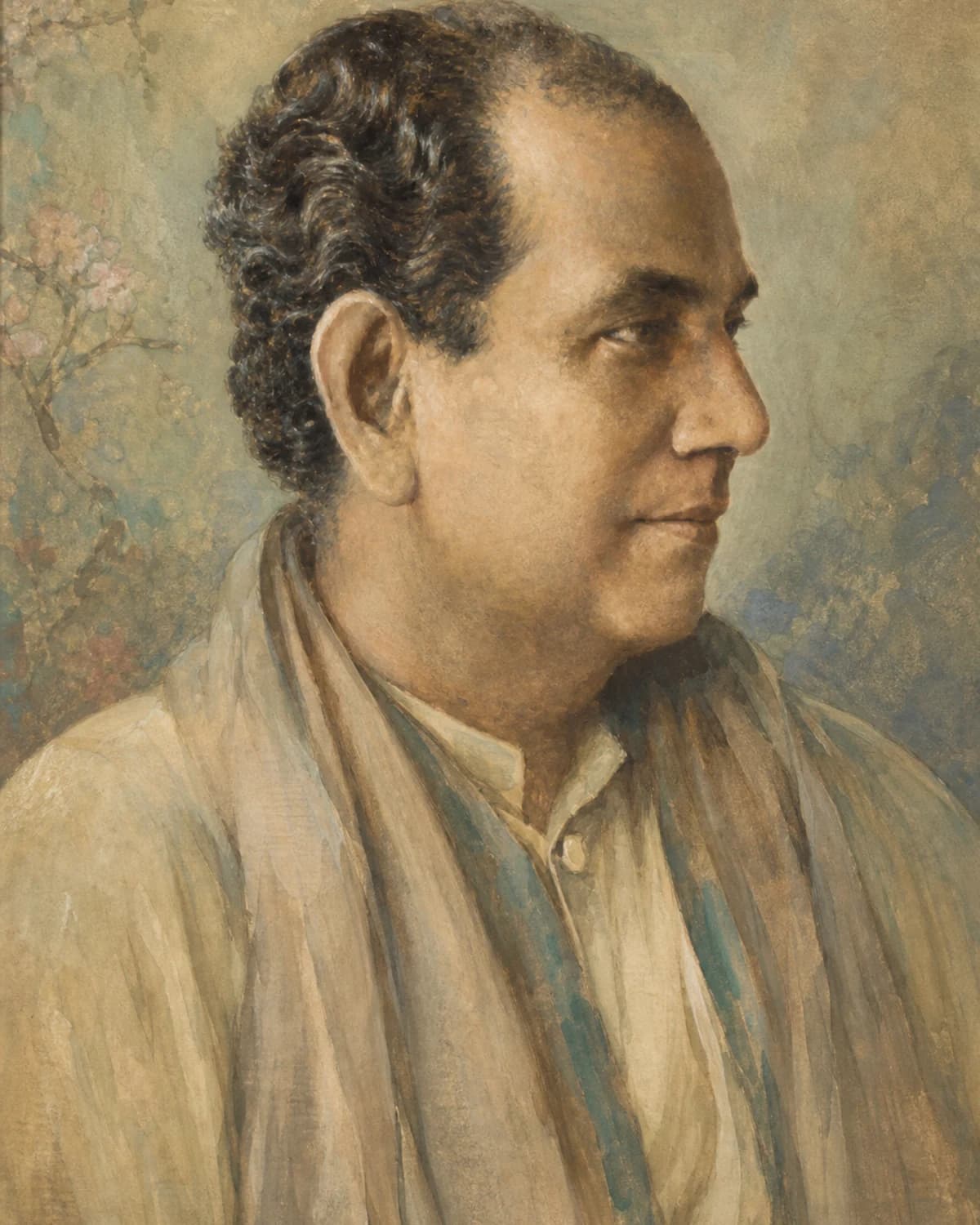
Abanindranath Tagore
At the start of the twentieth century Abanindranath Tagore (1871–1951) urged Indian artists to build on Mughal and Rajput miniatures and the murals of Ajanta in place of European academic training. In 1907, with his brother Gaganendranath and Ernest Havell, he founded the Indian Society of Oriental Art and became the head of the Bengal school; in Bengal he is also remembered as a writer of children’s books.
Biography
A camel with a heavy load sinks slowly to its knees in the middle of the desert, and it is clear that it will not rise again. “Journey’s End” is painted in violet and purple tones, as if the day were fading together with the animal. Abanindranath Tagore made it in the mid-1910s, at a time when he was already being called the founder of a new Indian painting.
He was born on 7 August 1871 in Calcutta, at Jorasanko, the family house of the Tagores, to Gunendranath Tagore and Saudamini Devi. His grandfather Girindranath painted, as did his elder brother Gaganendranath and his sister Sunayani Devi, and the poet Rabindranath Tagore was his uncle. In the 1880s Abanindranath spent nine years at the Sanskrit College in Calcutta and began drawing there, then studied English for about a year and a half at St. Xavier’s College. In 1890 he entered the Calcutta School of Art, where two Europeans, O. Ghilardi and C. Palmer, taught him pastel and oil painting. In the early 1890s his illustrations appeared in the magazine “Sadhana” and in Rabindranath’s books, among them “Chitrangada”. Around 1897 he took lessons from the vice-principal of the Government School of Art and went through the full European academic course, growing fondest of watercolour.
At the same time he was drawn to Mughal miniatures, and out of this came a series on the life of Krishna (1901–1903).
The decisive moment was his meeting with the Englishman Ernest Havell: together they set about reshaping the teaching at the Calcutta School of Art. Tagore considered Western art materialistic and believed that India had to return to its own traditions to recover the spiritual values it had lost. It sounds like a purely nationalist programme, but similar ideas had been current in Britain itself since the Pre-Raphaelites, and many British arts administrators were sympathetic to it. His work also shows the influence of Whistler’s Aestheticism. He is called the first major exponent of Swadeshi ideas in Indian art; in 1905 he painted “Bharat Mata” (“Mother India”). In 1907 Abanindranath, Gaganendranath and Havell founded the Indian Society of Oriental Art; Abanindranath became its principal artist and later its director. Out of this circle grew the Bengal school, which drew its imagery from the murals of the Ajanta caves and from Mughal and Rajput miniatures, and in time British art institutions themselves accepted it and promoted it as the national Indian style. In subject matter he took on everything: “Passing of Shah Jahan” (1900), “Buddha and Sujata” (1901), “Banished Yaksha” (1904), illustrations to Omar Khayyam (1909), “Aurangzeb Examining the Head of Dara Shikoh” (1911).
In the autumn of 1910 the London artist William Rothenstein came to India. For almost a year he travelled to Ajanta, Gwalior and Benares, and in Calcutta he drew alongside Tagore and his pupils. Their friendship lasted all their lives and had an unexpected sequel: Rabindranath later stayed at Rothenstein’s house in London, where the English edition of “Gitanjali” was prepared, and in 1913 the poet received the Nobel Prize. The family’s fame helped Abanindranath too. That same year, 1913, he had solo exhibitions in London and Paris, and in 1919 in Japan. He grew close to the Japanese art historian Okakura Kakuzō and the painter Yokoyama Taikan, and in his late works he combined Indian painting with Chinese and Japanese calligraphy, hoping to find a language common to all of Asia.
Many regard the “Arabian Nights” series, completed in 1930, as his finest achievement. It seems to me that oriental exoticism has little to do with it: through the Arabian tales Tagore was looking at colonial Calcutta, at its motley, mixed life.
In Bengal he was known as Aban Thakur, the author of children’s books. “Rajkahini”, “Buro Angla”, “Nalak” and “Khirer Putul” became landmarks of Bengali children’s literature, and “Putur Boi” (“Putu’s Book”) contains a map of the imaginary city of Halisahar, laid out like a game board but bearing the names of nineteenth-century places in Calcutta. He had many pupils: Nandalal Bose, Asit Kumar Haldar, Mukul Dey, Kshitindranath Majumdar, Sarada Ukil, K. Venkatappa and others. In 1942 he was elected chancellor of Visva-Bharati University. Altogether he left about five hundred paintings, illustrations, sketches and drawings.
Abanindranath Tagore died in Calcutta on 5 December 1951. Soon afterwards his eldest son, Alokendranath, handed almost the entire family collection of his work to the Rabindra Bharati Society, which took up residence on the site of their house at Jorasanko. There the paintings went into trunks and were hardly ever exhibited; in his lifetime the artist had sold and given away little, so the picture of him long remained incomplete. R. Siva Kumar’s book on his paintings came out only in 2008.
Related context
Associations
Works connected through artistic movements, cultural context and period. Priced works available in this market appear first.








Profile notes
Profile and sources
Image
Artist image
На основе открытого изображения: Unknown author Unknown author; Wikimedia Commons; Public domain.
