
26.04.1604–13.12.1674
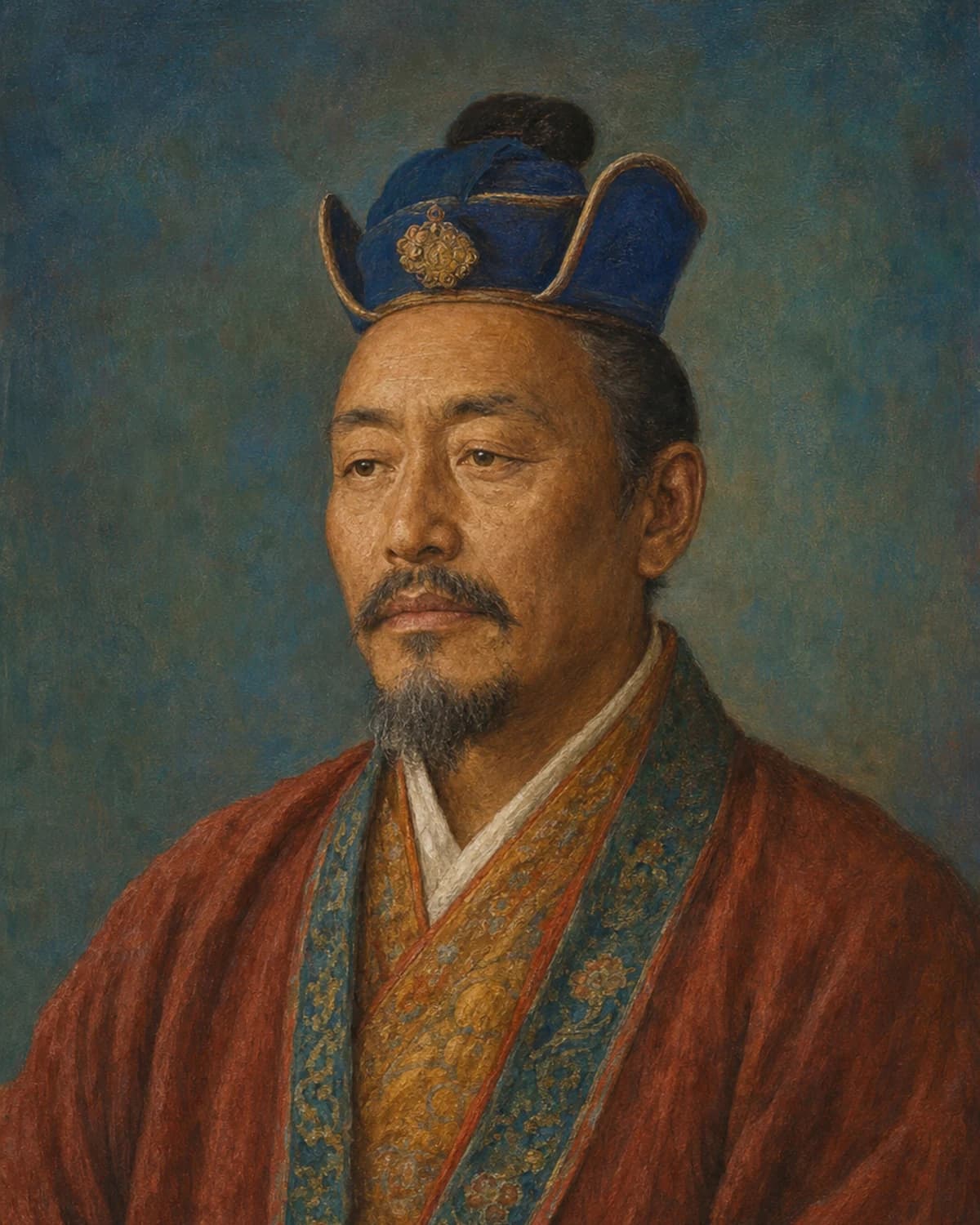
10th Karmapa, Chöying Dorje
The 10th Karmapa, head of the Karma Kagyu school, drew and modelled figures from childhood; his earliest known works are dated to the age of nine. In 1648 he left central Tibet and for twenty years and more wandered through Bhutan, Yunnan, Burma and Nepal, founding monasteries. In exile he wrote books, composed songs and made a great many paintings and sculptures.
Biography
The first known works by Chöying Dorje date from 1613, when he was nine. On a square of white cotton he drew the first Karmapa in a black hat and dark robe, as the boy had seen him in a vision. Later that year came a drawing on paper: an episode from the life of Milarepa, in which he saves a deer from a hunter. Whether this was the result of instruction or simply the drawings of a gifted child, the sources do not make clear.
He was born on 26 April 1604 at Khaytri Tang in Golok (Amdo), in the north-east of Tibet. At eight he was recognised by the 6th Shamarpa, Mipam Chökyi Wangchuk, and received the full Kagyu transmission. The biographies agree that his talent for painting and modelling showed very early. A series of his paintings on the life of the Buddha Shakyamuni is also known.
In 1618 the ruler of Tsang, Karma Phuntsok Namgyal, offered to enthrone him as the spiritual head of Tibet, and the Karmapa refused. In 1629 he made a pilgrimage to Mount Kailash. In those decades Tibet was torn by conflict: on one side the rulers of Tsang, patrons of the Kagyu and Jonang schools, on the other the Gelug school and the Mongol Güshi Khan. The khan’s troops attacked Shigatse, and many Kagyu monasteries were destroyed or turned over to the Gelug. Anticipating a long absence, Chöying Dorje gave a large part of his property to the needy and appointed Goshir Gyaltsab as temporary regent. In 1648 he left Tibet.
His exile lasted from 1648 to 1672, or by other reckonings about twenty years. He passed through Bhutan, Amdo and Kham, Burma and Nepal, founding monasteries along the way. The ruler of Lijiang received him and gave him a replica of the black hat; the original was kept at Tsurphu, and the Karmapa carried the replica with him. In a part of Yunnan inhabited by the Naxi he founded the monastery of Ogmin Namling at Lashiba. The road was dangerous: he concealed his identity, wore ordinary clothes, was robbed, and in regions where he did not know the dialect he sometimes had to beg for food. During these years he wrote books on various subjects, composed songs, and made paintings and sculptures, a great many of which survive. In this period he gave back his monastic vows and started a family; one of his sons, Norbu Zangpo, was recognised as the 6th Gyaltsab.
His art is spoken of as exceptional even against the whole Tibetan tradition. From an early age he loved Indian statues from Kashmir, and his sculptures, whether cast in metal or carved in ivory, wood or shell, are stylistically close to the brasses of Kashmir and Swat. He did not copy but reworked older models: he studied early statues on visits to the Jokhang temple in Lhasa. In his painting Chinese influence is evident, which is why many works are on silk. It goes back to the images of arhats that he saw in Tibet and copied more than once, and to the silk paintings he saw in Lijiang, where he spent several years at the court of the local ruler. There are also works in the manner of Kashmir and western Tibet. To my mind, this list of influences shows better than anything how much he managed to see during the years on the road.
In 1672 the Karmapa returned to central Tibet with a large entourage. The Kagyu school was no longer the leading one.
In 1674 the 5th Dalai Lama received him at the Potala Palace; the meeting was a reconciliation, but at first he was not allowed into Tsurphu monastery. Chöying Dorje died on 13 December 1674.
Related context
Associations
Works connected through artistic movements, cultural context and period. Priced works available in this market appear first.
Profile notes
Profile and sources
Image
Artist image
На основе открытого изображения: Chöying Dorje, 10th Karmapa; Wikimedia Commons; Public domain.
